
The Standards Library can be accessed by navigating to Main Menu > Self Study > Standards Library. User roles who have access to the Standards Library include:
-
Institution Admin
-
College Admin
-
Department Admin
-
Evidence Bank Curator
-
Evidence Contributor
-
Self Study Chair
-
Self Study Institution Chair
-
Self Study Liaison
-
Self Study Section Editor
-
Self Study Section Approver
Downstream & Cross-Platform Impacts
-
Self Study Alignment: Standard sets provide the framework users align evidence, narratives, and responses to during self study work. Changes to a standard set can affect how users organize and review self study materials.
-
Assessment and Reporting Consistency: Standards help create a shared reference point for accreditation, institutional goals, program review, and other assessment activities. Consistent standard naming and coding supports cleaner reporting and easier interpretation across teams.
-
Evidence Organization: When standards are used as part of self study or assessment workflows, they influence how evidence is categorized, reviewed, and connected to accreditation requirements.
-
User Access and Workflow Visibility: Users with access to the Standards Library can view available standard sets and related details. Published standard sets are the versions users can rely on for active work.
-
Version Control and Revisions: Updating a standard set may require creating or managing revisions so users can distinguish between current published standards and changes being prepared for future use.
Considerations
-
Standard Set Purpose: Decide whether the standard set represents an accreditor framework, institutional framework, program review structure, or another internal set of expectations before building it.
-
Ownership Level: Confirm the appropriate Organizational Hierarchy level for the standard set so it is associated with the correct area of the Institution.
-
Naming and Coding Conventions: Establish clear, consistent names and codes before adding standards. These values may appear in downstream workflows and reports, so they should be easy for users to recognize.
-
Standard Structure: Determine how detailed each standard should be before configuration. Overly broad standards may make alignment less meaningful, while overly granular standards may make the set harder to maintain.
-
Published vs. Draft Work: Consider whether the standard set is ready for active use before publishing. Draft or in-revision work should be reviewed carefully before it becomes available for users.
Best Practices
-
Keep standard set names, codes, and descriptions consistent with institutional or accreditor language.
-
Decide who owns and maintains each standard set before publishing it.
-
Review the full standard structure before users begin aligning evidence or self study content.
-
Avoid unnecessary duplication by checking whether a similar standard set already exists.
-
Keep descriptions brief but meaningful so users understand the purpose of the standard set.
-
Coordinate major updates with teams that rely on standards for self study, assessment, reporting, or accreditation work.
Standards Library
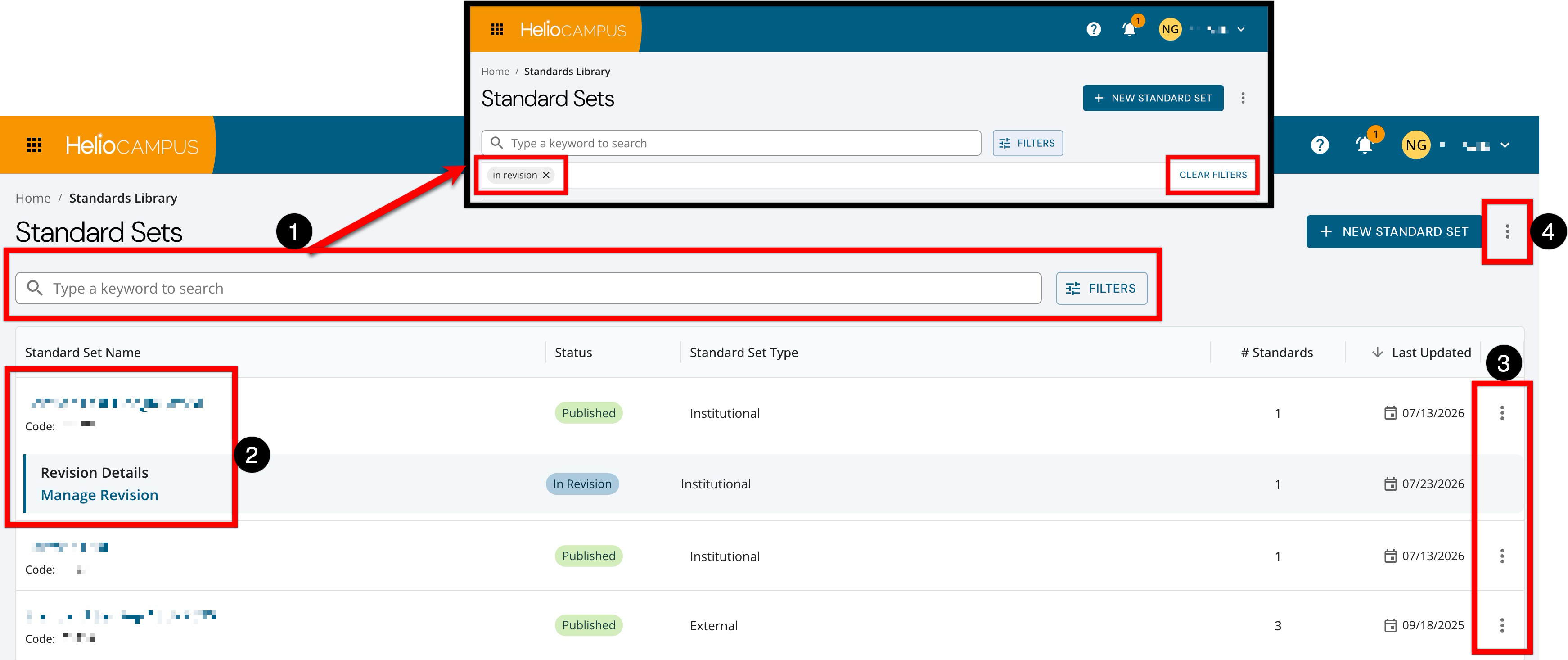
Search functionality is available, and by clicking the Filters option, specific filters can be applied and removed (1). Clicking a standards name (2) will display the Standard Set Homepage; if a set is in revision, the revised version can be accessed by clicking Manage Revision. By expanding the kebab menu for a standard set (3) and selecting View Details, a drawer will open to display quick glance information. The Standards Library can be exported to CSV format by expanding the export kebab menu (4). Users assigned read-only access to the Standards Library do not have access to export functionality and are unable to export standard sets.
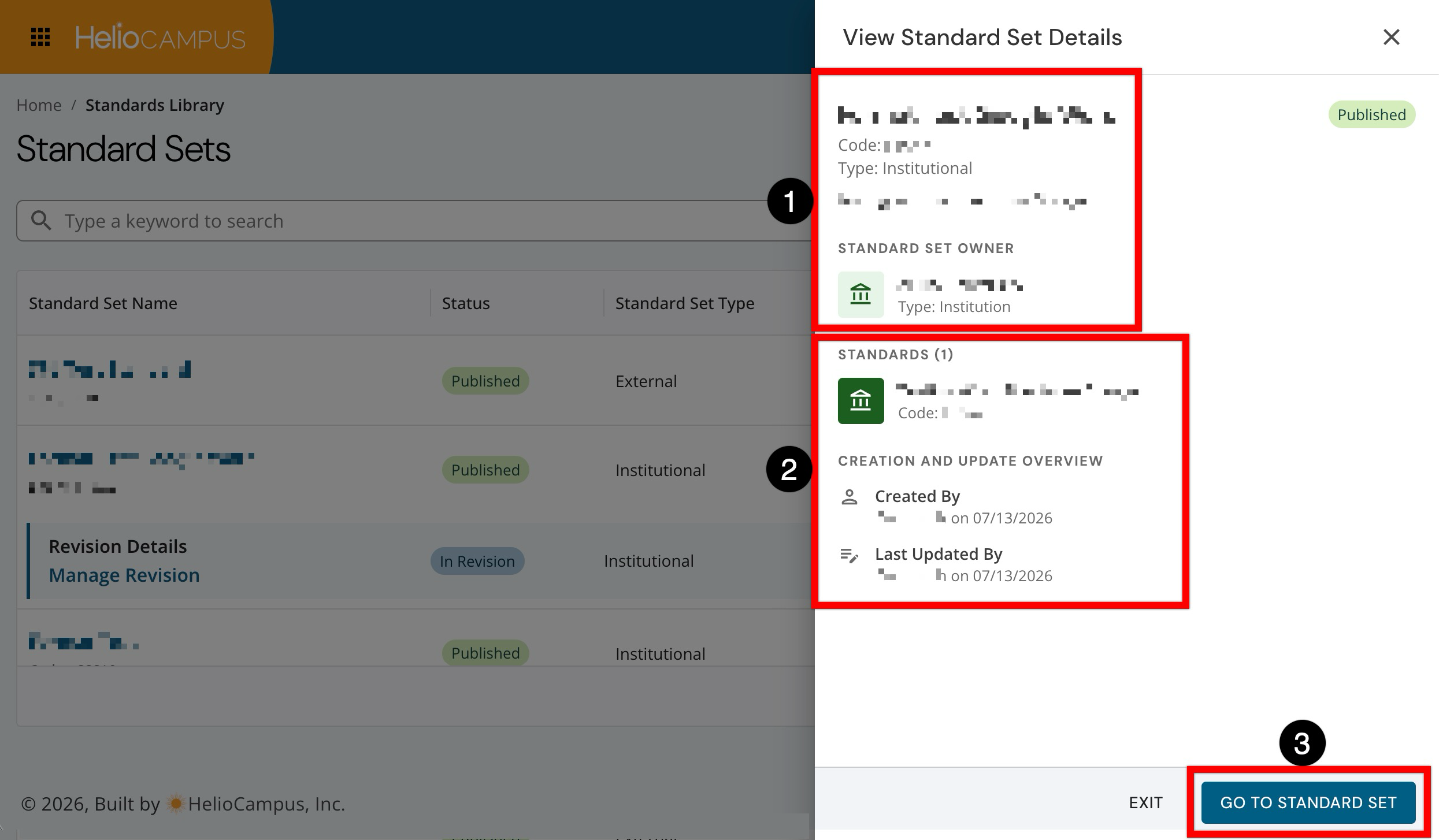
When viewing quick-glance details, general information similar to the list view is displayed first (1). While the list view displays the total count of standards associated with a set, the Details drawer displays those standards with their name and code (2). Also available is the creation and update information, including the user name and date (2).
Standard Set Homepage
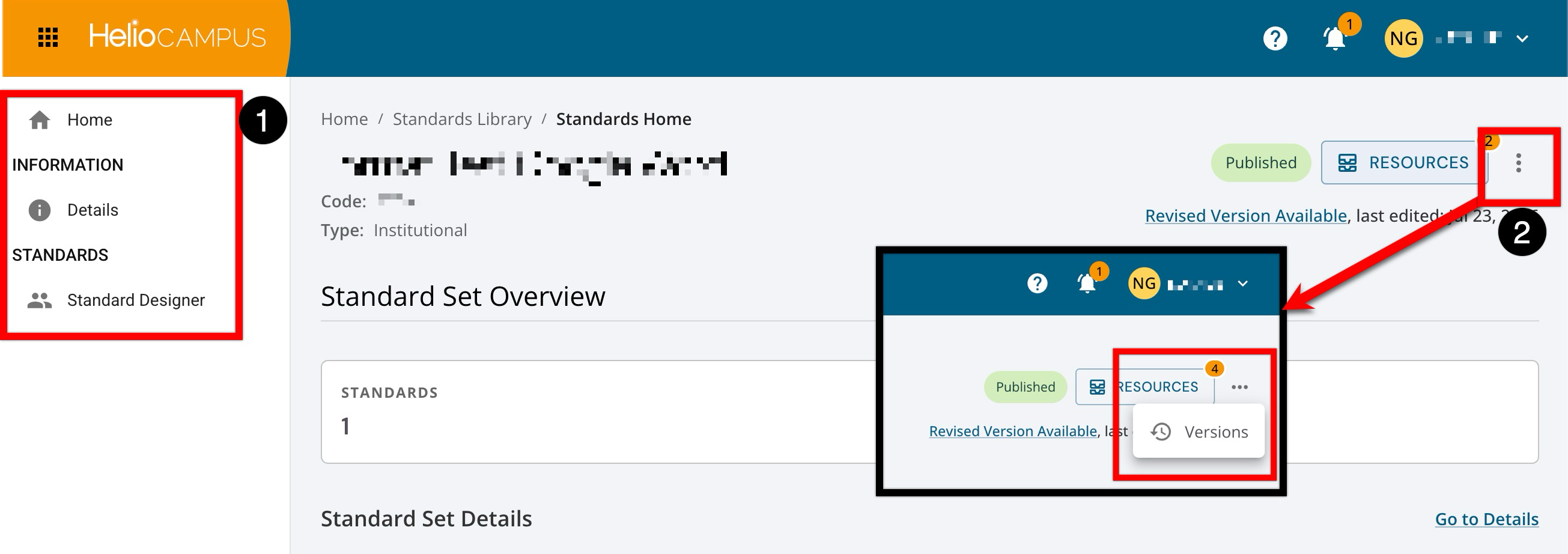
The homepage is the landing page for a selected standard set. It provides an at-a-glance overview of the standard set and also serves as the access point for standard set details, standard design, version information, and related resources. The left-hand menu is the set’s navigation menu (1), organized into sections for standard set information and standard configuration. The Information section is used to review and maintain details for the standard set, while the Standards section provides access to the Standard Designer, where standards in the set can be reviewed and managed. At the top right of the page, the action menu (2) provides access to standard set versions.
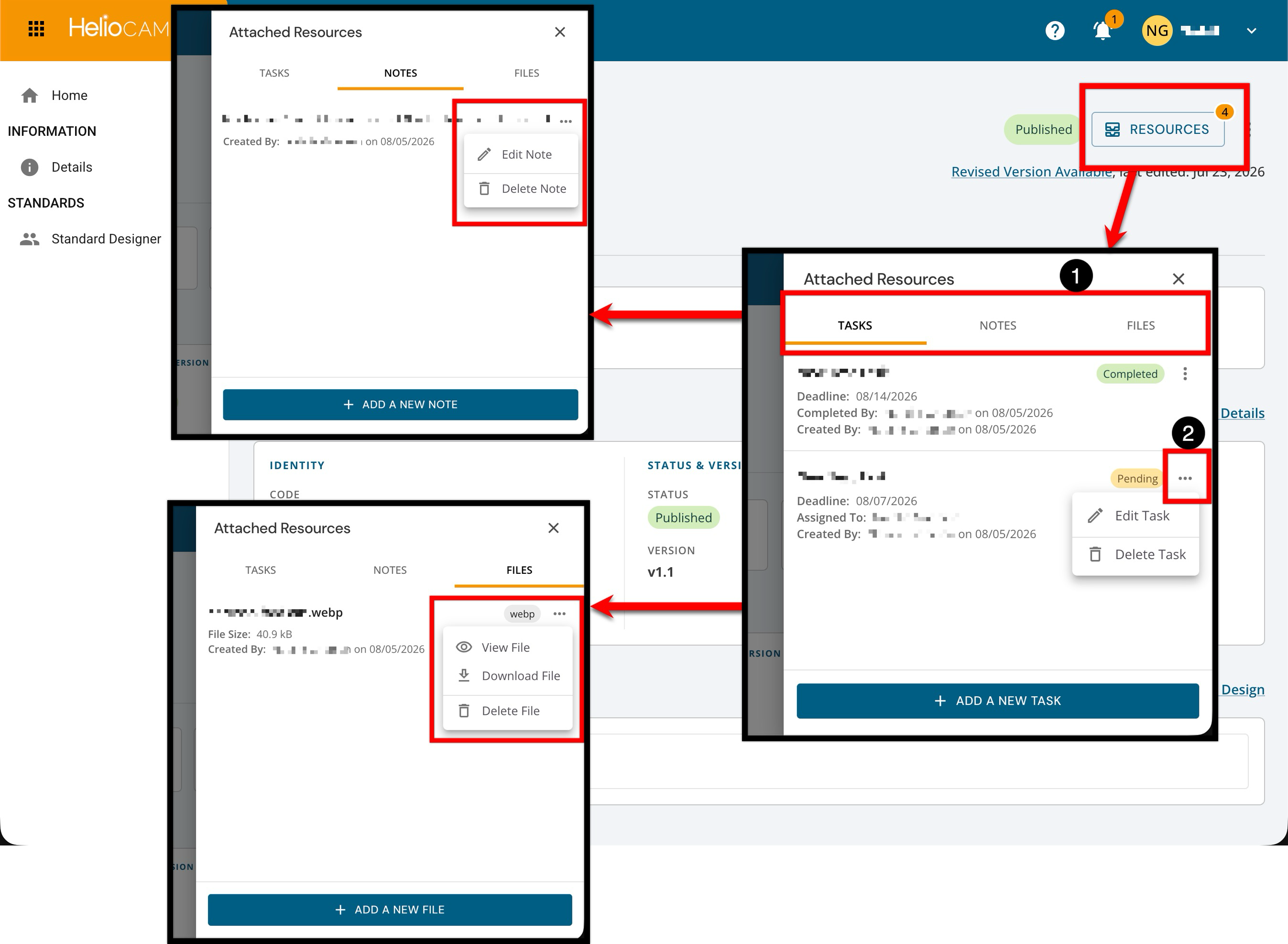
By clicking the Resources button, set-specific attachments can be accessed in a centralized drawer with organized tabs for tasks, notes, and files (1), with options to view, edit, or delete, as applicable, by resource type (2). New resources can be added quickly through the action buttons at the bottom of each tab.
-
Tasks: Displays tasks assigned to the selected standard set, with creation and assignment details, due dates, status indicators to track progress, and options to edit or delete tasks.
-
Notes: Provides quick access to all associated notes with timestamps and creation details, with options to edit or delete notes.
-
Files: Displays all attached documents and media, with options to view, download, or delete them.
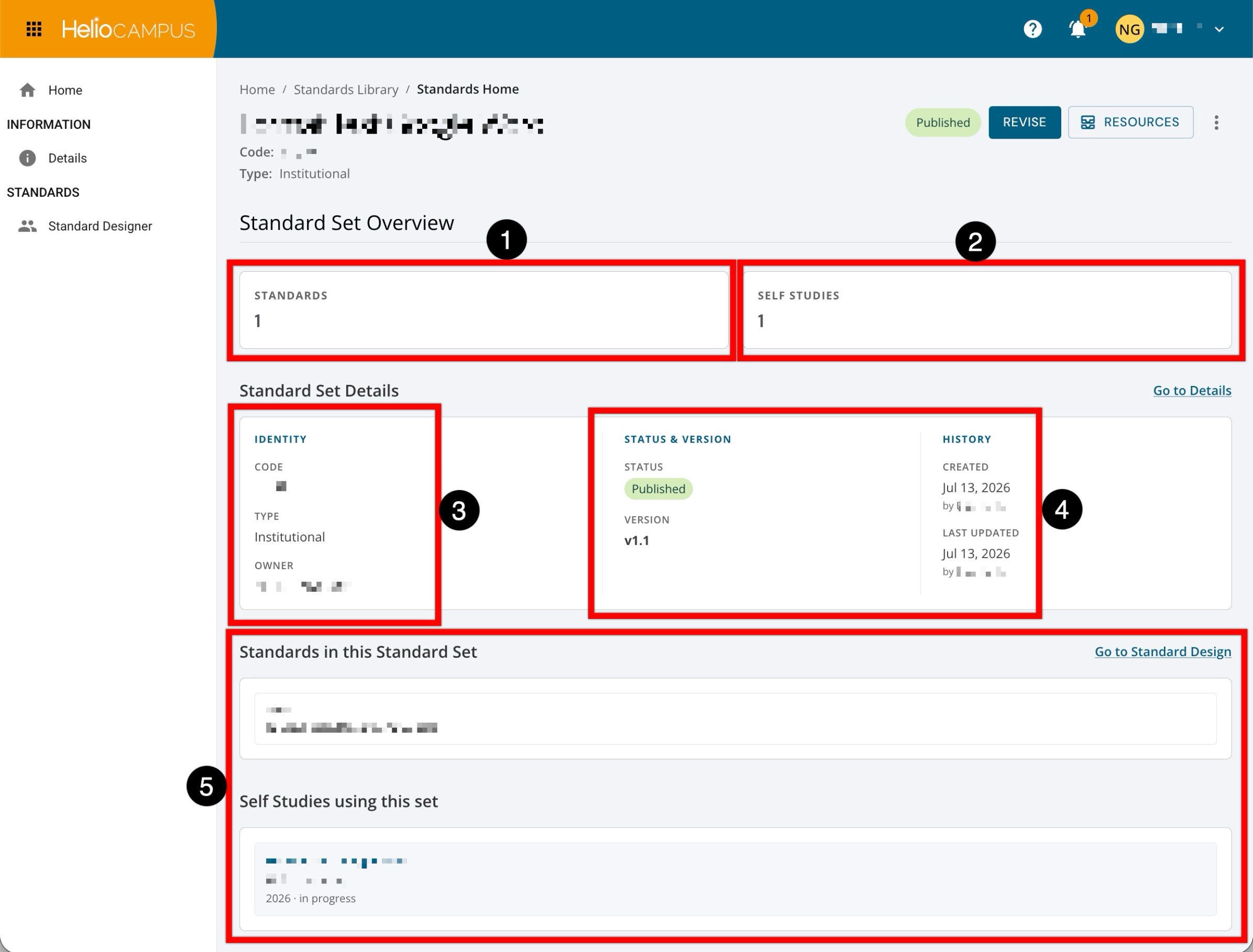
The Homepage provides an at-a-glance overview of key metrics for quick review. Summary cards display the total number of standards in the set (1) and the number of programs currently associated with it (2). Additional standard set information is organized into distinct sections, including identifying details such as code, type, and owner (3), as well as status, version, and creation and update information, including the user name and date (4). Further details on the standards included in the set and the self-studies associated with it are also available (5).
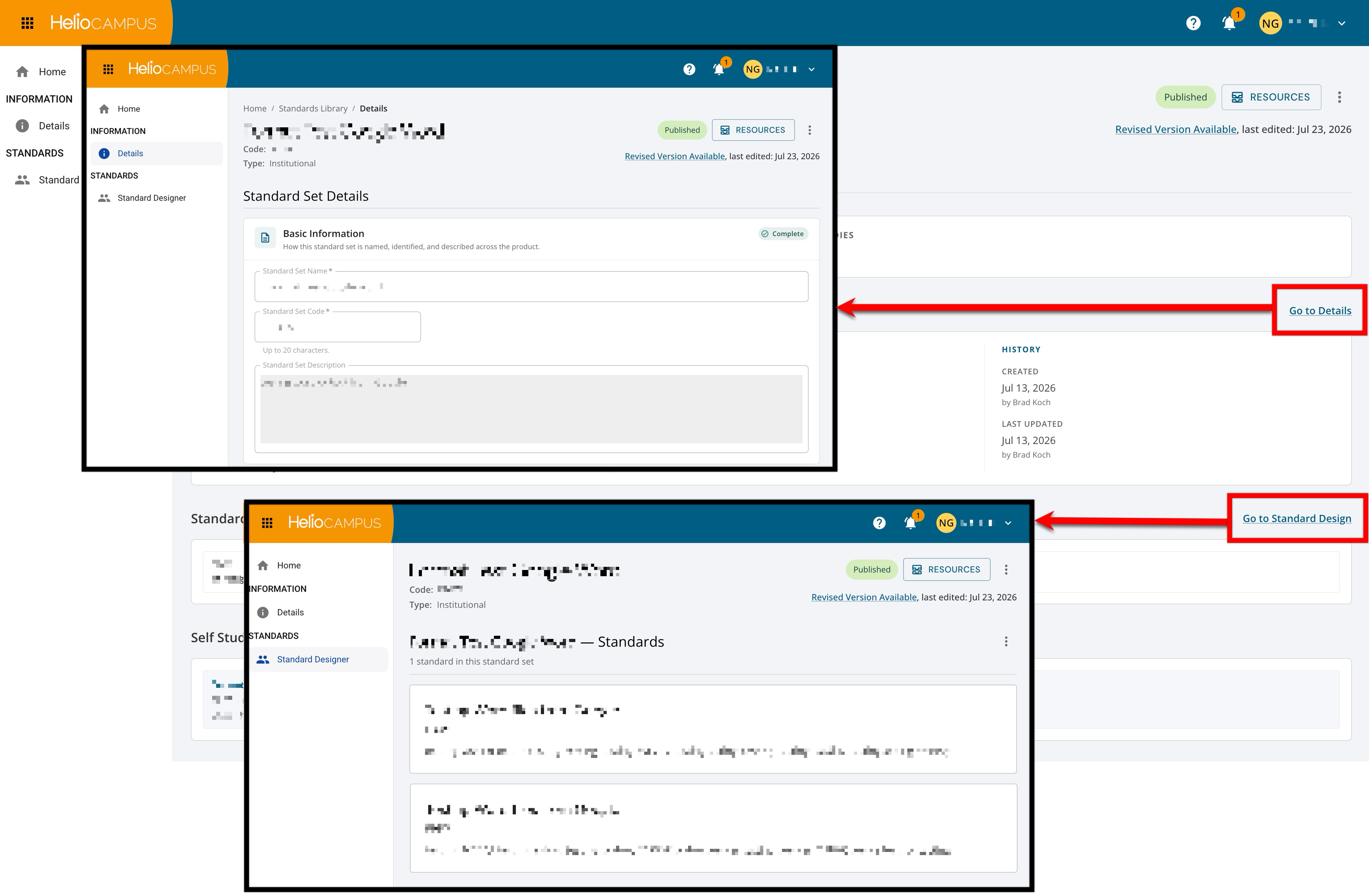
Select Go to Details (1) to view and edit a standard set’s basic information, including its name, code, type, and description. Select Go to Standard Design (2) to open the standard designer to review and manage the standards included in the set. These options help users navigate between pages for managing a set and are the same as using the Details and Standard Designer options through the left menu.
Standard Set Statuses
|
Draft |
When sets are imported during implementation or manually created post-implementation, they are all in Draft status, and edits can be made as needed before publishing via the Homepage. Draft sets can only be deleted via the Homepage. 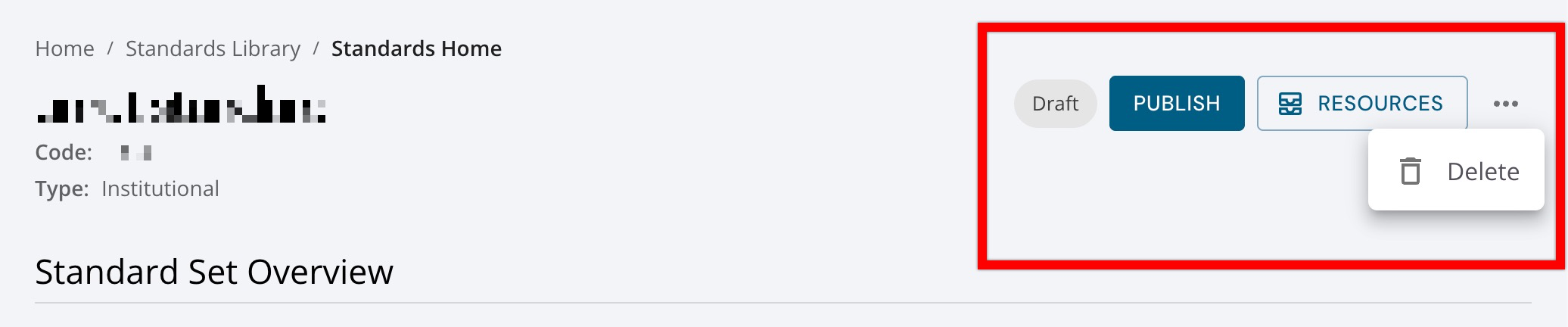
|
|
Published |
Once a set is in Published status, edits can no longer be made unless the standard set is transitioned to In Revision via the Homepage. Versions can be viewed for historical context, and published sets can only be revised or archived via the Homepage. 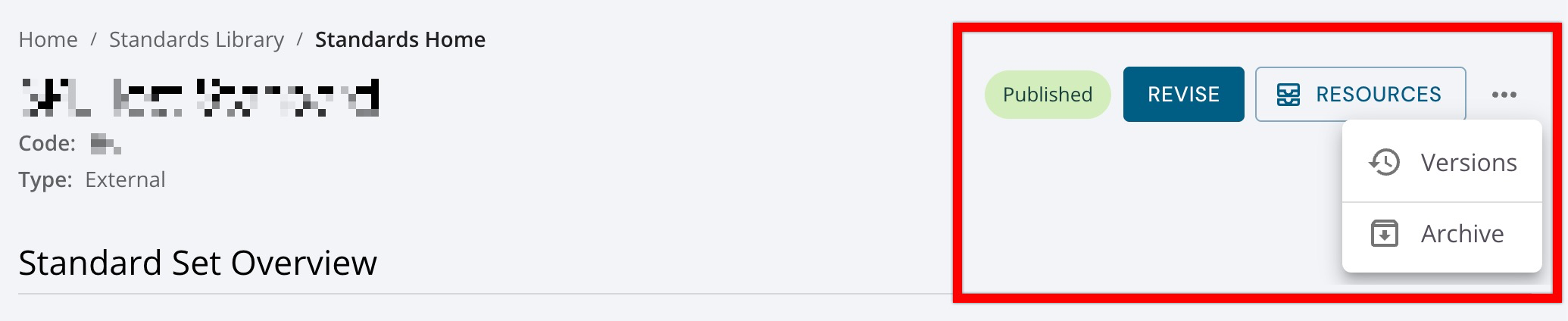
|
|
In Revision |
When a set is revised, versions can be viewed for historical context. Revised sets can only be deleted or published via the Homepage. 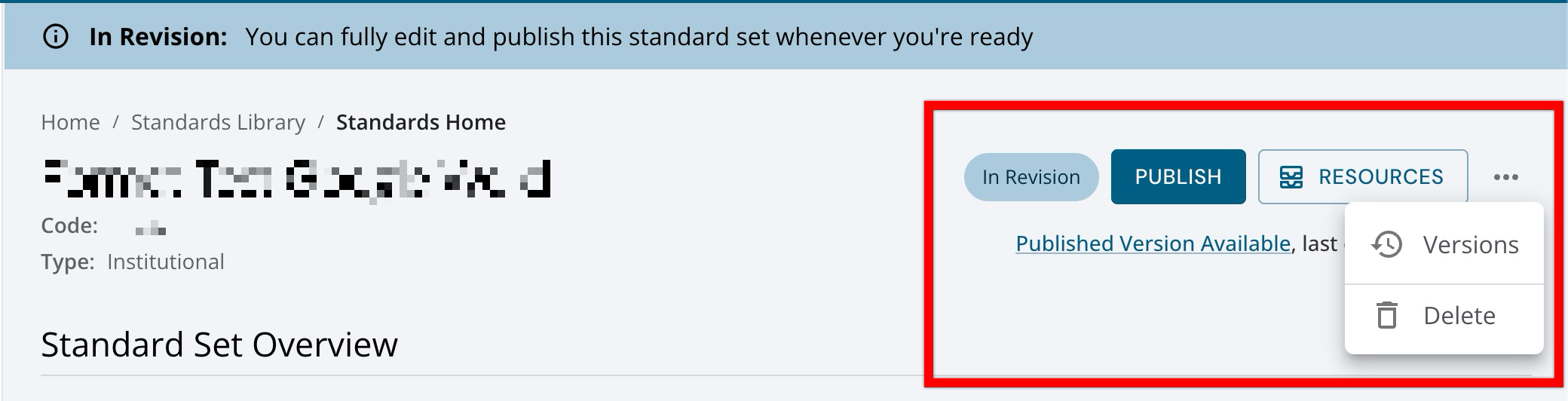
|
|
Archived |
This status indicates that the standards are discontinued. Archiving a set is a manual process performed via the Homepage. Archived sets can only be unarchived or deleted via the Homepage. 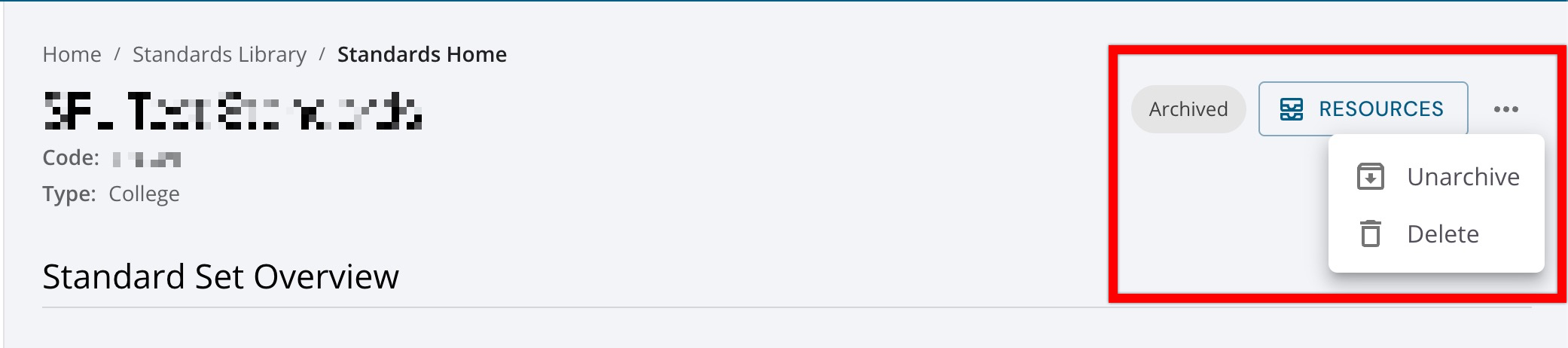
|