
Managing syllabi with the platform's Syllabus Template feature supports a "single source of truth” approach and reduces duplicated institutional effort across terms and sections.
-
Institutional Standardization via templates and placeholder-driven structure.
-
Version Control and Consistency through template management and field locking, while still allowing faculty edits where appropriate.
-
Improved Learner Access because syllabi can be displayed in the LMS through LTI (and, optionally, publicly).
-
Term Efficiency because syllabus content can be copied forward from prior terms, and historical versions can be archived.
-
Export Flexibility with Word, PDF, print, and private/public URL options.
In the platform, a syllabus template is a digitized, version-controlled record of a course's schedule and activities. Syllabi can be edited by faculty and then viewed by students through a Learning Management System (LMS) or shared externally via export options available in the platform. Syllabus templates are the framework that standardizes how syllabi are structured across an Institution and can be owned at different organizational levels. This framework ensures that new sections start with the expected activities and placeholders for downstream syllabi content inherited through the Organizational Hierarchy, such as policies, office hours, and learning outcomes.
Institutions can further manage syllabi at a more granular level by enabling these settings as applicable. Both settings are optional with the Syllabus Template feature functionality and can be enabled at the Institution, College, Department, course, and co-curricular activity levels:
-
Enable Admin Approval in Course Section Publishing: Institutions can choose to perform an administrative review of syllabi/sections after faculty have completed their syllabi, and before releasing them to students.
-
Allow Instructor to Edit the Syllabus After the Course Section is Published: Institutions can also choose whether faculty can continue making edits after a section has been published by enabling this setting via Course Syllabi Settings at the Institution, College, and Department levels of the Organizational Hierarchy.
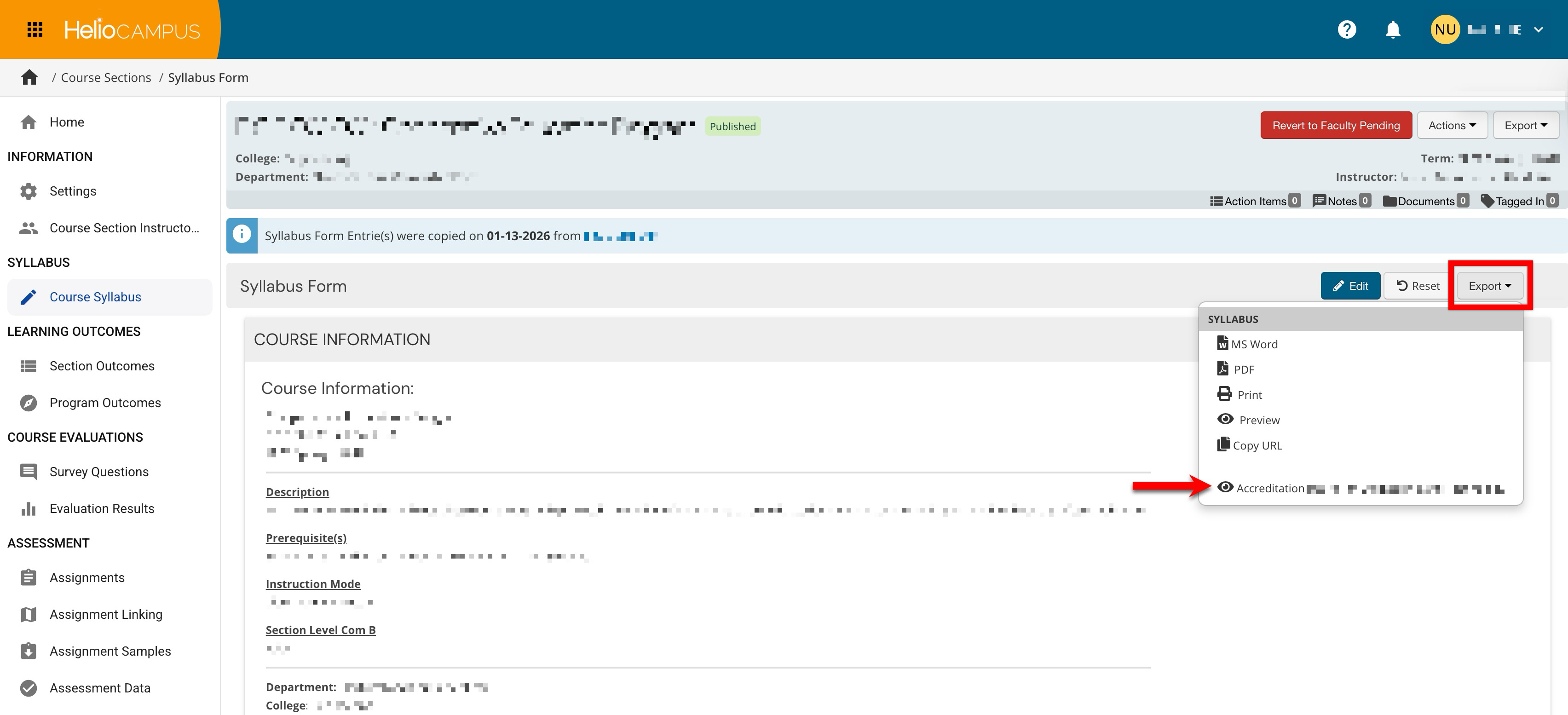
The platform also offers the ability to export accreditor syllabus templates, which are in an export format that matches a specific accreditor's required headings and structure. When exporting an accreditor syllabus template, the platform uses a HelioCampus-provided accreditor .docx template and maps syllabus template items into the accreditor's required headings for a cleaner, accreditor-ready document. Accreditor syllabus template functionality requires HelioCampus intervention; contact Support for more information.
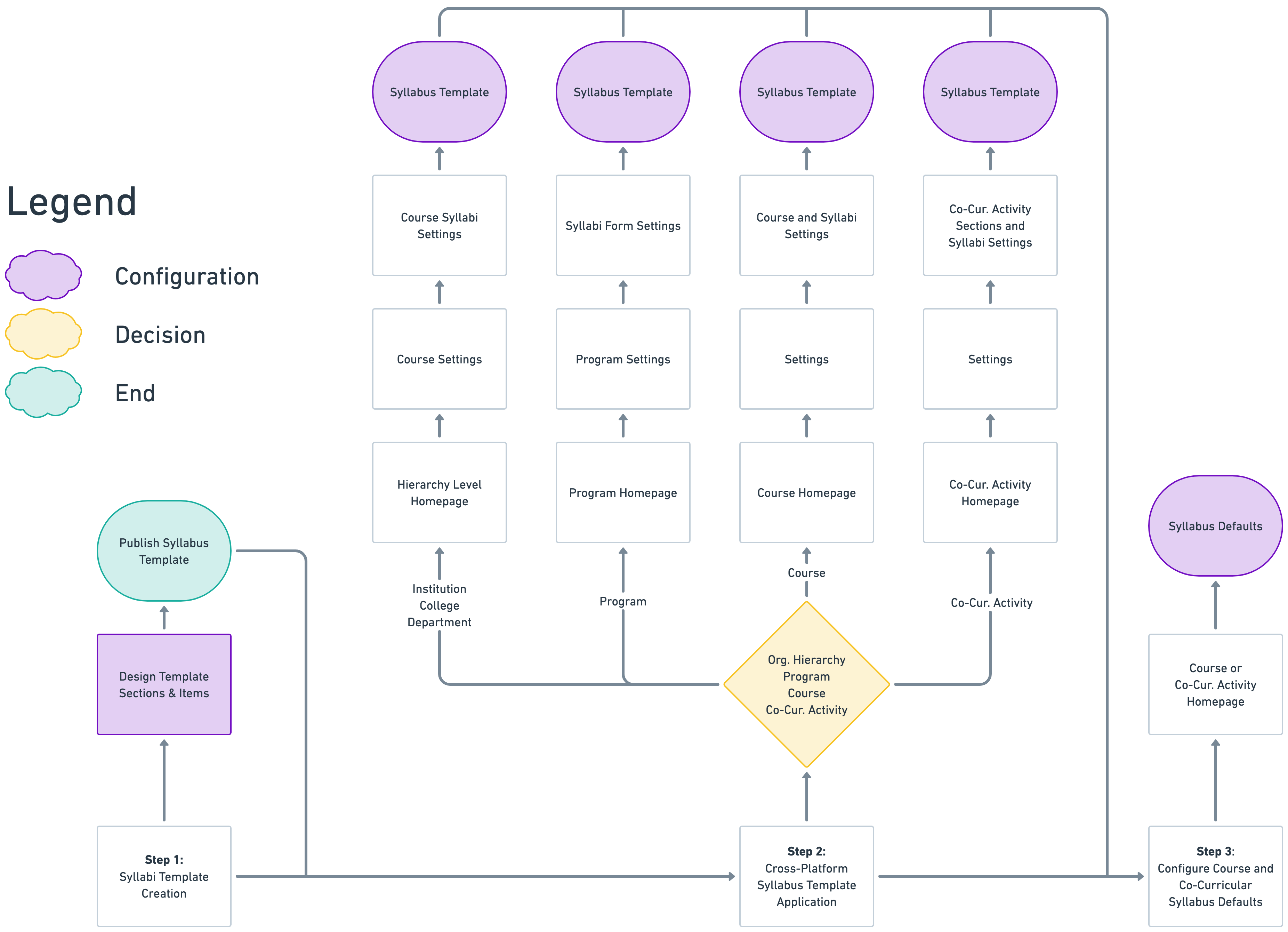
Syllabus Template Process
-
Syllabus Template Creation. Learn more.
-
Syllabus Template Application:
-
Configure Course and Co-Curricular Activity Syllabus Defaults:
-
Co-Curricular Activity Syllabus Defaults
-
Instructors Complete Section Syllabi:
-
Co-Curricular Section Syllabi
-
Publish Sections
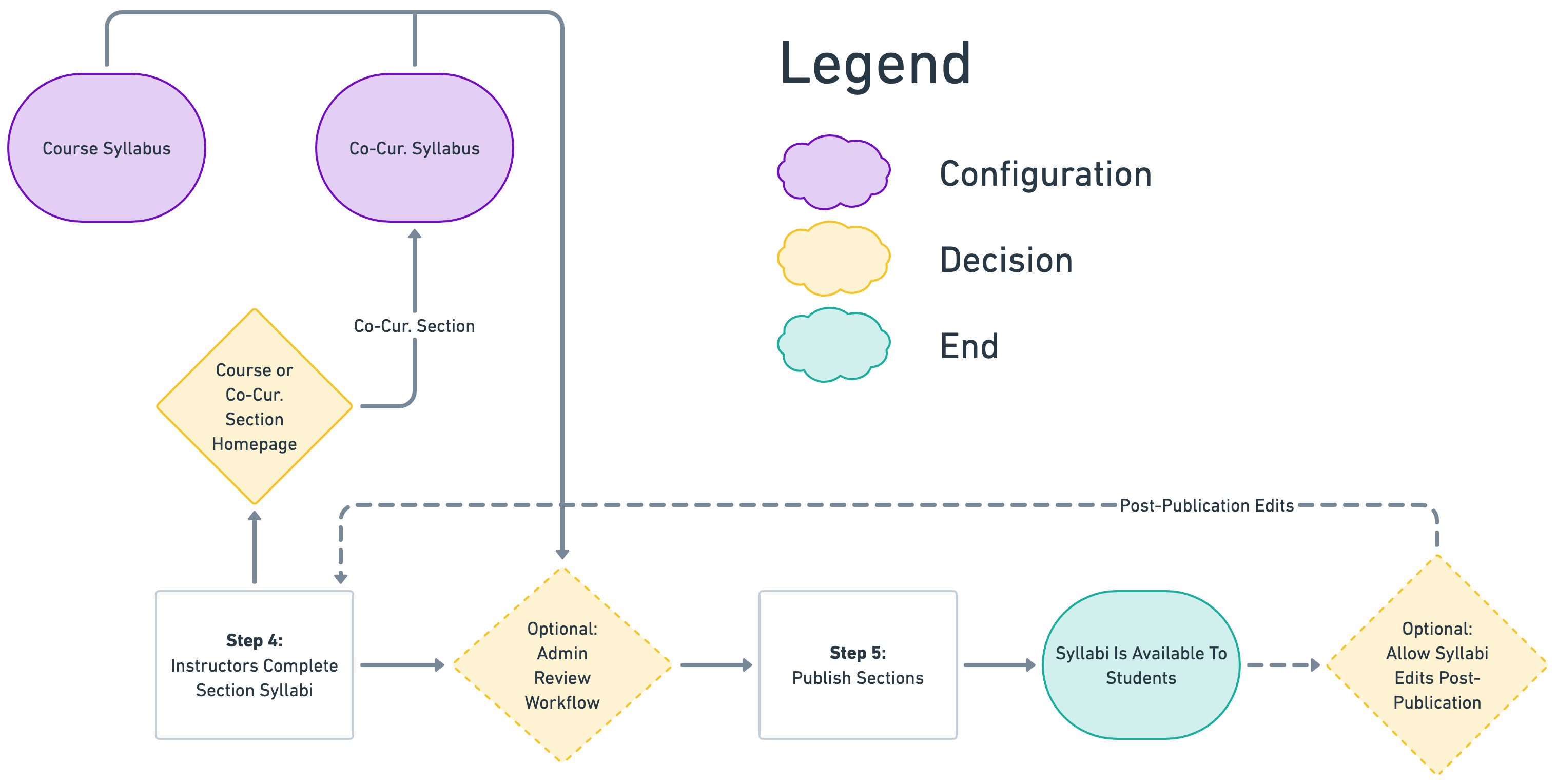
Additionally, Institutions can enable the following optional workflows:
Optional Workflow - Enable Admin Review Before Publishing/Student Access:
-
Navigate to the applicable homepage:
-
From the homepage, navigate to the Settings page:
-
Locate Term Activation Settings, then enable the Enable Admin Approval in Course Section Publishing setting:
Optional Workflow - Enable Post-Publication Syllabi Edits:
-
Navigate to the applicable homepage:
-
From the homepage, navigate to the Settings page:
-
Locate the syllabi settings, then enable the Allow Instructors to Edit the Syllabus After the Course Section Is Published setting:
-
Organizational Hierarchy:
-
Educational Experiences:
-
User Role Access & Permissions
|
Who Can Create Syllabus Templates |
|
|---|---|
|
A syllabus template defines both the structure and content of a syllabus for clarity and consistency. Learn more. |
|
Who Can Edit Course and Co-Curricular Activity-Level Syllabus Defaults |
|
|
Configure syllabus template items for a course that will then cascade to the syllabus for the course section. Learn more. |
|
Who Can Edit Section-Level Syllabus Content |
|
|
Faculty can edit syllabus content for their assigned course sections. Learn more.
|
Administrator Touch Points
Required Workflow Touch Points:
|
Touch Point |
Action |
|---|---|
|
Main Menu > Syllabus Templates |
Syllabus template creation |
|
Syllabi Homepage > Template Designer |
Template design |
|
|
Optional Workflow Touch Points - Enable Admin Review Before Student Access:
|
Touch Points |
Actions |
|---|---|
|
Organizational Hierarchy:
Educational Experiences:
|
Enable setting - Enable Admin Review Before Student Access |
Optional Workflow Touchpoints - Enable Post-Publication Syllabi Edits:
|
Touch Points |
Actions |
|---|---|
|
Organizational Hierarchy:
Educational Experiences:
|
Enable setting - Enable Post-Publication Syllabi Edits |
Faculty Touch Points
|
Touch Points |
Actions |
|---|---|
|
|
|
Publish sections, thus making syllabi available to students, or for review if the optional admin review workflow is enabled. |
Downstream & Cross-Platform Impacts
-
LMS Integrations: When using LTI integrations, students can view syllabi for enrolled courses in the LMS, and faculty can edit them there while keeping the platform as the centralized system of record.
-
Evaluation Readiness: When syllabi auto-publish functionality is enabled, sections are published automatically in preparation for evaluations and assessments.
-
Learning Outcomes Transparency: Templates can display learning outcomes information directly on the syllabus, tying syllabi to broader outcomes.
Best Practices
-
Build/maintain standardized syllabus templates so sections start with a consistent structure and institutional content. Standardize the templates first, then let faculty customize them.
-
Faculty should ensure that course sections and syllabi are complete before the start of class.
-
Decide whether admin approval is necessary. Enabling admin approval for section publishing adds a review step before syllabi are available to students.
-
If faculty can edit after sections have been published, establish an organization-wide expectation for notifying students of changes.
-
Enable auto-publish for syllabi functionality to reduce missing syllabi at term start, and also publish sections automatically even when they are created mid-term.
Considerations
-
Hierarchy-Level Defaults and Locking: Course Syllabi Settings can be set at Institution, College, Department, and course/co-curricular activity levels, and can be locked to prevent lower levels from changing them. Learn more about locking platform settings.
-
Public Syllabus URLs: When Enable Public URL for Syllabus is enabled, a shareable hyperlink can be used to view a syllabus without logging in to the platform. If functionality is enabled, syllabi can be accessed without authentication, which supports external requirements but also increases exposure risk. This setting can be enabled via Course & Syllabi Settings at the Institution, College, and Department levels of the Organizational Hierarchy, as well as at the course and co-curricular activity levels. Learn more:
-
Organizational Hierarchy:
-
Educational Experiences:
-
Supporting Articles
|
Article |
Content |
|---|---|
|
Syllabus Templates |
|
|
Template manager and homepage overviews. |
|
|
Creating a template, adding sections and items, and finalizing it. |
|
|
Editing template details, editing the template, and exporting an accreditor template. |
|
|
Descriptions and configuration options of syllabus template items, |
|
|
Educational Experiences |
|
|
Settings and configuration points for the default template, public URL, and optional workflow settings for admin review and post-publication edits. |
|
|
Editing course-level syllabus defaults that will cascade to sections. |
|
Completing syllabi for sections. |
|
Organizational Hierarchy |
|
|
Settings for the default template, the public URL, and the optional post-publication edits workflow. |
|
|
Setting for the optional admin review workflow. |
|
|
Admin Tools |
|
|
Term timelines |
|