Departments are academic components within the Organizational Hierarchy and sit below Colleges. Departments help organize the academic structure to support governance, reporting, and role-based access to features and data. Learn more about the Organizational Hierarchy.
Product Tip
If an Institution's organizational structure changes, please contact Support to facilitate implementation. Changes to the Organizational Hierarchy should not be sent to HelioCampus via data files.
Downstream Impacts
At a high level, Department settings act as hierarchy-level defaults. When settings are enabled and especially when they are locked at a hierarchy level, they are inherited downstream and prevent configuration at lower hierarchy levels. Department decisions can standardize behavior across large parts of the platform.
-
Permissions and Visibility: Department placement affects what Department-scoped admins can access and manage, and which data they can see (especially in workflows and reporting that respect hierarchy scoping).
-
Configuration Inheritance and Locking: Department-level settings can be used to standardize behavior. If settings are locked at higher levels, lower levels may be unable to change them. Learn more.
-
Survey Governance: If a survey is created and scheduled at the Institution-level, it remains owned and managed at that level. Institutions should decide whether Department Survey Admins will own Department-level surveys or whether work will be centralized. Learn more.
-
Notification identity: If notifications are configured to use Department-level email identity, changes at the Department level can change the sender identity for recipients. This can impact deliverability expectations and user trust if the sender name/address changes.
Considerations
-
Changing the Hierarchy Structure Has Broad Impact: Moving or renaming Departments can affect downstream admin scope, reporting rollups, and user expectations for where items live in navigation.
-
Centralized vs Distributed Admin Model: If Departments are expected to self-manage (surveys, settings, etc.), ensure the right Department-level roles exist and are maintained; otherwise, central admins may become a bottleneck.
-
Communicate “why settings look locked.”: If users report they cannot edit settings at the Department (or below), include guidance that higher-level settings may be locked to enforce standardization, and that this is intentional governance behavior.
Best practices
-
Decide early which processes are owned centrally (Institution/College) vs locally (Department), and document that ownership for admins.
-
Keep Department naming/coding consistent with institutional source systems to reduce reporting confusion and mismatched filters.
-
Apply Department-level defaults when departments need consistent downstream setup, and avoid over-locking if programs/courses need flexibility.
-
Decide whether “From” identity should be Institution-wide, College-based, or Department-based so recipients see a predictable sender.
Department Manager
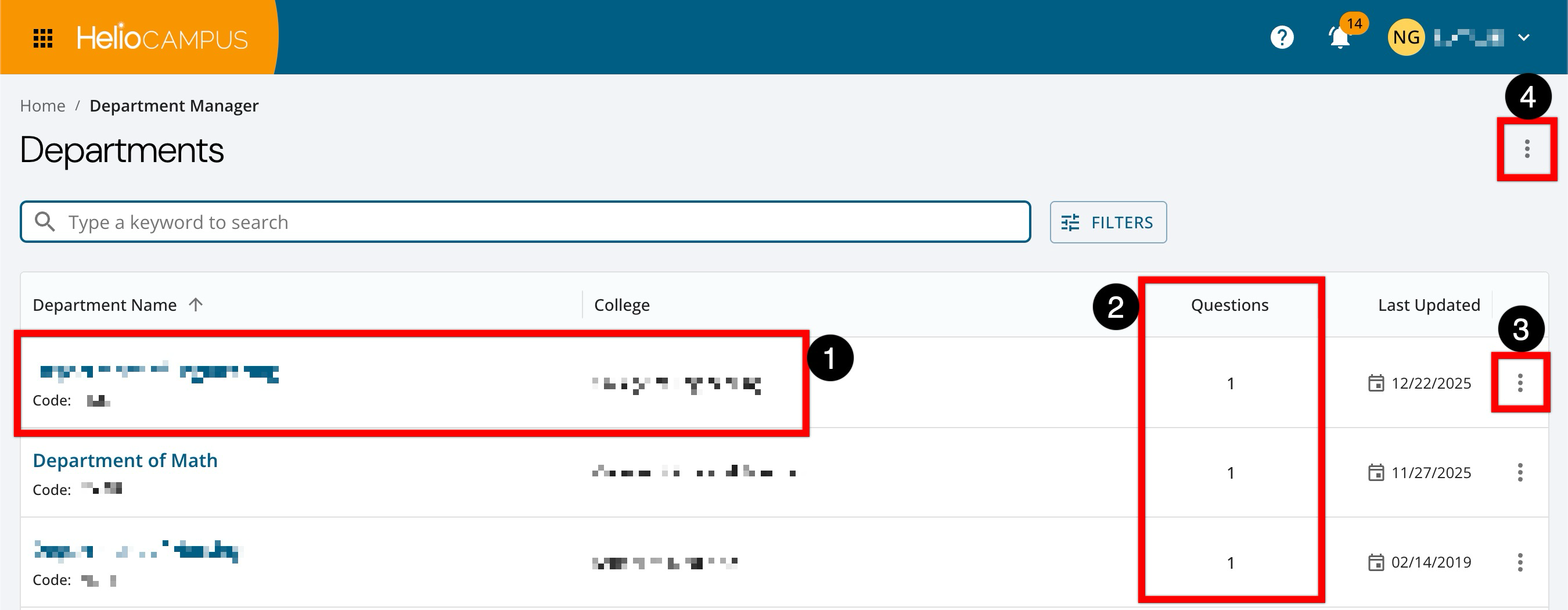
The manager displays a record's name and code, along with the associated owning College; clicking the name (1) displays the homepage. The Questions column (2) provides a quick count of department-specific survey questions. By expanding the Actions menu (3), additional information can be viewed without navigating to the homepage by clicking View Details. Export functionality is available by expanding the More Options menu (4) to export the manager to CSV format.
Department Homepage
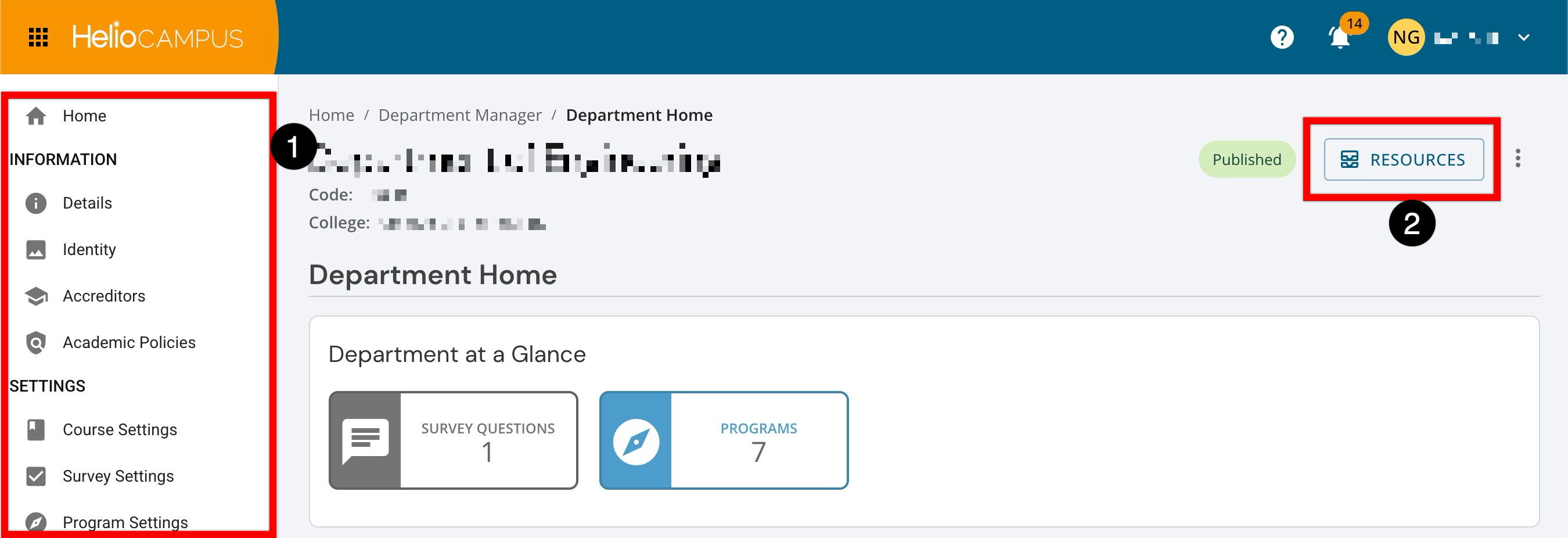
The homepage is the landing page for hierarchy-level-specific administration. In addition to serving as a central "at-a-glance" page, it surfaces summary metrics and visualizations that help confirm the structure and activity at a given hierarchy level. This page is the access point for level-specific configurations and settings that support ongoing operations.
The left-hand menu is the hierarchy-level navigation menu (1), organized into sections of configuration points and settings. The Information section is used to review and maintain core record information and level-specific setups. Below the Information section, various settings menus provide access to level-specific configurations that define defaults and behavior that apply broadly across the hierarchy level. At the top right of the homepage, there is a Resources button (2) that provides a centralized place to access supporting tools and links related to the hierarchy level.
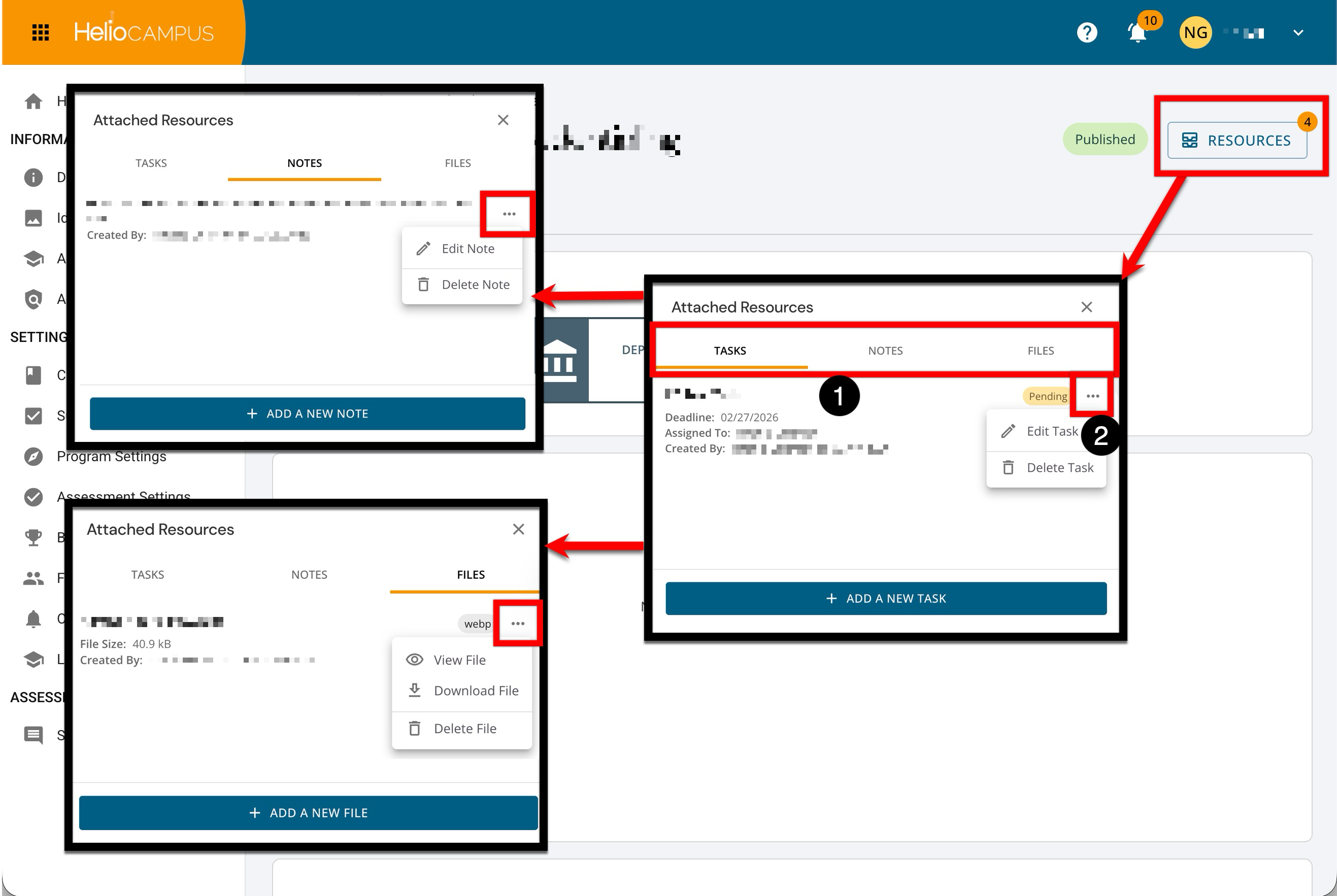
By clicking the Resources button, all level-specific attachments can be accessed in a centralized drawer with organized tabs for tasks, notes, and files (1) with options to view, edit, or delete, as applicable, by resource type (2). New resources can be added quickly through the action buttons at the bottom of each tab.
-
Tasks: Displays tasks assigned to the selected hierarchy level, with creation and assignment details, due dates, status indicators to track progress, and options to edit or delete tasks.
-
Notes: Provides quick access to all associated notes with timestamps and creation details, with options to edit or delete notes.
-
Files: Displays all attached documents and media, with options to view, download, or delete them.