Questions are reusable 'building blocks' that can be created and managed across the platform and then included in templates. These questions support standardization while still allowing flexibility for local customization at different levels as needed. Higher-level questions can be cascaded into templates, allowing shared questions to be asked consistently.
Questions support consistent wording so results can be aggregated and compared more reliably. By using standardized questions to reduce duplicated effort by reusing questions across templates. This functionality enables shared governance, allowing different levels to own and maintain the questions they are responsible for.
Video Resource: Learn about question types with a quick video walkthrough!
|
Institution |
Define institution-wide questions (for example, shared course evaluation items) that appear consistently. Institution-level questions are inherited by Colleges/Departments/Courses when rollup placeholders are used. |
||
|
College |
College-specific questions that apply across associated Departments within a College. College questions can complement Institution questions and are inherited by Departments/courses associated with that College when rollup placeholders are used. |
||
|
Department |
Department-specific question sets (for example, discipline-level items) that apply across a Department while still inheriting higher-level questions. Department questions are inherited by courses and course sections associated with that Department when rollup placeholders are used. |
||
|
Courses Co-Curricular Activities |
Course or activity-specific questions that apply to specific courses and activities across terms/sections (for example, course design or content questions). Questions can complement inherited questions and are inherited by associated course and co-curricular sections when rollup placeholders are used. |
||
|
Course Sections Co-Curricular Sections |
Section-specific questions for targeted feedback (for example, a pilot format or special modality). Section-level questions are the most localized configuration point, can complement inherited questions, and do not cascade. |
||
|
Administrative Division |
Division-specific questions (for example, Academic Affairs) that should apply across associated units. Administrative Division questions can complement Institution questions and are inherited by Administrative Units when rollup placeholders are used. |
||
|
Administrative Unit |
Unit-specific questions (for example, a department office or support unit). Unit questions complement inherited questions, and do not cascade. |
||
|
Question Library |
Organizes reusable questions that can be added to survey and data collection templates for all hierarchy levels, courses, and co-curricular activities, course and co-curricular sections, and data collections. This supports consistent wording across levels while still allowing each level to own and maintain the questions they create. |
||
User Role Access & Permissions
|
Organizational Hierarchy |
|
|
Institution Administrators can create and manage questions organization-wide. College and Department Administrators can create and manage questions at their respective levels, and for the courses/activities and course/co-curricular sections they are associated with. |
|
Administrative Division Administrators can create and manage questions at their respective levels, and for the Administrative Units they are associated with. Administrative Unit Administrators can create and manage questions only for units they are associated with. |
|
Courses/Co-Curricular Activities |
|
|
Administrators can create and manage questions at their respective levels, and for the course/co-curricular sections they are associated with. Coordinators can only create and manage questions for courses and activities they are associated with. |
|
Course Sections/Course Sections |
|
|
Administrators can create and manage questions at their respective levels, while Coordinators and Instructors can only create and manage questions for sections they are associated with. |
|
Question Library |
|
|
Administrators can create and manage questions for use in survey templates. |
|
*While Course Coordinators and Instructors can add survey questions at their respective hierarchical levels, these roles cannot perform the following actions:
|
|
Question Type Quick Reference
|
|
Available Configuration Options |
|||
|---|---|---|---|---|
|
Metric |
Group |
Skip Logic |
Comments |
|
|
Multi-Choice, Single Answer |
✅ |
✅ |
✅ |
✅ |
|
Multi-Choice, Multi-Answer |
✅ |
✅ |
✅ |
✅ |
|
True/False |
✅ |
✅ |
✅ |
✅ |
|
Drop-Down Select |
✅ |
✅ |
✅ |
✅ |
|
Instructor Multi-Choice |
✅ |
✅ |
❌ |
✅ * |
|
CLO Placeholder – Student |
✅ |
✅ |
❌ |
❌ |
|
CLO Placeholder – Faculty |
✅ |
✅ |
❌ |
❌ |
|
Instructor Text/Memo |
❌ |
❌ |
❌ |
❌ |
|
Text/Memo |
❌ |
❌ |
❌ |
❌ |
|
Text Block, No Answer |
❌ |
❌ |
❌ |
❌ |
|
Auto Complete Drop-Down |
❌ |
❌ |
❌ |
❌ |
|
Single Line Text |
❌ |
❌ |
❌ |
❌ |
-
The Instructor Multi-Choice question type has a comment field except when it is part of a grouped/matrix question.
Multi-Choice, Single Answer
Video Resource: Building Multiple Choice, Single-Answer Questions
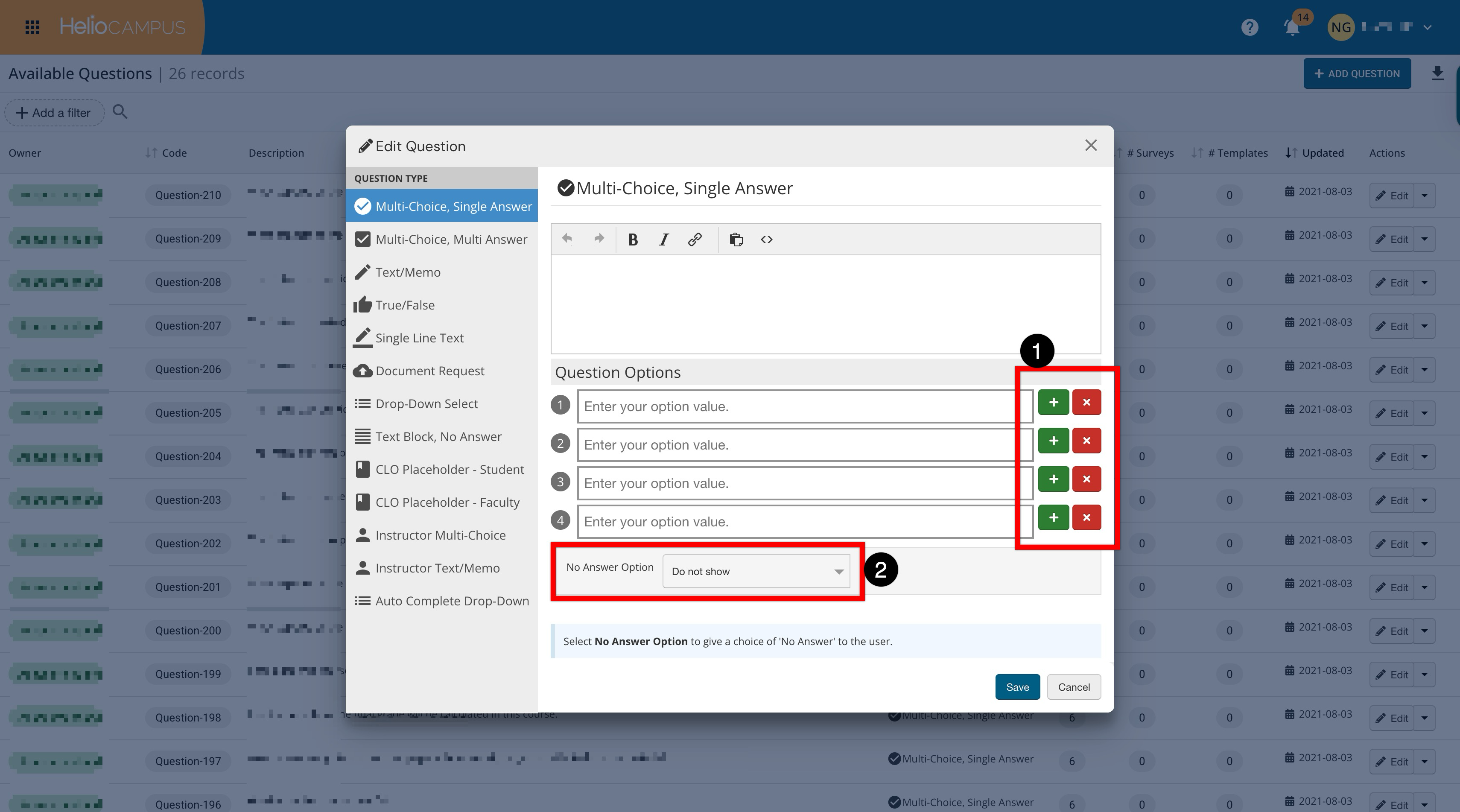
This question type provides a single answer option selection for a single question. Unlike the Multi-Choice, Multi-Answer question type, participants can select only one answer per question. Answer options can be added or removed individually via the option value fields (1). The No Answer Option drop-down (2) can be configured to show a non-scored ‘No Answer’ choice either before (prepend) or after (append) the configured option values.
|
Configuration Options |
||||
|
As Metric |
Is Required |
Is Matrix |
Skip Logic |
Has Comment |
|
|
|
|
|
|
Multi-Choice, Multi-Answer
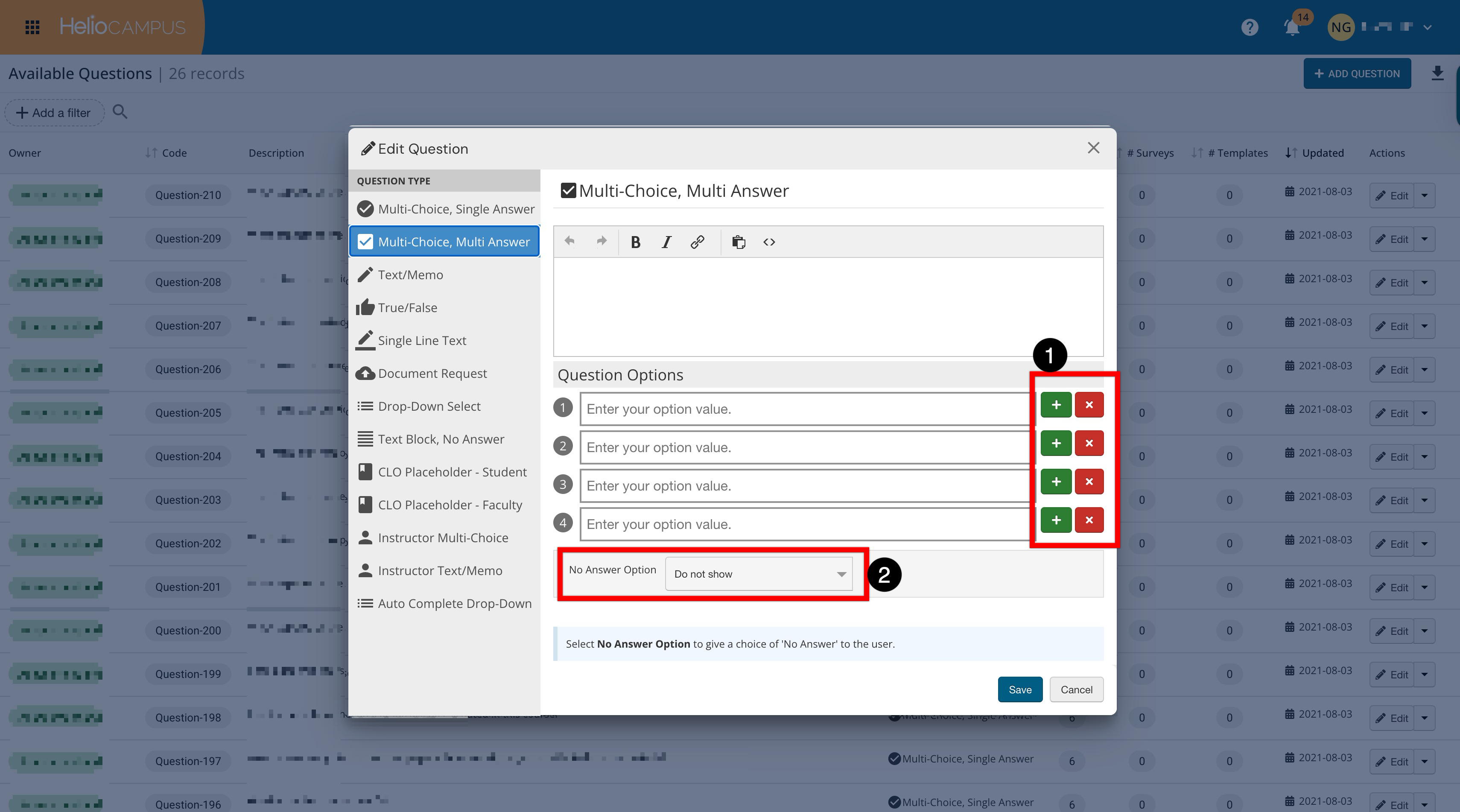
This question type provides multiple answer options for a single question. Unlike the Multi-Choice, Single Answer question type, participants can select multiple answer options for a single question. Answer options can be added or removed individually via the option value fields (1). The No Answer Option drop-down (2) can be configured to show a non-scored ‘No Answer’ choice either before (prepend) or after (append) the configured option values.
|
Configuration Options |
||||
|
As Metric |
Is Required |
Is Matrix |
Skip Logic |
Has Comment |
|
|
|
|
|
|
Text/Memo
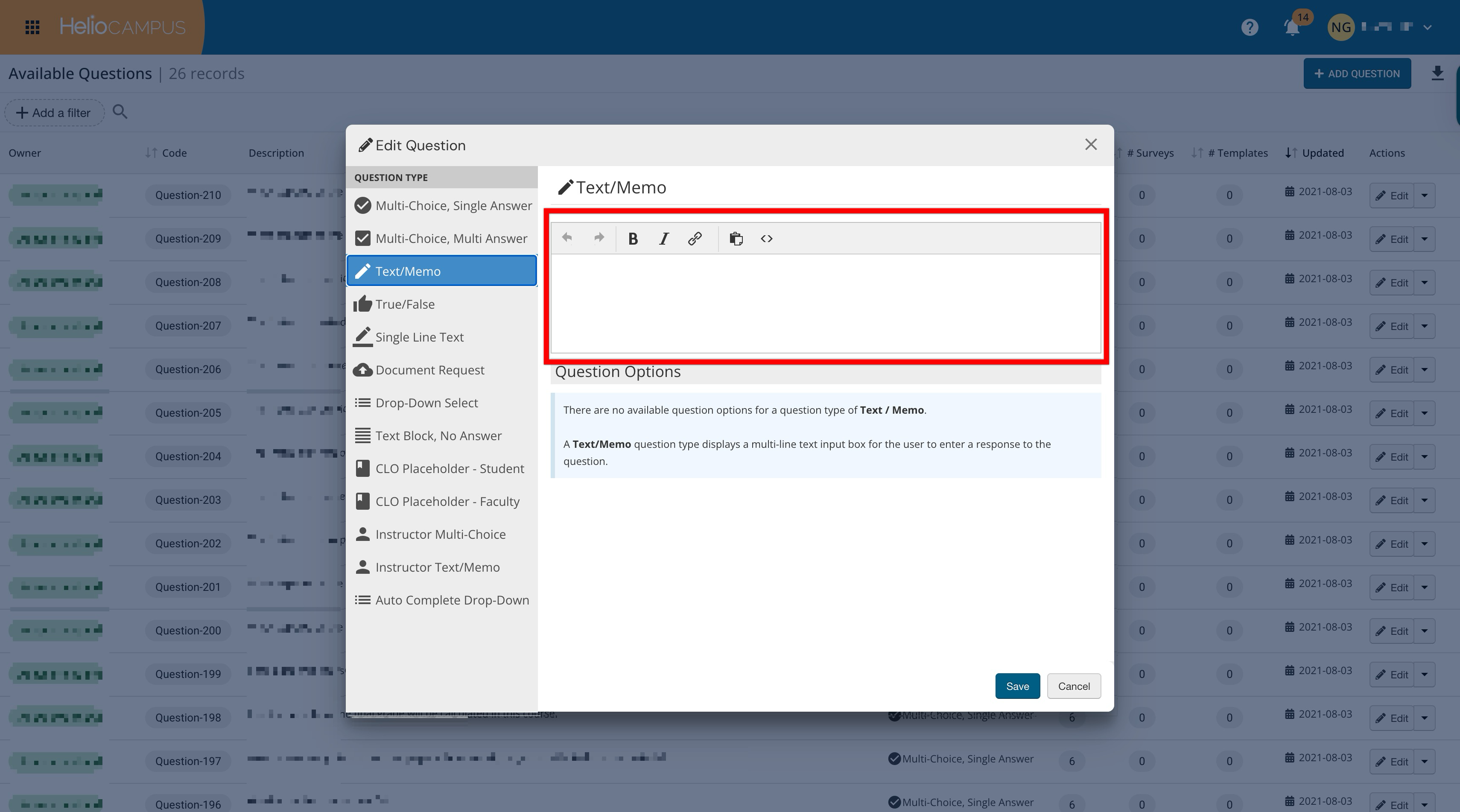
Using this question allows participants to enter an open-ended text response to the defined question. Question text can be entered into the text box and formatted as needed, though there is no additional configuration for answer options.
|
Configuration Options |
||||
|
As Metric |
Is Required |
Is Matrix |
Skip Logic |
Has Comment |
|
❌ |
|
❌ |
|
❌ |
True/False
This question type is not available for data collection forms.
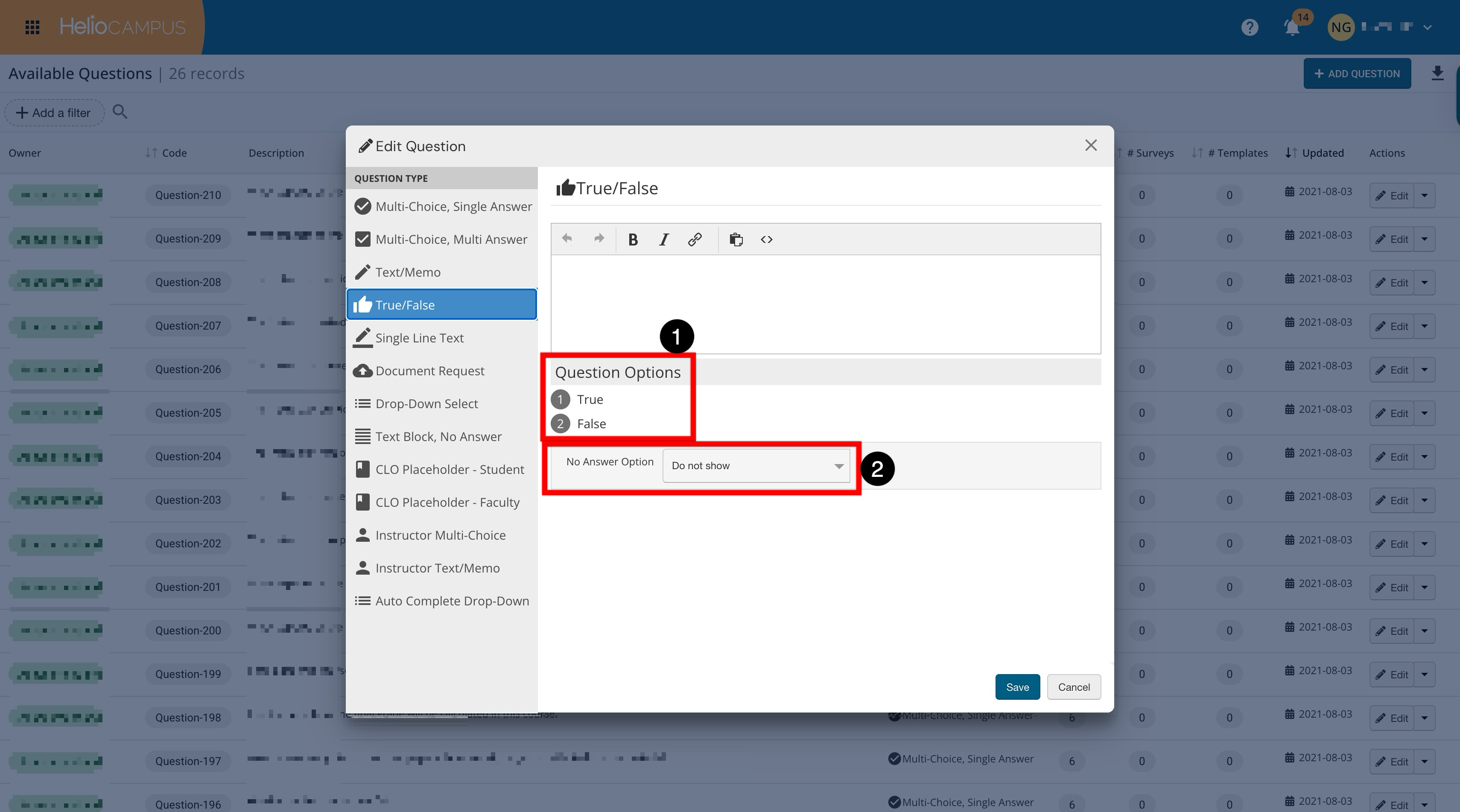
This question type provides a true/false format (1). No other answer options can be configured for this question type. The No Answer Option drop-down (3) can be configured to show a non-scored ‘No Answer’ choice either before (prepend) or after (append) the configured option values.
|
Configuration Options |
||||
|
As Metric |
Is Required |
Is Matrix |
Skip Logic |
Has Comment |
|
|
|
|
❌ |
|
Single Line Text
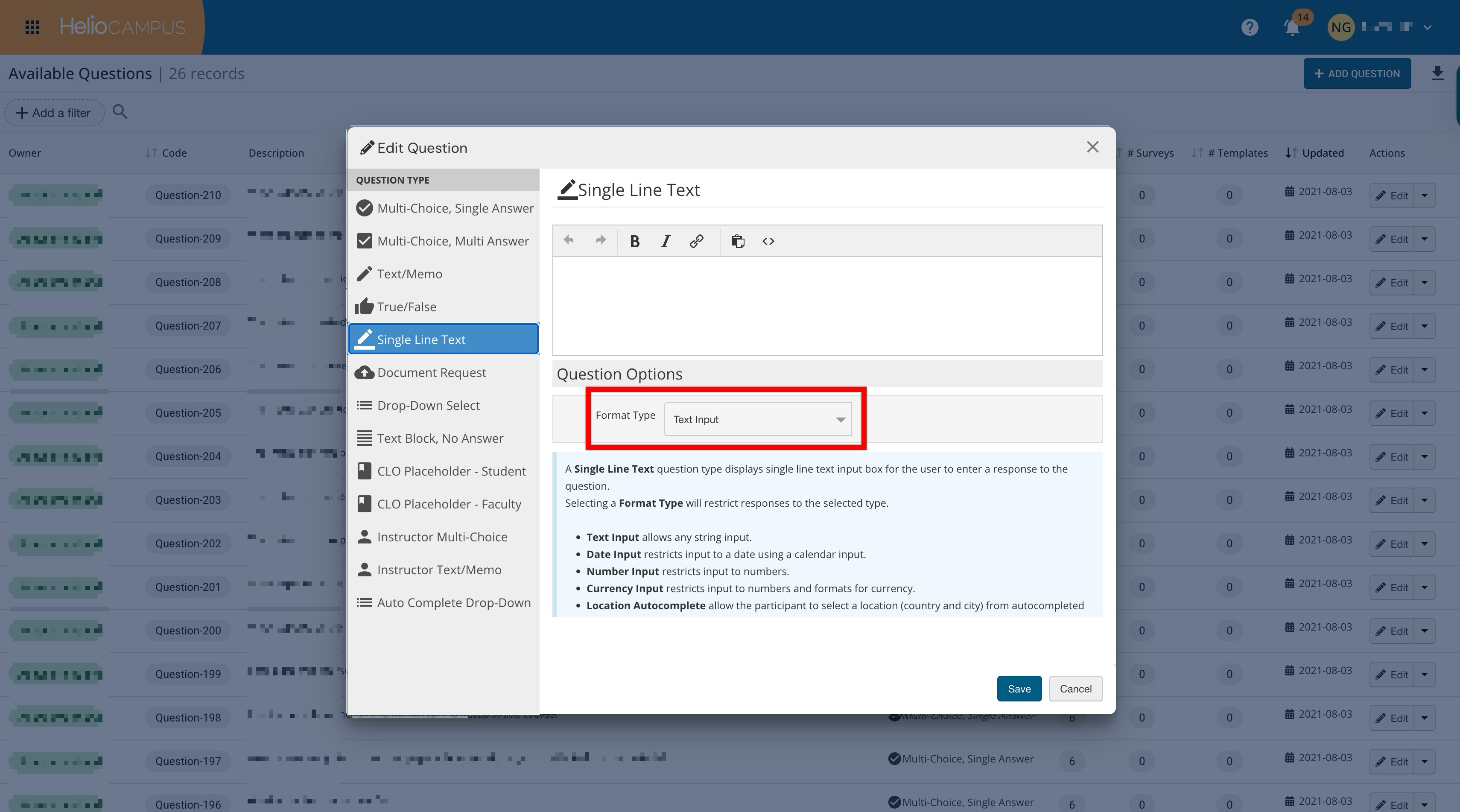
This question type provides the ability for a question answer to be free-form with a character limit of 255. The Format Type drop-down can be used to determine the required format for the answer to the question being entered by participants.
Selecting Location Autocomplete integrates with Google Maps to automatically define a location.
|
Configuration Options |
||||
|
As Metric |
Is Required |
Is Matrix |
Skip Logic |
Has Comment |
|
❌ |
|
❌ |
❌ |
❌ |
Document Request
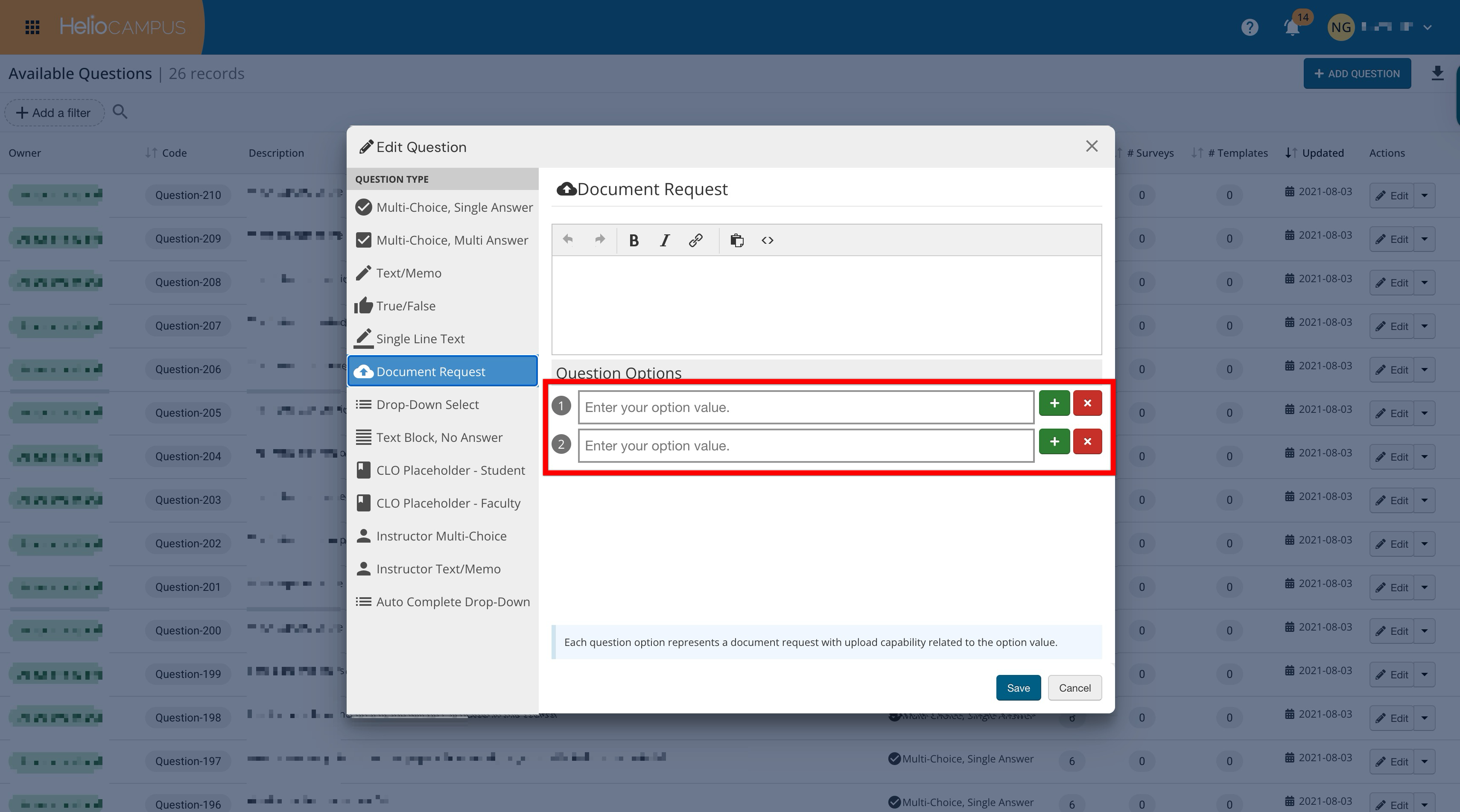
A document request can be added as a question, and each answer option allows the upload of a file. For example, if a file is required for survey completion, the question text can specify the form request, and the answer option (where the file will be uploaded) can be configured to match the requested form name. Answer options can be added or removed individually via the option value fields
|
Configuration Options |
||||
|
As Metric |
Is Required |
Is Matrix |
Skip Logic |
Has Comment |
|
❌ |
|
❌ |
❌ |
|
Drop-Down Select
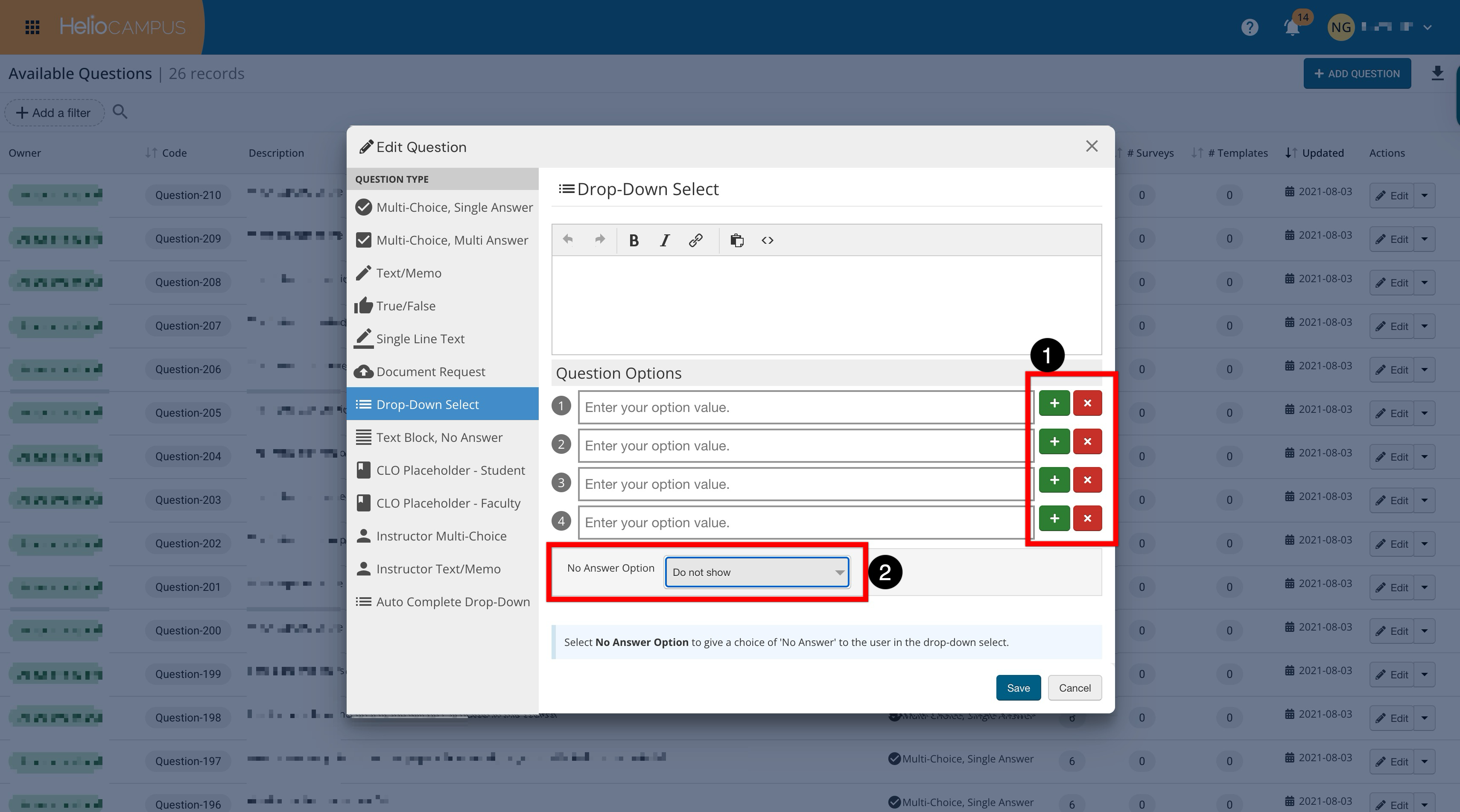
This question type is similar to the Multi-Choice Single-Answer question type, except it displays the answer options in a drop-down rather than in an expanded list view. Answer options can be added or removed individually via the option value fields (1). The No Answer Option drop-down (2) can be configured to show a non-scored ‘No Answer’ choice either before (prepend) or after (append) the configured option values.
|
Configuration Options |
||||
|
As Metric |
Is Required |
Is Matrix |
Skip Logic |
Has Comment |
|
|
|
|
|
|
Text Block, No Answer
This question type does not provide any answer option configurations. The entered text will act as a header on templates and will be used to display instructional or informational text. Text can be entered into the text box and formatted as needed (1).
|
Configuration Options |
||||
|
As Metric |
Is Required |
Is Matrix |
Skip Logic |
Has Comment |
|
❌ |
❌ |
❌ |
❌ |
❌ |
CLO Placeholder – Student
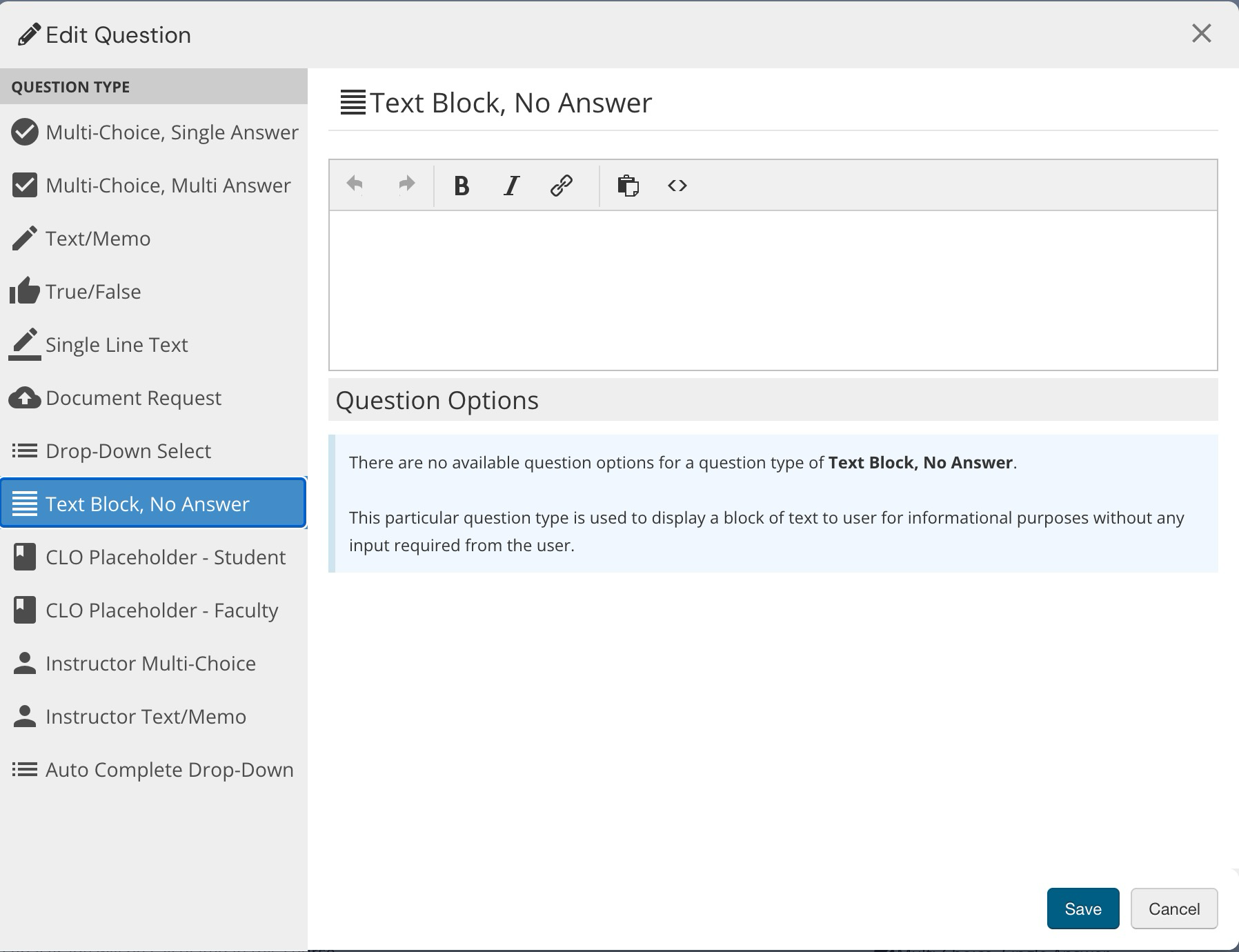
Utilized in Course Evaluations for students. For this question type, the platform will automatically include the course's Course Learning Outcomes (CLOs) in the question and present the same question for each CLO. For example, if there are two CLO placeholder questions in a Survey and 10 CLOs in a Course, this will result in 20 question prompts in the survey. The Measure drop-down (1) can be configured to specify whether the answer should be weighted by what’s covered in a course, by general student performance/understanding, or by a combination of both. The No Answer Option drop-down (2) can be configured to show a non-scored ‘No Answer’ choice either before (prepend) or after (append) the configured option values. Answer options can be added or removed individually (3).
|
Configuration Options |
||||
|
Can Be Metric |
Can Be Required |
Can Be Matrix |
Skip Logic |
With Comment |
|
|
|
❌ |
❌ |
❌ |
CLO Placeholder – Faculty
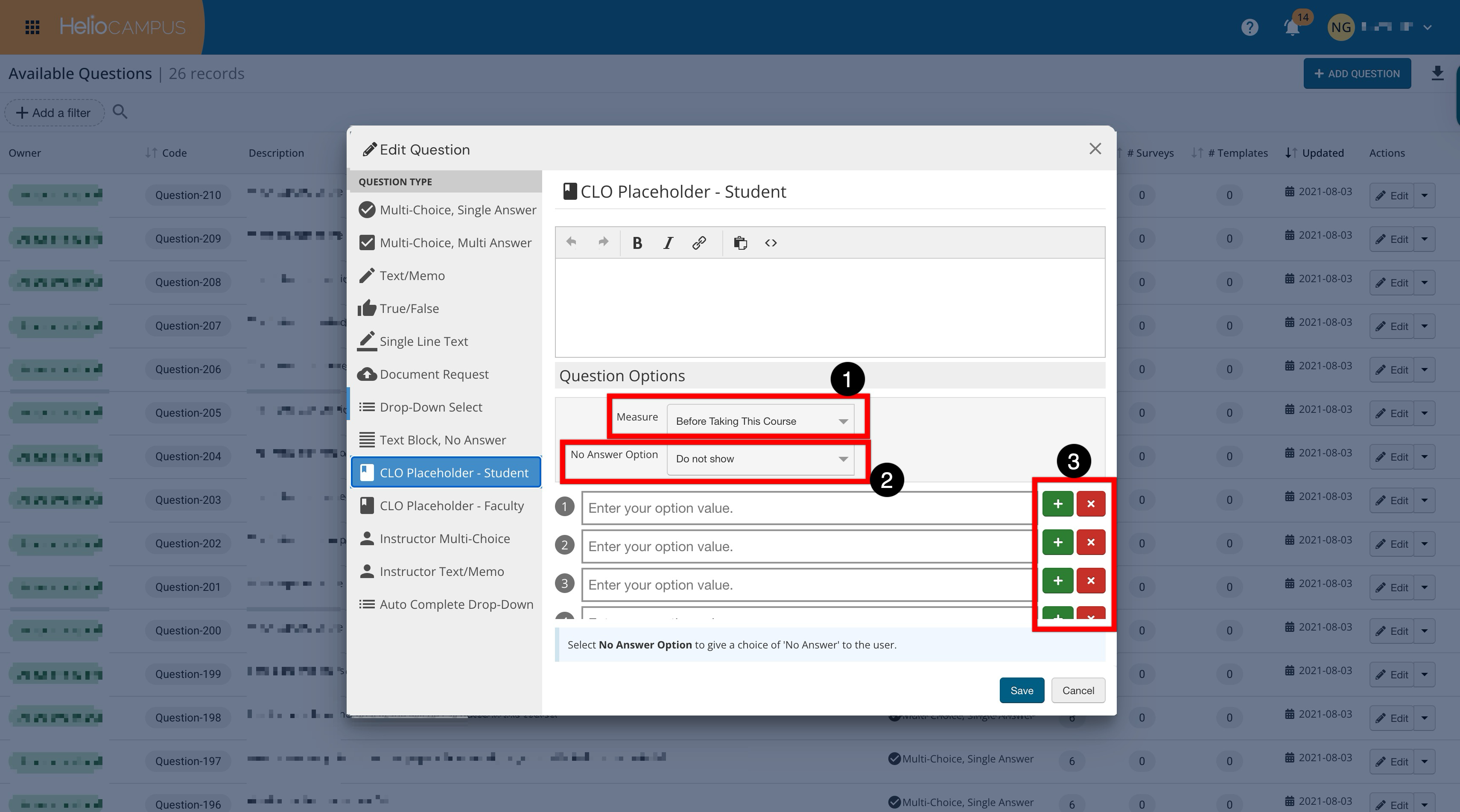
Utilized for requesting student feedback regarding the performance of a specific Instructor. For this question type, the platform will automatically include Course Learning Outcomes (CLOs) from the Course in the question and present the same question for each CLO. For example, if there are two CLO placeholder questions in a survey and 10 CLOs in a course, this will result in 20 question prompts in the survey. The Measure drop-down (1) can be configured to specify whether the answer should be weighted by what’s covered in a course, by general student performance/understanding, or by a combination of both. The No Answer Option drop-down (2) can be configured to show a non-scored ‘No Answer’ choice either before (prepend) or after (append) the configured option values. Answer options can be added or removed individually via the option value fields (3).
|
Configuration Options |
||||
|
Can Be Metric |
Can Be Required |
Can Be Matrix |
Skip Logic |
With Comment |
|
|
|
|
❌ |
❌ |
Instructor Multi-Choice
Video Resource: Building Instructor Multiple Choice Question Types
This question type pertains to a specific faculty for a course. Survey participants will have multiple answer options when responding to a question about the following faculty roles:
-
Course Section Director
-
Instructor
-
Preceptor
-
Teaching Assistant
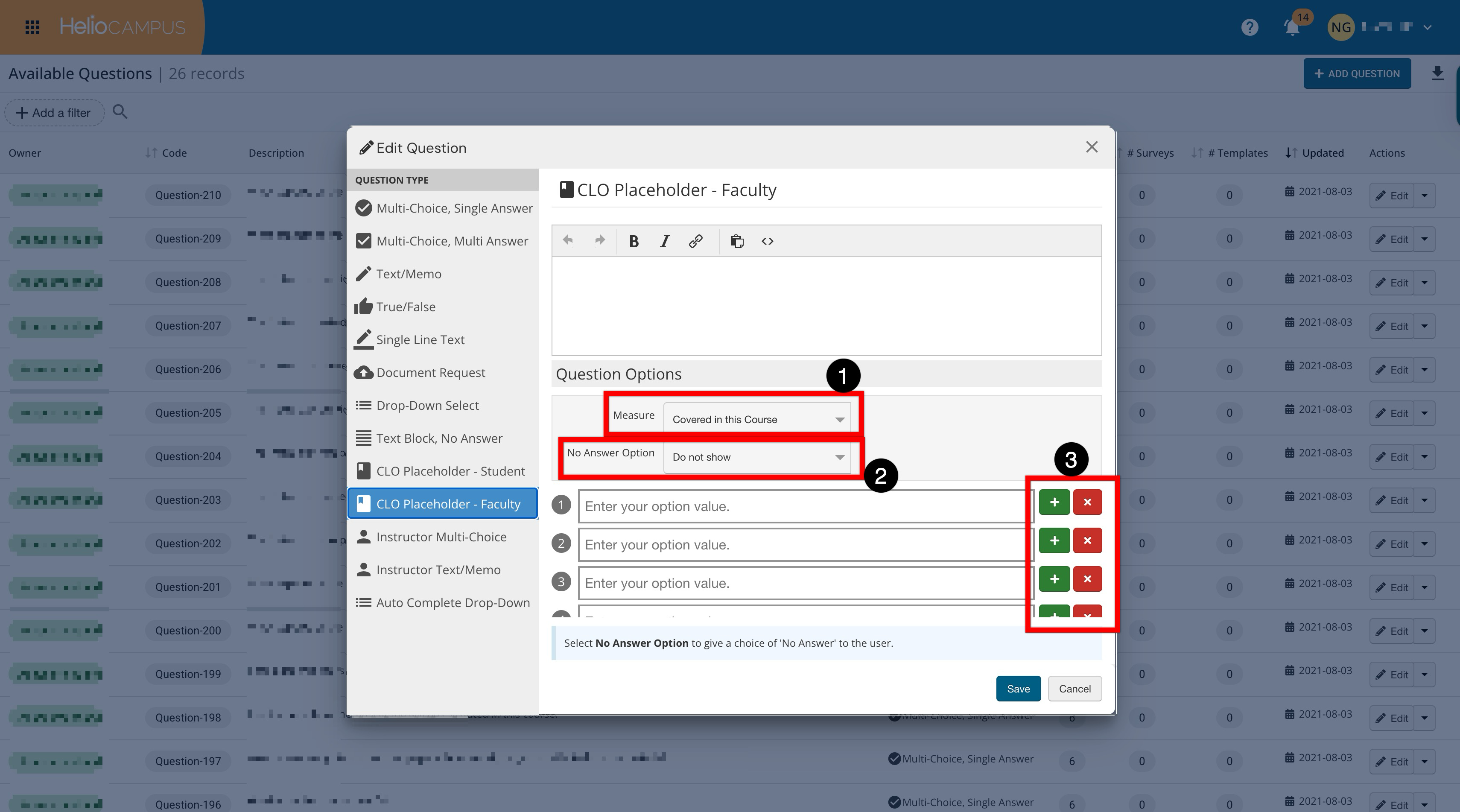
The Include drop-down (1) is used to define the faculty role that the question pertains to. The No Answer Option drop-down (2) can be configured to show a non-scored ‘No Answer’ choice either before (prepend) or after (append) the configured option values. Answer options can be added or removed individually via the option value fields (3)
|
Configuration Options |
||||
|
Can Be Metric |
Can Be Required |
Can Be Matrix |
Skip Logic |
With Comment |
|
|
|
|
❌ |
❌ |
Instructor Text/Memo
Video Resource: Building Instructor Text/Memo Question Types
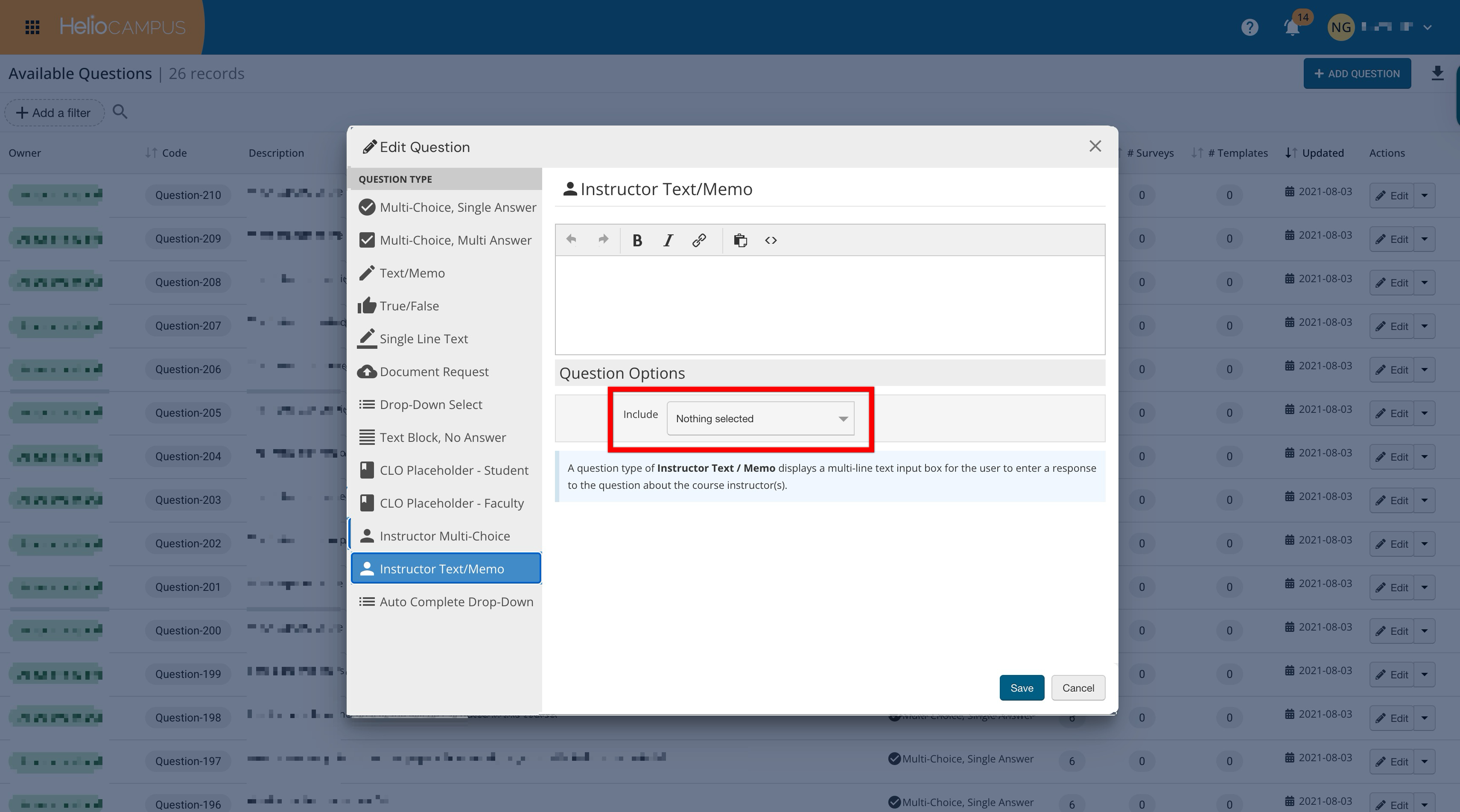
This question type displays a multi-line text input box for Survey participants to enter a response regarding the Course faculty. The Include drop-down is used to define the faculty role that the question pertains to.
|
Configuration Options |
||||
|
Can Be Metric |
Can Be Required |
Can Be Matrix |
Skip Logic |
With Comment |
|
❌ |
|
|
❌ |
❌ |
Auto Complete Drop-Down
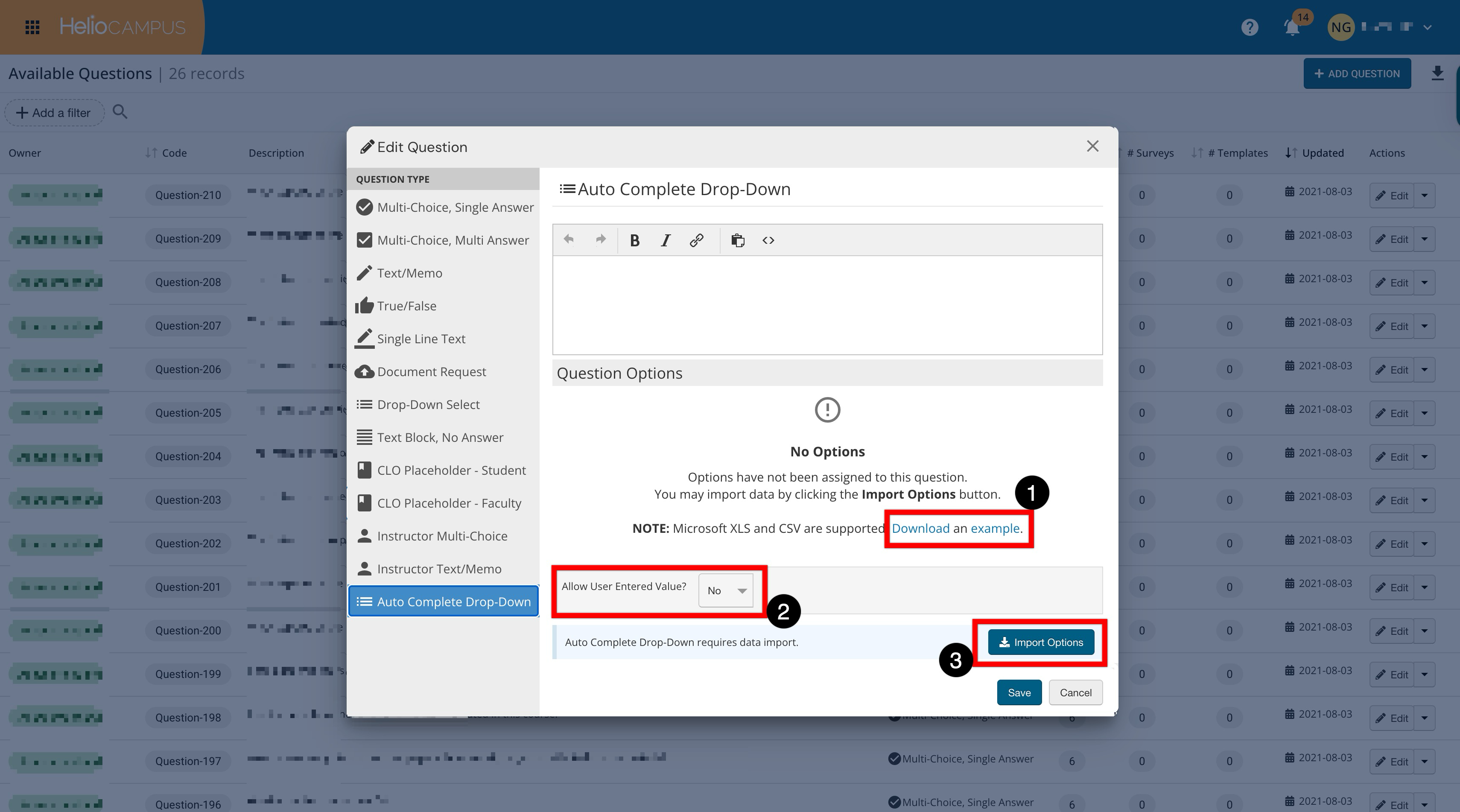
All multiple-choice question types have an answer option limit of 25. In cases where more than 25 answer options are required for a multiple-choice question, this question type can be used instead to download an example template (1) to define all 25+ options instead of using a multiple-choice question type; Upon download, the template will display example data. This example data should be removed/replaced with the 25+ answer options. The Allow User Entered Value (2) can be used to enable users the ability to add their own answer option. Import Options (3) can be clicked to upload the completed template/answer options.
|
Configuration Options |
||||
|
As Metric |
As Required |
As Matrix |
Skip Logic |
With Comment |
|
❌ |
|
❌ |
❌ |
❌ |