An Institution is the top level of the Organizational Hierarchy. It represents the overall university or organization and serves as the container for downstream structures and activities, such as Colleges, Departments, and Programs. The Institution level is also where several platform-wide settings are maintained, as they influence behavior across multiple features and organizational units.
Institutions are established during implementation, and ongoing maintenance focuses on keeping the Institution record accurate and ensuring Institution-level settings align with how the platform is being used (for example, ensuring communications and notifications are configured appropriately). Institutions are accessed by navigating to Main Menu > Organizational Hierarchy > Institution to view the Institution Manager. Learn more about the Organizational Hierarchy.
Product Tip
If an Institution's organizational structure changes, please contact Support to facilitate implementation. Changes to the Organizational Hierarchy should not be sent to HelioCampus via data files.
Downstream Impacts
At a high level, Institution settings act as hierarchy-level defaults. When settings are enabled and especially when they are locked at a hierarchy level, they are inherited downstream and prevent configuration at lower hierarchy levels. Institution decisions can standardize behavior across large parts of the platform.
-
Standardization Across The Hierarchy: Institution Admins can set defaults that support consistent setup and reporting across Colleges, Departments, and Programs, and can lock those defaults to keep downstream units aligned. Learn more.
-
Email and Notification Behavior: Institution email configurations define the "send from“ identity used for platform emails. Also available are settings used to configure who receives certain operational alerts, such as nightly import error notifications (and which contact types are targeted). Learn more.
-
Survey Behavior At Scale: Institution-level survey schedules, notifications, and survey results/form settings can drive consistent survey behavior across the Institution, supporting comparability and governance. Learn more.
-
Course/Course Section Behavior and Communications: Institution-level course settings (including course evaluation enablement, additional course settings, and notification settings) can affect what is available and how communications behave. Learn more.
Considerations
Before Configuration:
-
Confirm Governance: who owns institution-wide decisions vs. college-level decisions.
-
Confirm communication expectations: what email identity should appear on platform notifications.
During Configuration:
-
Decide which settings should be defaults vs. locked requirements (locked settings prevent downstream configuration).
-
Verify operational notification recipients, especially for import errors.
After Configuration:
-
Re-validate downstream behavior (especially surveys and notifications) after any major institution-level change.
-
Establish a periodic review cadence for contact settings and email identities to ensure notifications continue to reach the right team.
Best Practices
-
Configure Institution email settings before notifications are sent from the platform. When hierarchy-level defaults exist, decide on standards early so Colleges and Departments do not configure conflicting approaches that later need to be reconciled.
-
Lock settings when the goal is consistency and governance across units, or when downstream changes would create reporting inconsistencies or create a support burden. Leave settings unlocked when Colleges or Departments legitimately need autonomy for different processes.
-
Review who is configured to receive import error notifications and verify that those contacts are maintained over time, since these notifications support day-to-day data health monitoring.
-
For any configuration called out as having irreversible or disruptive impacts (for example, resetting curriculum mapping when changing outcome mapping measurement in programs), communicate that changes should be planned, tested, and timed carefully.
Institution Manager
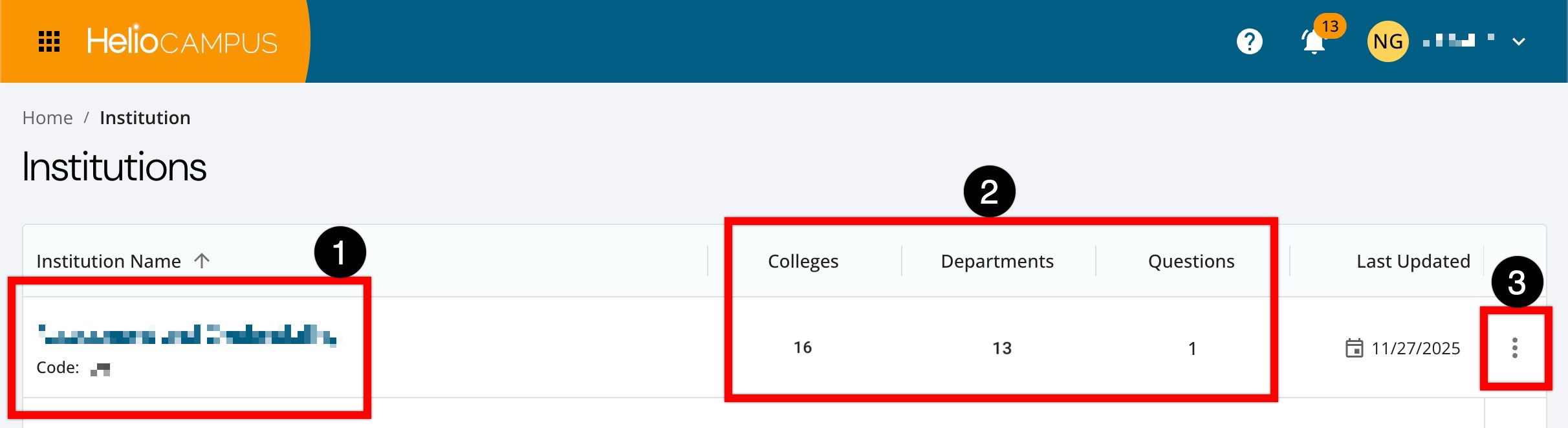
The manager displays a record's name and code; clicking the name (1) will display the homepage. Summary columns (2) provide quick counts of associated records, and by expanding the Actions menu (3), additional information can be viewed without navigating to the homepage by clicking View Details.
Institution Homepage
The homepage is the landing page for hierarchy-level-specific administration. In addition to serving as a central "at-a-glance" page, it surfaces summary metrics and visualizations that help confirm the structure and activity at a given hierarchy level. This page is the access point for level-specific configurations and settings that support ongoing operations.
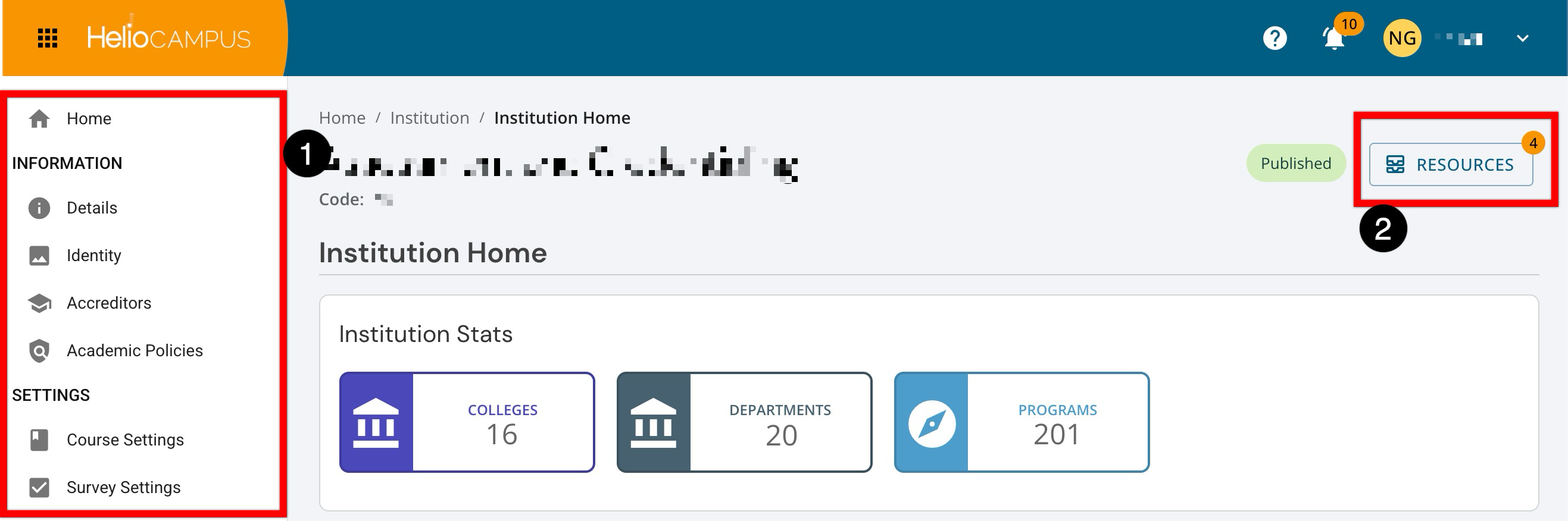
The left-hand menu is the hierarchy-level navigation menu (1), organized into sections of configuration points and settings. The Information menu is used to review and maintain core record information and level-specific setups. Below the Information section, various settings menus provide access to level-specific configurations that define defaults and behavior that apply broadly across the hierarchy level. At the top right of the homepage, there is a Resources button (2) that provides a centralized place to access supporting tools and links related to the hierarchy level.
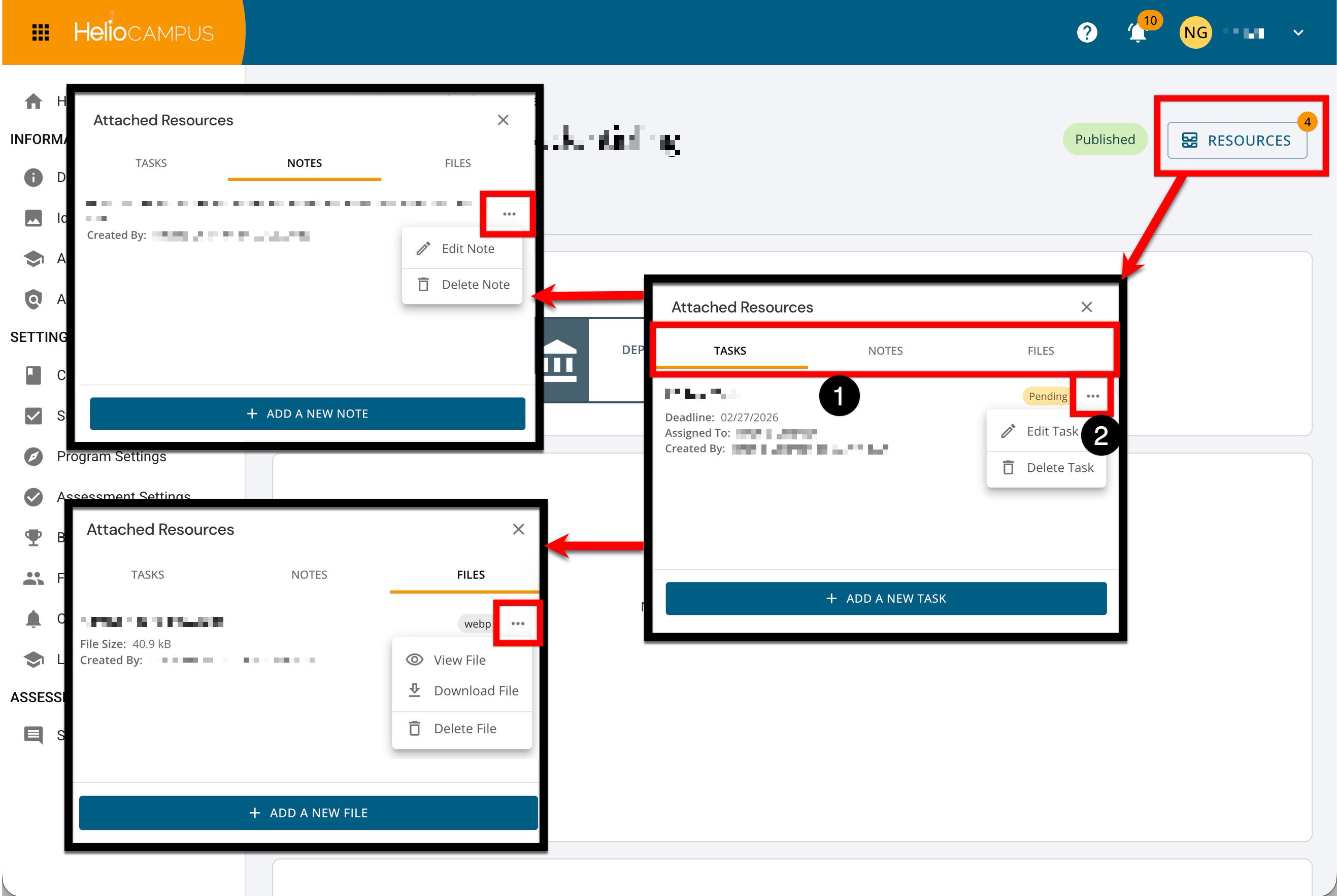
By clicking the Resources button, all level-specific attachments can be accessed in a centralized drawer with organized tabs for tasks, notes, and files (1) with options to view, edit, or delete, as applicable, by resource type (2). New resources can be added quickly through the action buttons at the bottom of each tab.
-
Tasks: Displays tasks assigned to the selected hierarchy level, with creation and assignment details, due dates, status indicators to track progress, and options to edit or delete tasks.
-
Notes: Provides quick access to all associated notes with timestamps and creation details, with options to edit or delete notes.
-
Files: Displays all attached documents and media, with options to view, download, or delete them.