
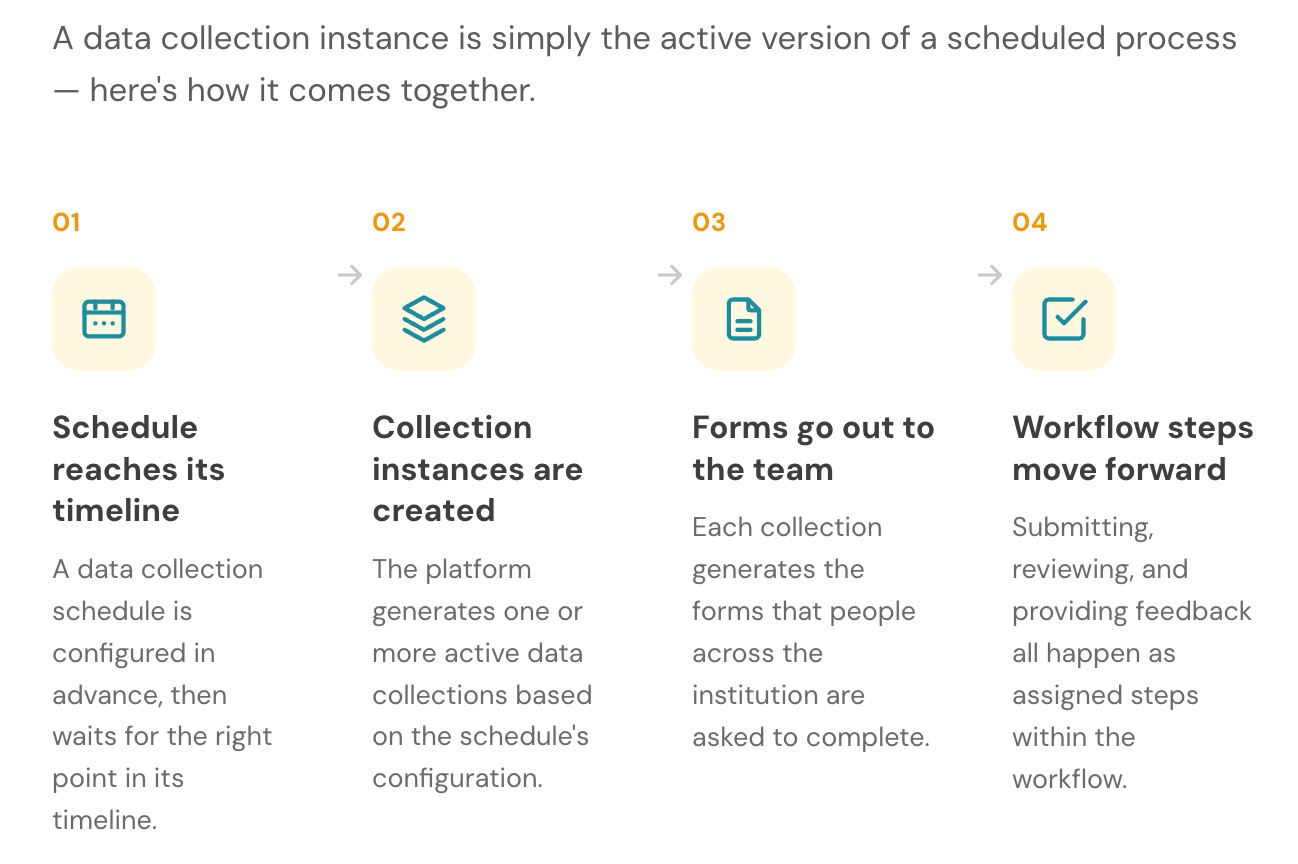
The Data Collection Manager is the central workspace for monitoring and managing active data collections after creation. A data collection instance is the active version of a scheduled collection process. Once a data collection schedule reaches the appropriate point in its timeline, the platform creates one or more data collections based on the schedule configuration. The Data Collection Manager then helps Institutions oversee complex, multistep processes that require users across an organization to submit information, review content, provide feedback, or complete assigned workflow steps. Instead of tracking who has submitted information or who still needs to review a form, the Data Collection Manager brings these activities into one location, giving administrators a clearer view of each collection, the forms generated from it, the workflow status of those forms, and the users responsible for completing each step.
Downstream & Cross-Platform Impacts
-
Participant Routing and Workload Visibility: The Data Collection Manager affects how assigned work appears to participants and reviewers across the collection cycle. Workflow design, role assignments, and due dates determine who receives forms, when action is expected, and how work moves between contributors.
-
Assessment and Planning Continuity: Information collected through the Data Collection Manager can become part of a broader assessment, accreditation, or planning record. Consistent form completion supports year-over-year review, continuous improvement documentation, and evidence of institutional follow-through.
-
Notification and Dashboard Impact: Collection settings generate email notifications and platform tasks for assigned users. These communications influence what users see as required work and can affect how quickly forms move through the workflow.
-
Reporting and Export Consistency: Reports and exports reflect the data collection’s configuration, submitted responses, workflow status, and selected reporting parameters. Clear form structure and consistent participant responses help produce cleaner outputs for review and sharing.
Considerations
-
Source Data Dependency: Data collections rely on existing platform data such as programs, courses, sections, departments, terms, outcomes, users, and roles. If that source data is incomplete or outdated, the collection may not route, filter, or report information as expected.
-
Evaluation Readiness: A well-managed data collection creates a more review-ready record by organizing submissions, approvals, revisions, and deadlines in one workflow. This helps evaluators understand what was collected, who contributed, and whether the process was completed as expected.
-
Timeline and deadlines: Review activation dates, start dates, end dates, reminder timing, and any recurring schedule needs before users begin working. Dates should allow enough time for completion, review, revision, and final reporting.
-
Access and visibility: Confirm who should manage the data collection, who should complete forms, who should review submissions, and who should see results. Access planning helps prevent routing issues and unintended visibility gaps.
Best Practices
-
Review the data collection’s purpose, audience, workflow, and reporting needs before the start date.
-
Test the workflow from each major participant role before the start date.
-
Confirm participant assignments and reviewer responsibilities before the start date.
-
Monitor progress during the collection period instead of waiting until the end date.
-
After completion, review results and process feedback before reusing or revising the data collection for a future cycle.
Data Collection Manager
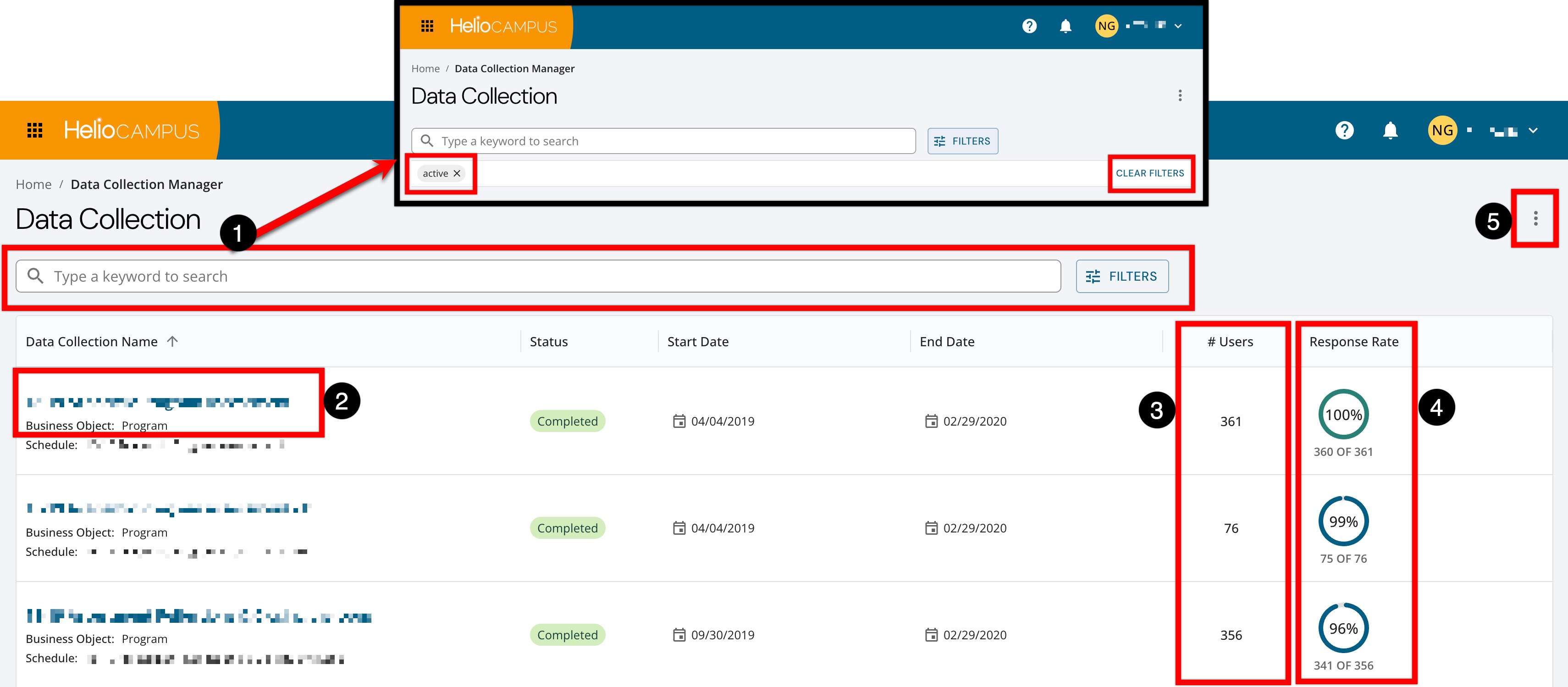
Search functionality is available, and by clicking the Filters option, filters can be applied and removed (1). Each row in the manager represents a data collection along with supporting details such as the related business object and schedule. Clicking a data collection’s name (2) will display the Homepage. The # Users column (3) shows how many users are included in the collection, while the Response Rate column (4) shows the percentage and count of users who have completed their assigned work. The Data Collection Manager can be exported to CSV format by expanding the export kebab menu (5). Users assigned read-only access to the Data Collection Manager do not have export access and cannot export collections.
The Data Collection Homepage
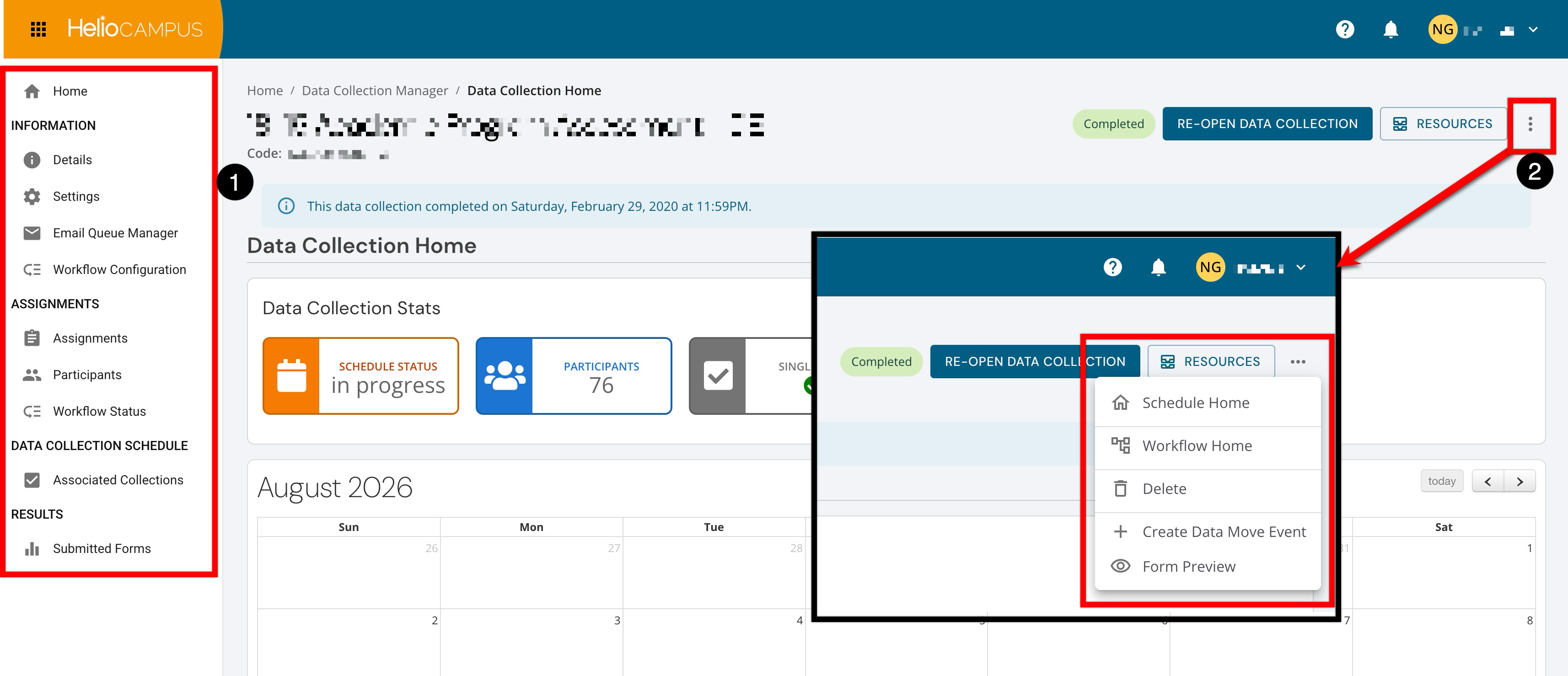
The Homepage provides a detailed view of an individual data collection and is the primary place to manage that specific collection. Administrators can use it to review basic information, access configuration areas, monitor progress, and manage related settings. The left-hand menu is the collections navigation menu (1), organized into sections for collection data, information, and configurations. At the top right of the page, the action menu (2) provides access to additional collection functionality.
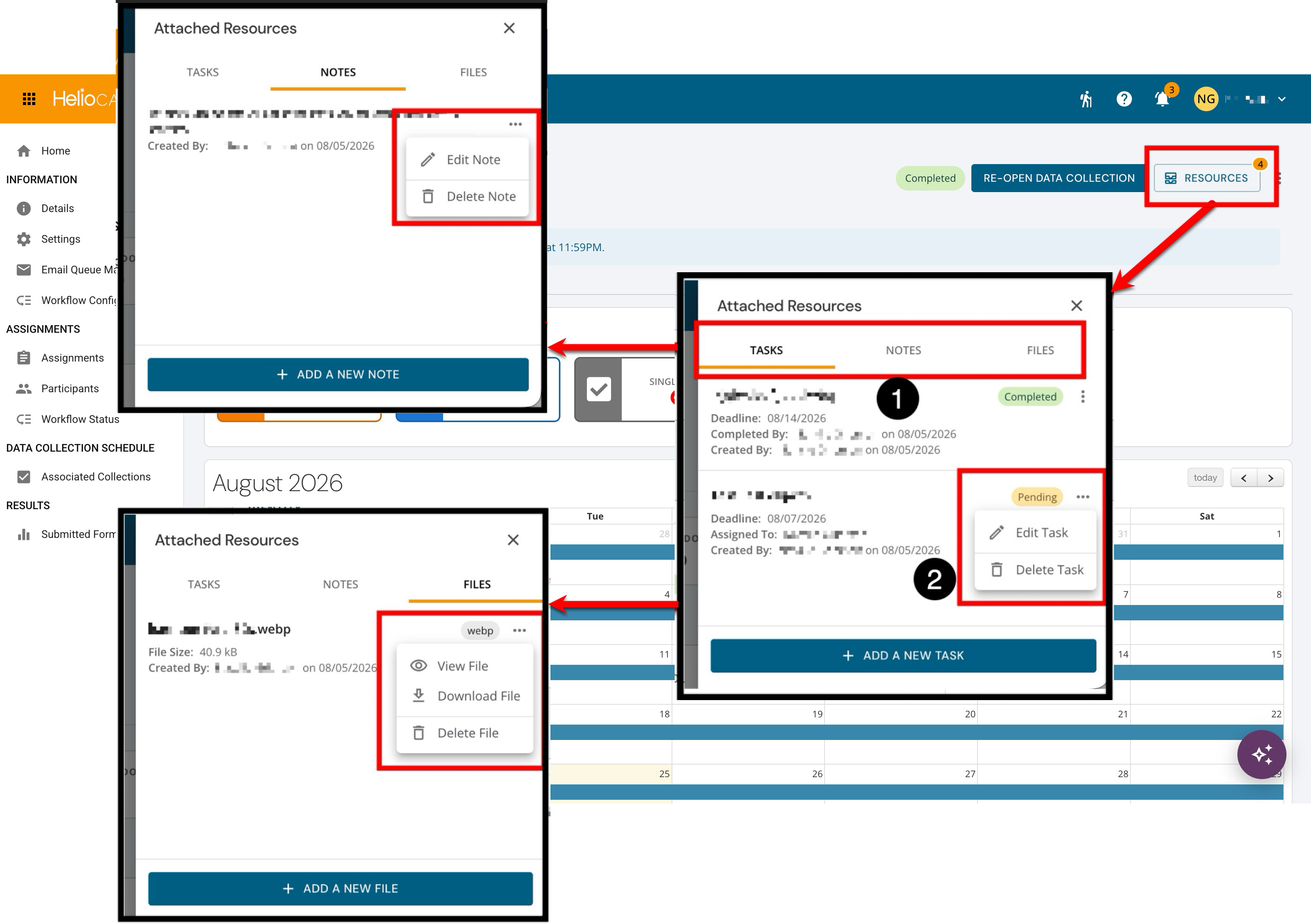
By clicking the Resources button, users can access collection-specific attachments in a centralized drawer with organized tabs for tasks, notes, and files (1), with options to view, edit, or delete, as applicable, by resource type (2). Users can quickly add new resources through the action buttons at the bottom of each tab.
-
Tasks: Displays tasks assigned to the selected collection, with creation and assignment details, due dates, status indicators to track progress, and options to edit or delete tasks.
-
Notes: Provides quick access to all associated notes with timestamps and creation details, with options to edit or delete notes.
-
Files: Displays all attached documents and media, with options to view, download, or delete them.
Data Collection Statuses
Each data collection moves through statuses that reflect where it is in the collection process. Understanding these statuses helps administrators know what can be edited, when forms are distributed, and when to expect user activity.
|
Status |
Details |
|---|---|
|
Pending |
The data collection is newly created. 
|
|
Active |
The data collection has reached its activation date. This status indicates that the collection is preparing for the collection process according to the configured timeline. In this status, administrators can edit dates, email notifications, and business objects. This review period is important because administrators can confirm the collection is configured correctly before participants begin working on the form. 
|
|
In Progress |
The data collection has reached its start date. At this point, the platform generates and distributes collection forms based on the workflow configuration. Participants can work on forms, submit information, and move forms through the workflow. In this status, collections can be stopped from the Homepage. 
|
|
Completed |
The data collection has reached its end date. Once completed, forms are finalized, and further edits are disabled. If additional time is needed, a completed data collection can be reopened from the Homepage, and the end date can be extended. 
|