Colleges are academic components of the Organizational Hierarchy. They are created from the data files HelioCampus receives from an Institution’s Student Information System (SIS), and cannot be manually added to the platform. Colleges are used to organize Departments and programs and to support governance and role-based access at an intermediate level between the Institution and Department. Colleges are accessed by navigating to Main Menu > Organizational Hierarchy > Colleges. Learn more about the Organizational Hierarchy.
Product Tip
If an Institution's organizational structure changes, please contact Support to facilitate implementation. Changes to the Organizational Hierarchy should not be sent to HelioCampus via data files.
Downstream Impacts
At a high level, College settings act as hierarchy-level defaults. When settings are enabled and especially when they are locked at a hierarchy level, they are inherited downstream and prevent configuration at lower hierarchy levels. College decisions can standardize behavior across large parts of the platform.
-
Hierarchy-level defaults and locking: Platform settings can exist at multiple hierarchy levels, and settings can be locked to prevent configuration at lower levels. Learn more.
-
Course-related behavior: College-level Course Settings can be managed from the College Homepage. Changes here can affect courses and course sections associated with the College. Learn more.
-
Survey Behavior: College-level Survey Settings can be managed from the College Homepage. This can influence how surveys behave for the College and its downstream units. Learn more.
-
Reporting and Filtering: Many reports and workflows use “College” as a parameter to filter or group results. This makes configuration important for consistent reporting and to avoid confusion when expected results are to align with organizational responsibility.
-
Cross-Feature Visibility of College/Department Context: Some areas of the platform explicitly surface College and Department associations to help users interpret records and results.
Considerations
Before Configuration:
-
Confirm the Institution’s intended organizational model: which units should be represented as Colleges vs. Departments in SIS, since the platform is reflecting that source structure.
-
Confirm who owns college-level decisions and how changes will be communicated.
During Configuration:
-
Consider whether settings are locked upstream (Institution) or downstream. If a setting is locked at a higher level, college-level edits may not be available or may be overridden by governance decisions.
-
For post-confriguration changes, consider timing relative to in-progress activity (especially for surveys and course-related processes), since mid-cycle changes can create an inconsistent experience across departments.
After Configuration:
-
Periodically validate that College names and codes still align with SIS and expectations, because reporting and filtering often rely on those labels.
Best Practices
-
Treat Colleges as a source-of-truth (SIS-managed) structure. Since Colleges are created from SIS files rather than manually added, establishing naming conventions and governance with the SIS/data owners early and maintaining those conventions over time is generally recommended.
-
Use College-level settings when the goal is consistent behavior across multiple Departments within a College. Use locking only when consistency is required, and decentralization would create support or reporting problems.
-
For settings that influence course, survey, or reporting behavior, set College defaults early to reduce downstream rework and exceptions.
College Manager
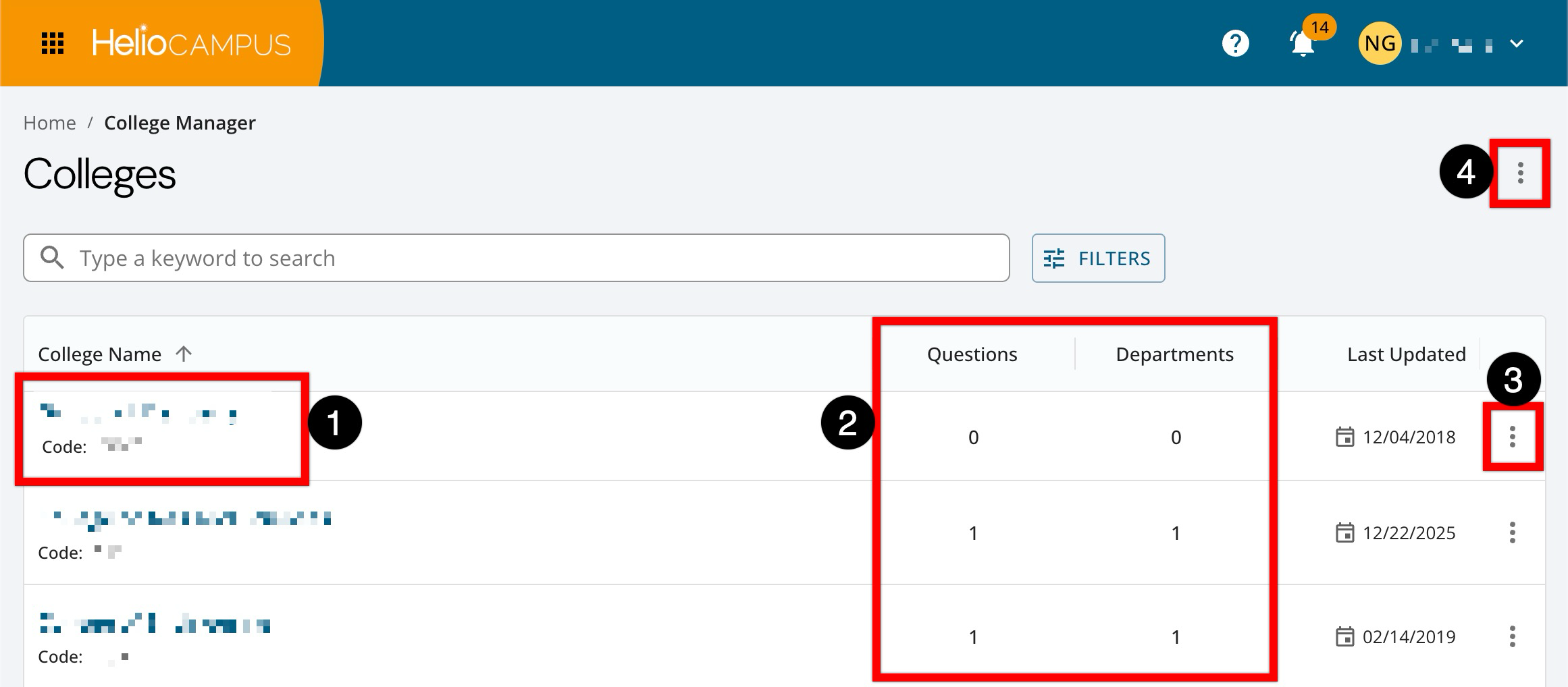
The manager displays a record's name and code; clicking the name (1) will display the homepage. Summary columns (2) provide quick counts of associated records, and by expanding the Actions menu (3), additional information can be viewed without navigating to the homepage by clicking View Details. Export functionality is available by expanding the More Options menu (4) to export the manager to CSV format.
College Homepage
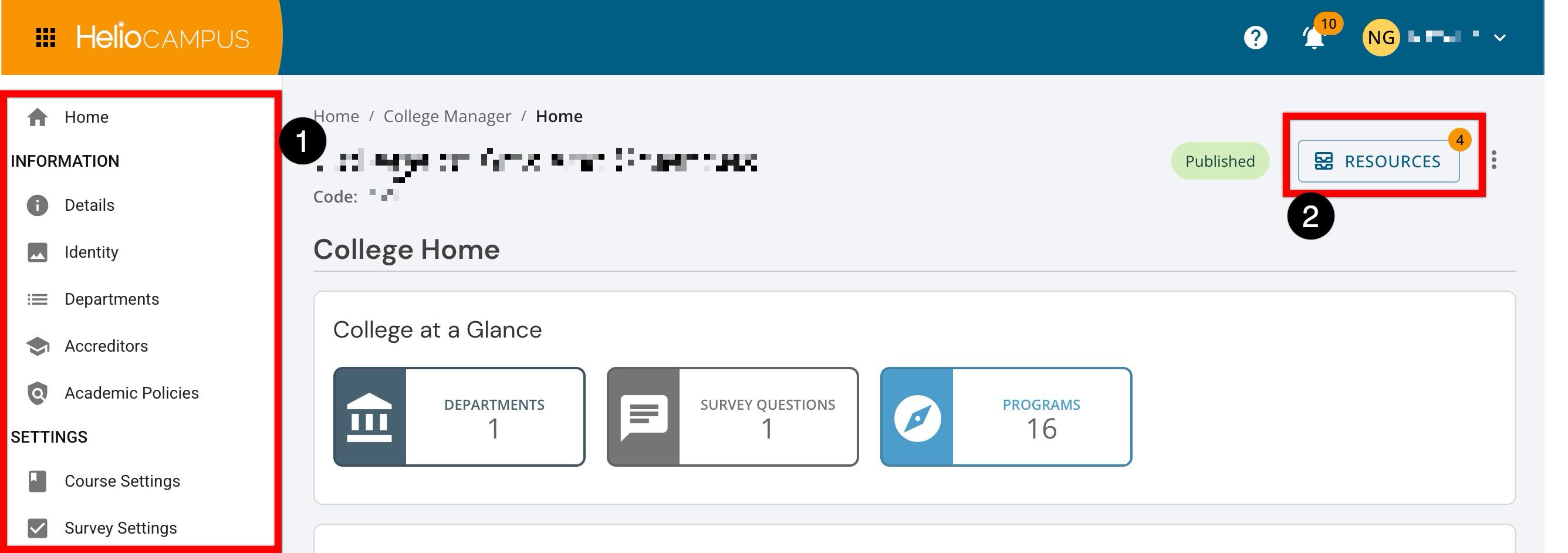
The homepage is the landing page for hierarchy-level-specific administration. In addition to serving as a central "at-a-glance" page, it surfaces summary metrics and visualizations that help confirm the structure and activity at a given hierarchy level. This page is the access point for level-specific configurations and settings that support ongoing operations.
The left-hand menu is the hierarchy-level navigation menu (1), organized into sections of configuration points and settings. The Information section is used to review and maintain core record information and level-specific setups. Below the Information section, various settings menus provide access to level-specific configurations that define defaults and behavior that apply broadly across the hierarchy level. At the top right of the homepage, there is a Resources button (2) that provides a centralized place to access supporting tools and links related to the hierarchy level.
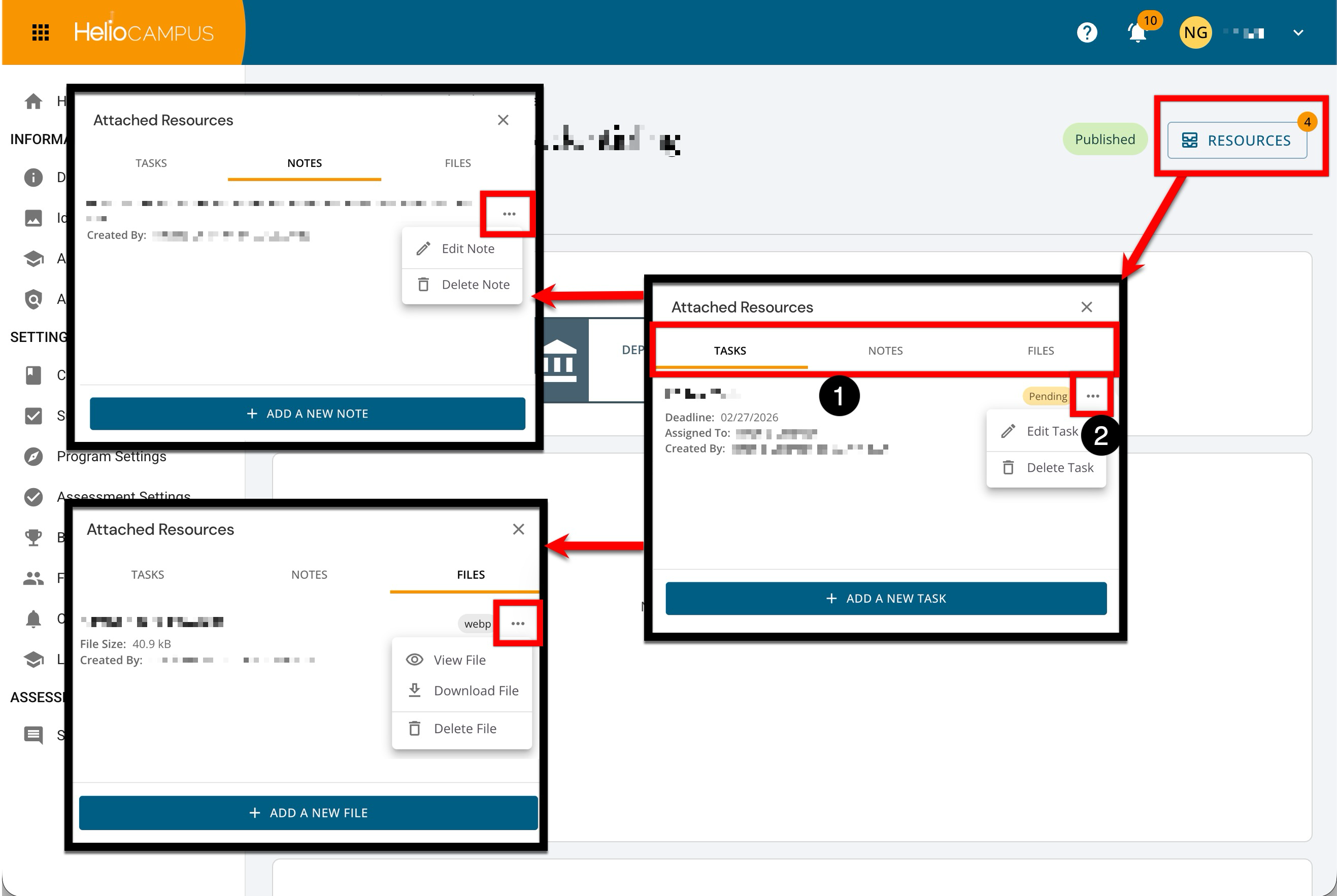
By clicking the Resources button, all level-specific attachments can be accessed in a centralized drawer with organized tabs for tasks, notes, and files (1) with options to view, edit, or delete, as applicable, by resource type (2). New resources can be added quickly through the action buttons at the bottom of each tab.
-
Tasks: Displays tasks assigned to the selected hierarchy level, with creation and assignment details, due dates, status indicators to track progress, and options to edit or delete tasks.
-
Notes: Provides quick access to all associated notes with timestamps and creation details, with options to edit or delete notes.
-
Files: Displays all attached documents and media, with options to view, download, or delete them.