Once Juried Assessment is enabled in a program, the Rubric Alignment page becomes available, allowing Administrators or Program Coordinators to create relationships between outcomes, Juried Assessment rubrics, and courses to facilitate scoring by Assessors.
Rubric alignment is designed to:
-
Connect the correct rubric to the Program so the rubric can be used in the Juried Assessment workflow.
-
Support consistent evaluation by ensuring assessors use the same criteria and performance levels when scoring artifacts.
-
Preserve assessment data integrity by encouraging clients to finalize rubric structure before scoring begins.
-
Improve reporting clarity by aligning rubric criteria to the intended outcomes being assessed.
Rubric alignment can impact:
-
Juried Assessment Setup: The aligned rubric becomes part of the evaluation structure used for the assessment.
-
Assessor Scoring: Assessors use the rubric criteria and performance levels to evaluate artifacts.
-
Inter-Rater Reliability: Clear rubric criteria and performance levels can help assessors score more consistently.
-
Adjudication: If assessor scores vary, the rubric may be used during review or resolution workflows.
-
-
Assessment Reporting: Rubric scores may roll into outcome-level results used for program review, accreditation, or continuous improvement.
Considerations
-
Alignment Before Scoring: Rubric alignment should be completed before Juried Assessment scoring begins to ensure the correct rubric is available for evaluation. The aligned rubric defines the criteria and performance levels assessors will use when reviewing student artifacts, so it should be reviewed carefully before it is saved.
-
Prior Confirmation: Before aligning a rubric, clients should confirm that:
-
The rubric criteria match the outcome or outcomes being assessed.
-
Performance levels are clearly defined and easy for assessors to interpret.
-
The rubric is appropriate for the artifact type being reviewed.
-
The rubric is ready for use before scoring begins.
-
Any rubric that has already been used for scoring is handled carefully to preserve historical assessment data.
-
Downstream and Cross-Platform Impacts
-
Change to Rubric Structure: Rubric Alignment can affect several downstream areas of the Juried Assessment workflow. Because the aligned rubric is used during scoring, changes to the rubric structure may affect assessor scoring, reliability results, adjudication workflows, and reporting.
-
LMS-Sourced Artifacts: Institutions using LMS-sourced artifacts should understand that rubric alignment does not create, update, or push rubrics into the LMS. Rubrics used in the platform’s assessment workflows should be managed in the platform; if Instructors need to score with LMS rubrics, those rubrics should be created and managed in the LMS according to the LMS process.
-
LMS and Assignment Types: Cross-platform behavior may vary based on the LMS and assignment submission type. Before using rubric-aligned Juried Assessment workflows for high-stakes assessment or accreditation reporting, Institutions should confirm that the appropriate assignments, artifacts, and submission types are supported and available for assessment.
Best Practices
-
Avoid changing rubric criteria or levels after scoring has started.
-
Confirm which outcomes are being assessed before selecting or creating a rubric.
-
Criteria should be specific, measurable, and aligned to the intended student learning outcome.
-
Assessors should be able to distinguish between each level without relying on interpretation or guesswork.
-
Faculty, assessors, and administrators should understand which artifacts are being assessed, which rubric will be used, and what actions they need to complete.
-
If the same rubric will be used across multiple programs, cycles, or similar assessments, consider maintaining it as a reusable rubric.
-
Confirm that the correct program, rubric, outcomes, course sections, assignments, and artifacts are available before scoring begins.
Reviewing and Understanding Alignment
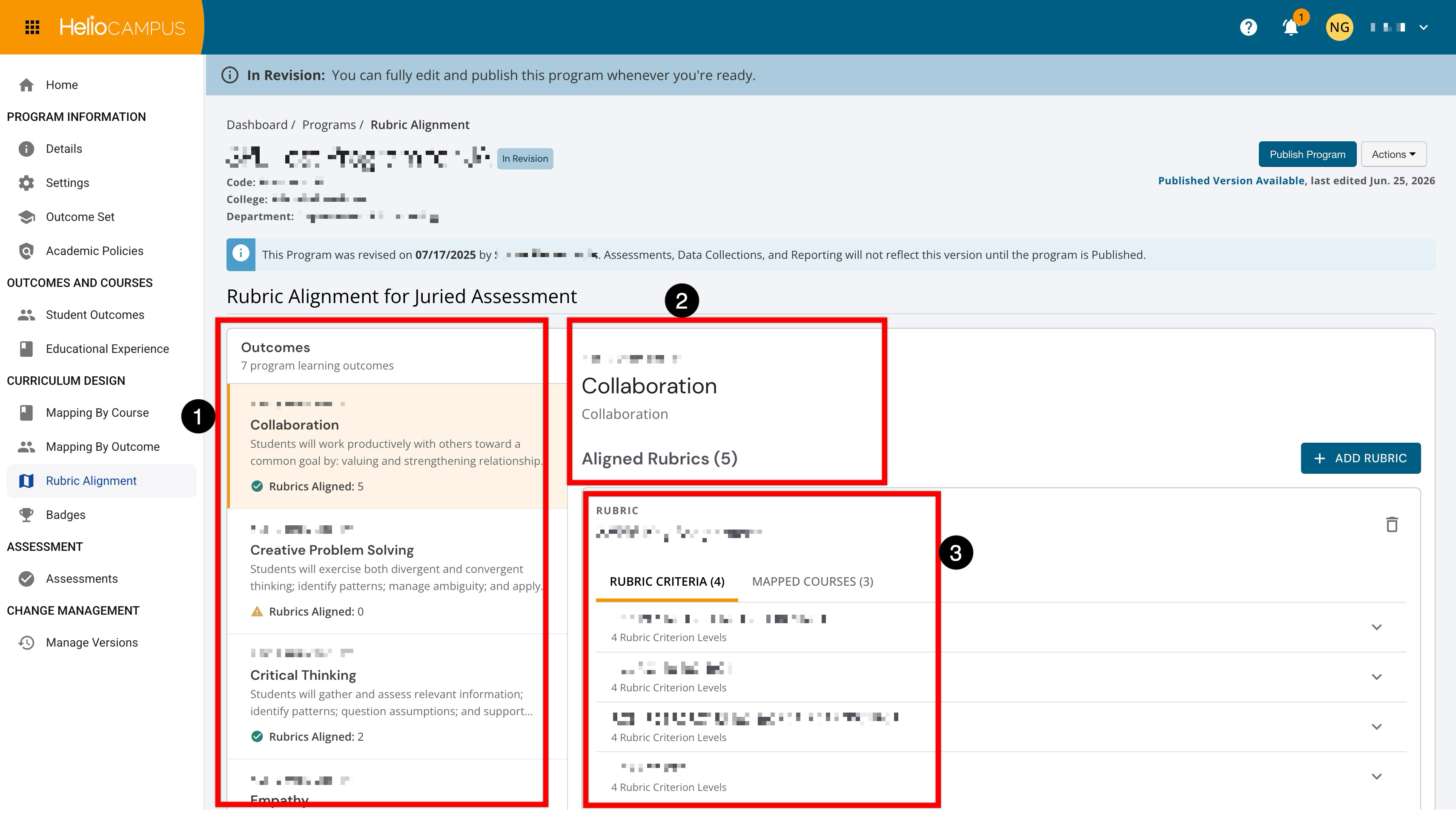
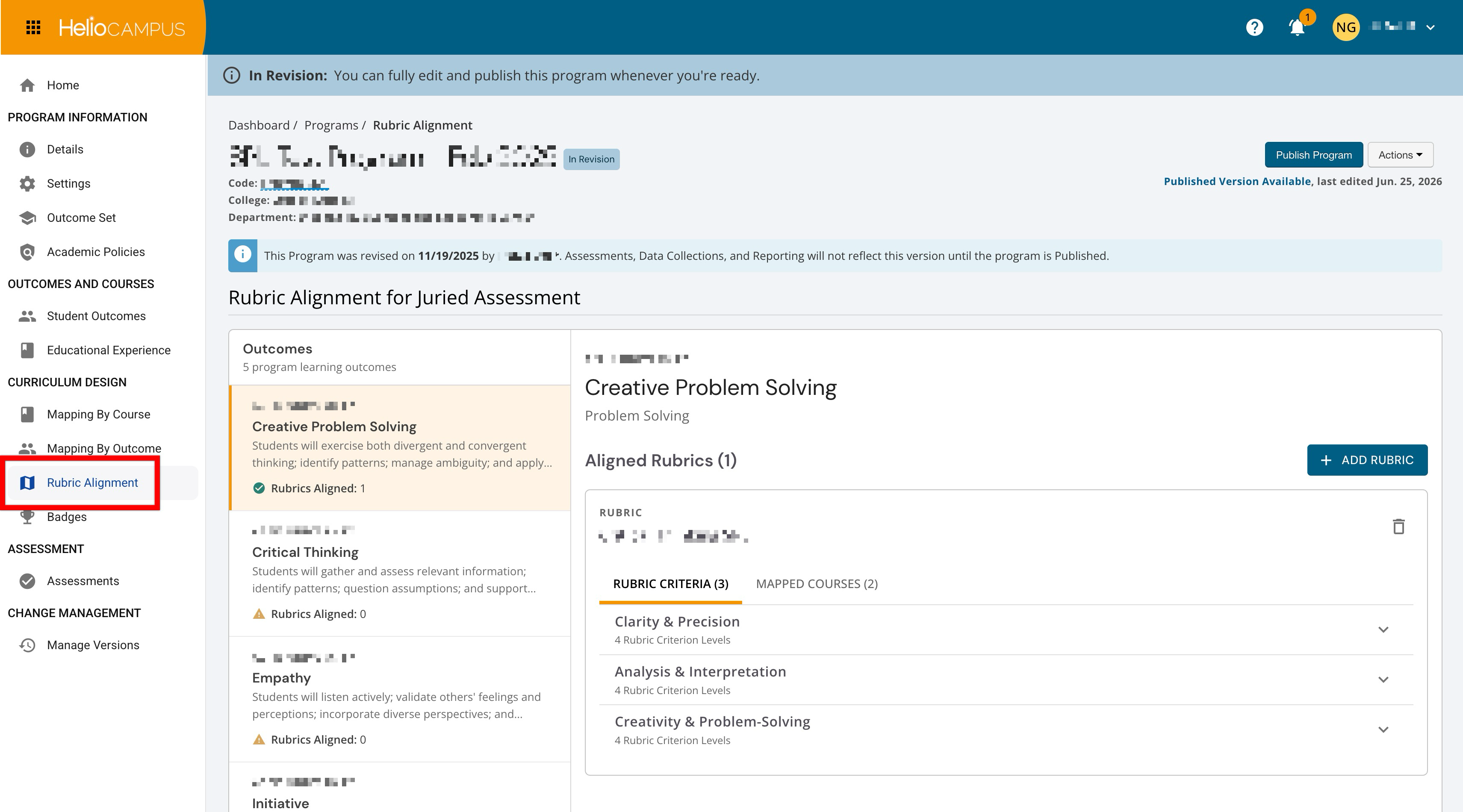
The left side displays the program outcomes that are available for alignment (1). Each outcome includes the name, description, and the number of rubrics currently aligned to that outcome. Selecting an outcome updates the right panel so users can review the rubrics associated with that outcome, followed by the Aligned Rubrics section, which lists each rubric aligned to the selected outcome (2). Each rubric includes the name and description to understand how the rubric is connected to the outcome (3); if multiple rubrics are aligned to the same outcome, each rubric appears as a separate item in the aligned rubric list.
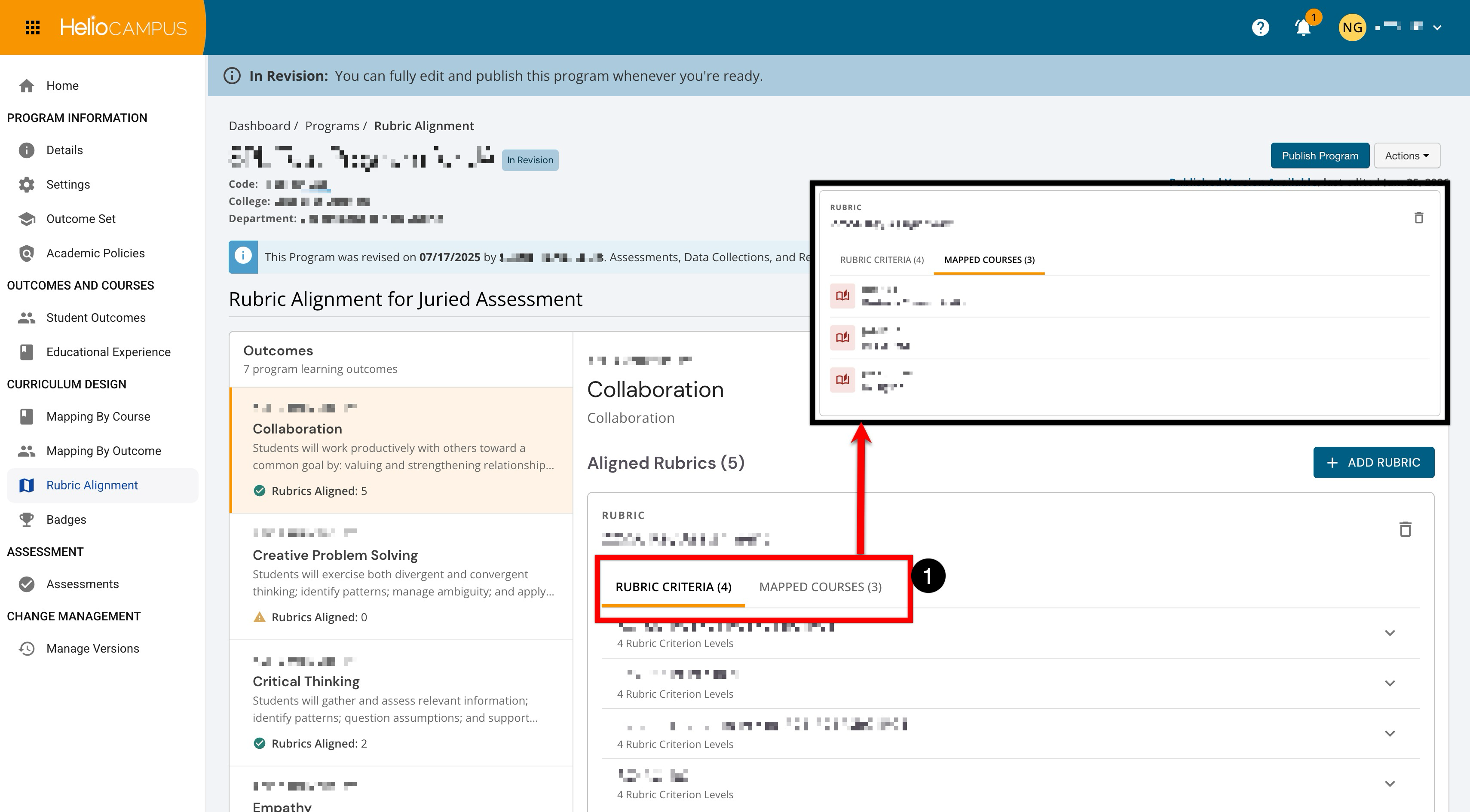
Each aligned rubric includes tabs for reviewing association information.
-
Rubric Criteria: Displays criteria included in the rubric. Criteria are the specific skills, behaviors, or areas of performance that assessors will use when evaluating student artifacts. Reviewing this tab helps users confirm that the rubric criteria support the selected outcome and that the rubric is appropriate for the Juried Assessment workflow.
-
Mapped Courses: Displays courses associated with the selected outcome. This helps users understand where the outcome is being assessed across the curriculum and which courses may contribute artifacts for Juried Assessment. Reviewing mapped courses can help confirm that the rubric alignment supports the intended assessment plan.
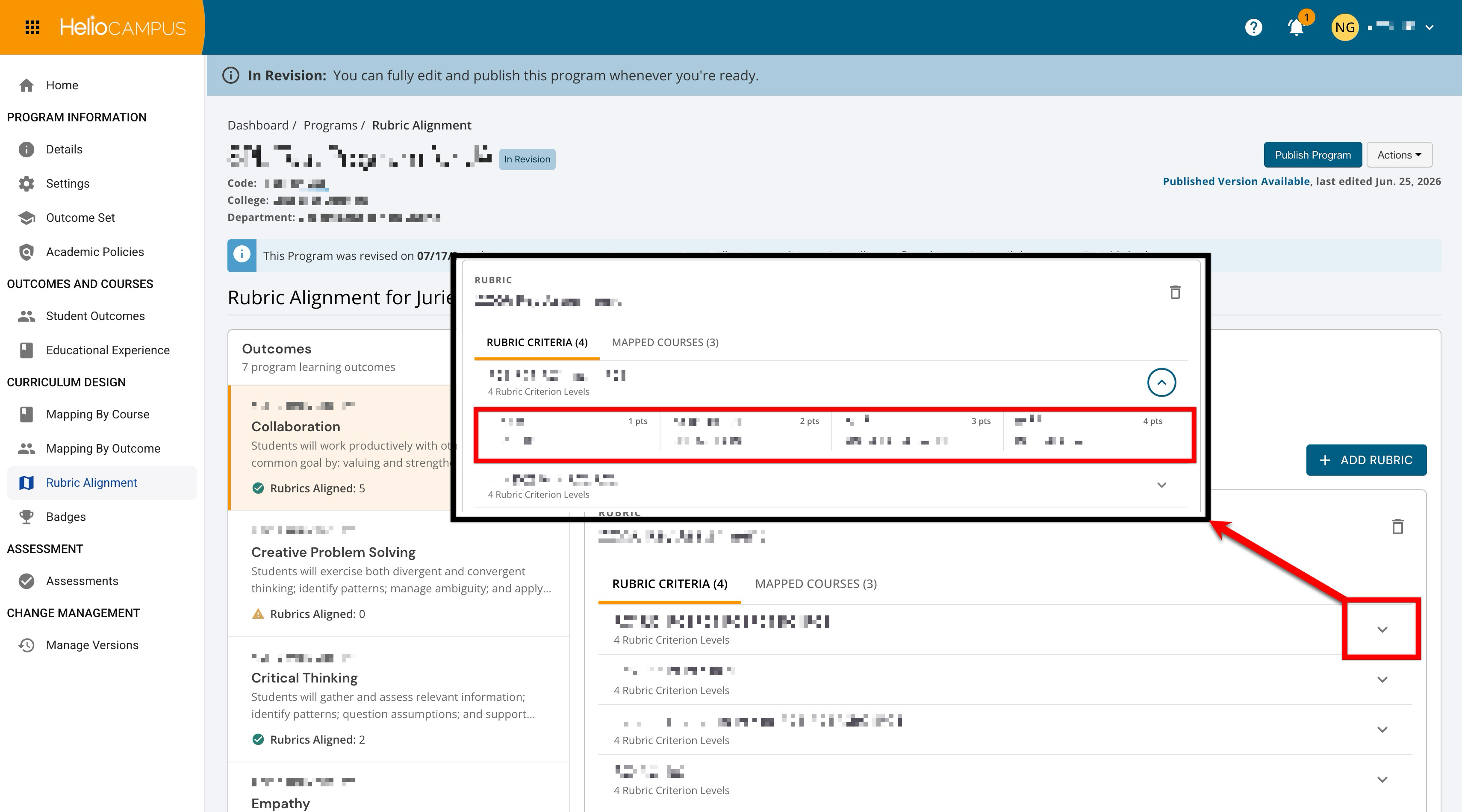
Rubric criterion can be expanded to display the performance levels associated with that criterion. Performance levels describe the scoring options available to assessors, such as increasing levels of achievement or proficiency. Expanding the criterion allows users to review the level descriptions and point values before the rubric is used in assessment. This is especially helpful when confirming that assessors will have enough information to apply the rubric consistently.
Align to an Existing Rubric
-
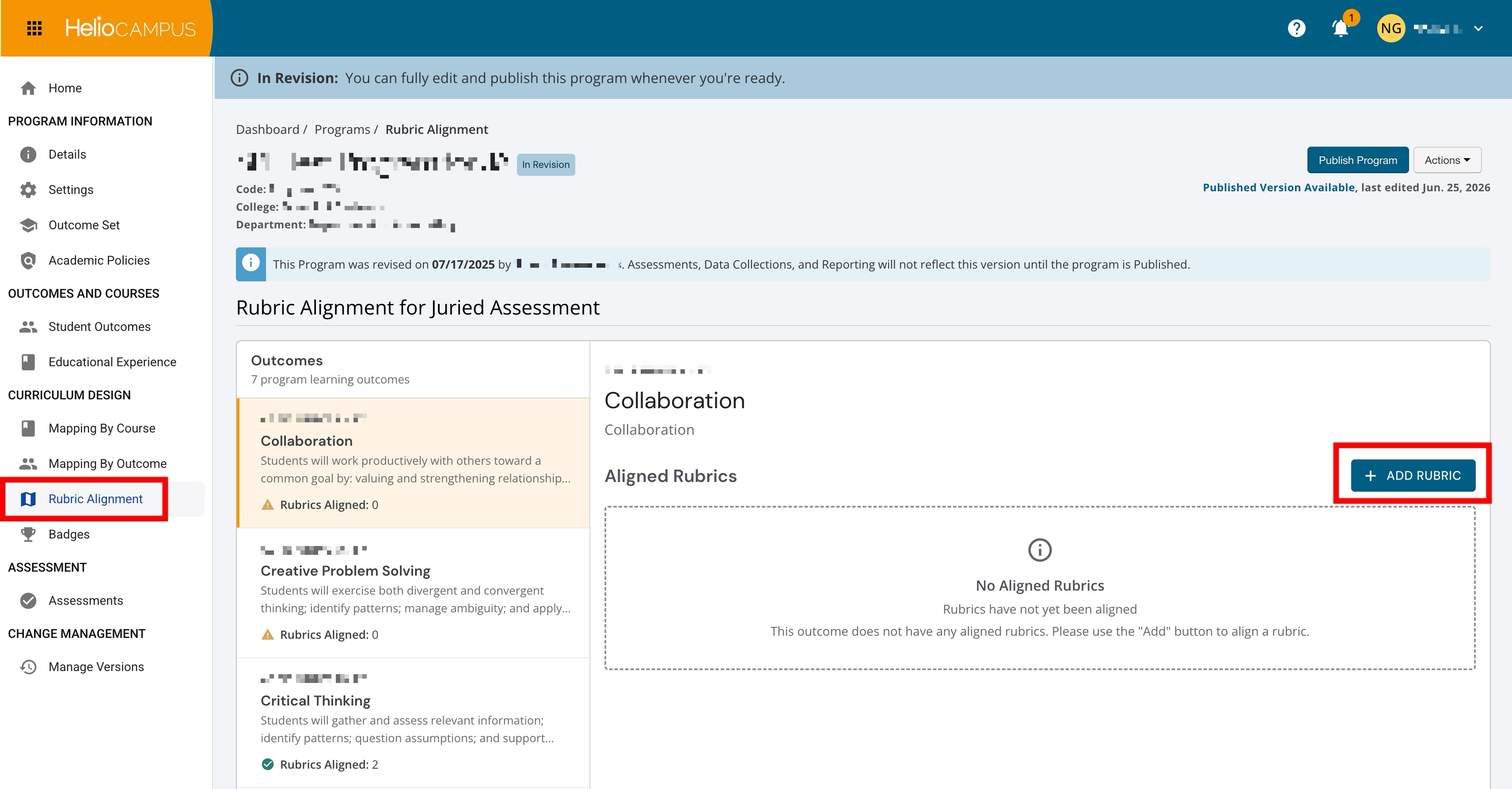
To align a rubric to a program, navigate to the program home, select the Rubric Alignment page, and click Add Rubric.
-
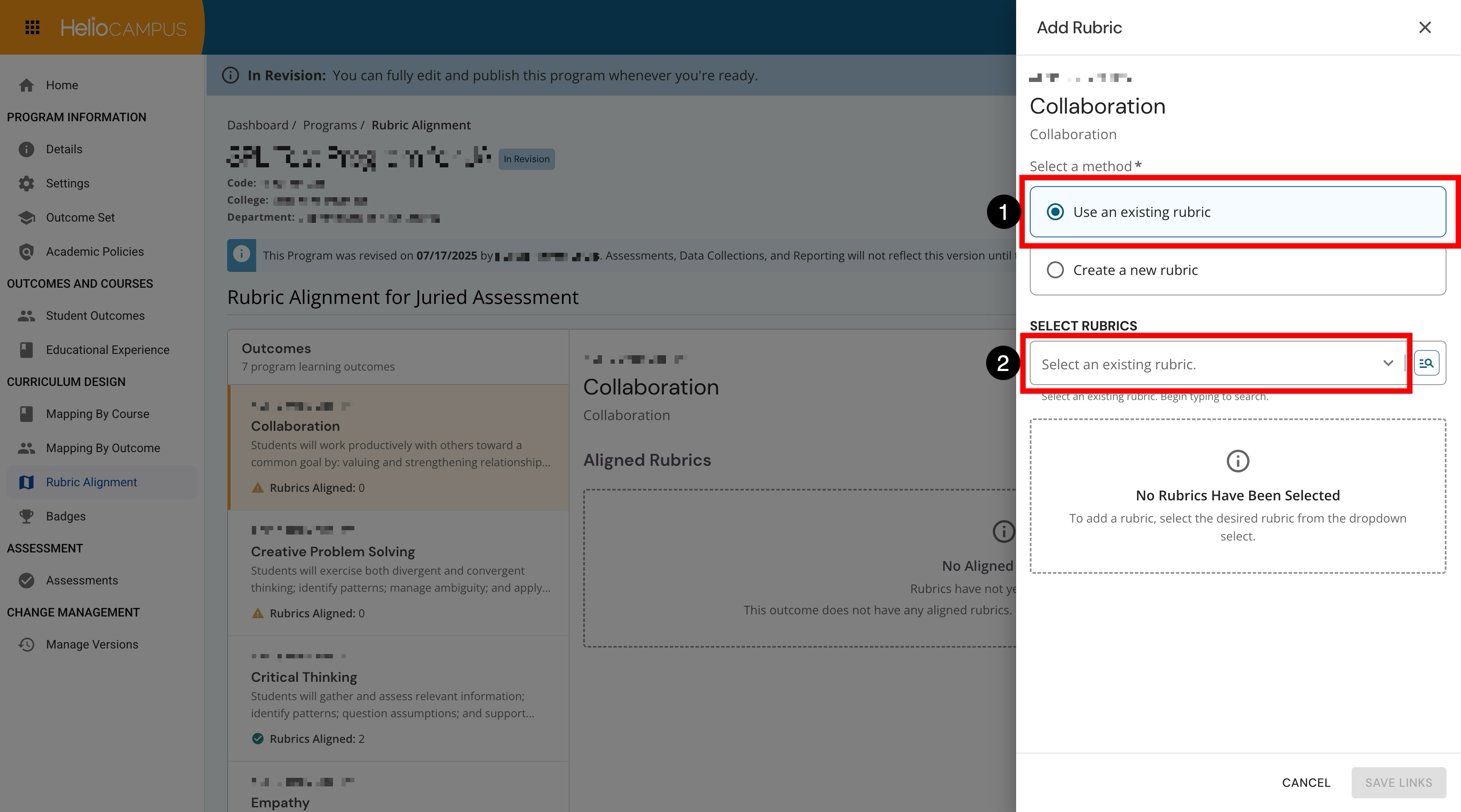
Select to use an existing rubric (1), then search for and select one or more rubrics (2).
-
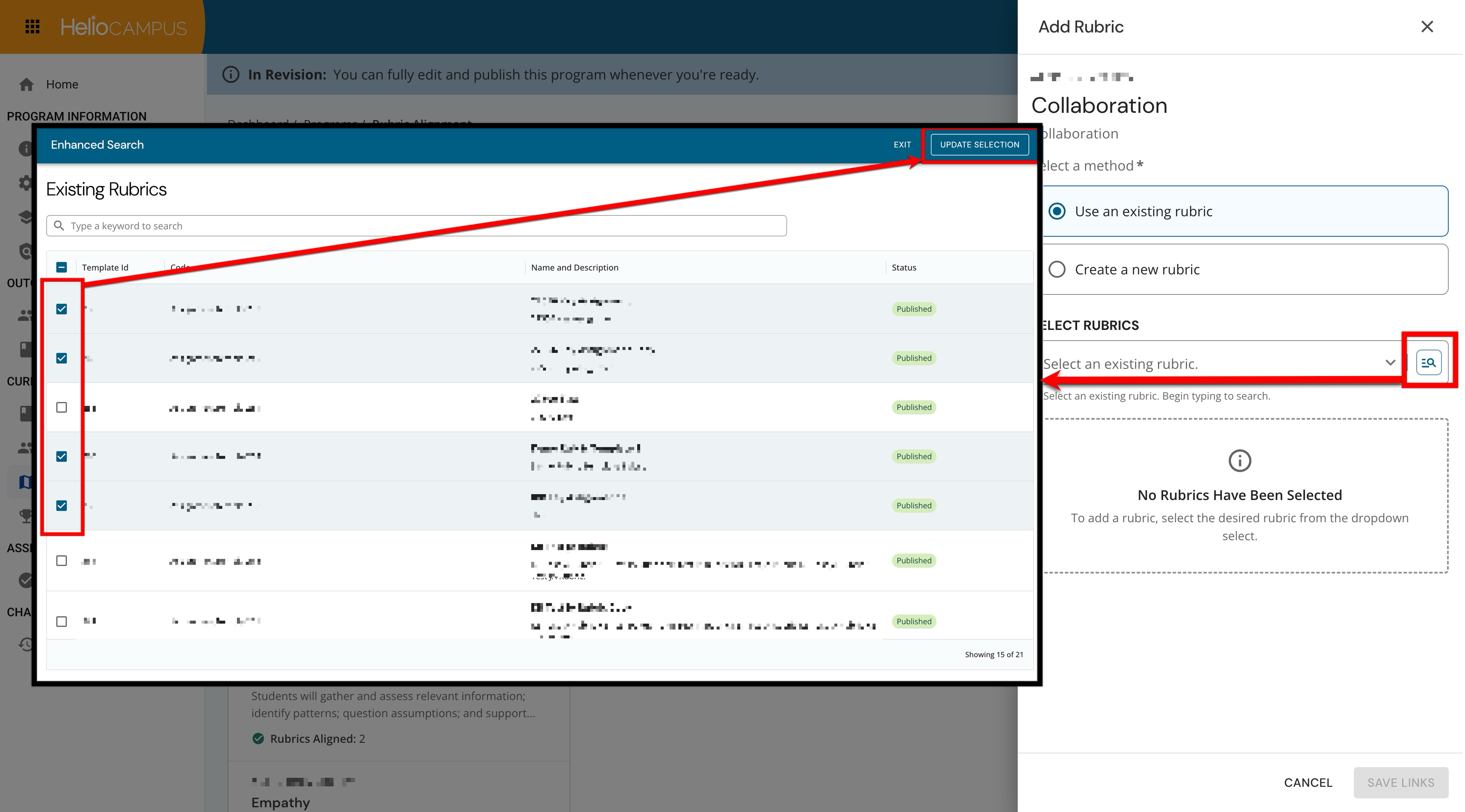
When using the enhanced search, search functionality is available, and specific filters can be applied (1). Once filters have been applied, they will display below the search bar and can be removed individually or in bulk (2). Rubrics can be selected in bulk (3) or individually (4).
-
-
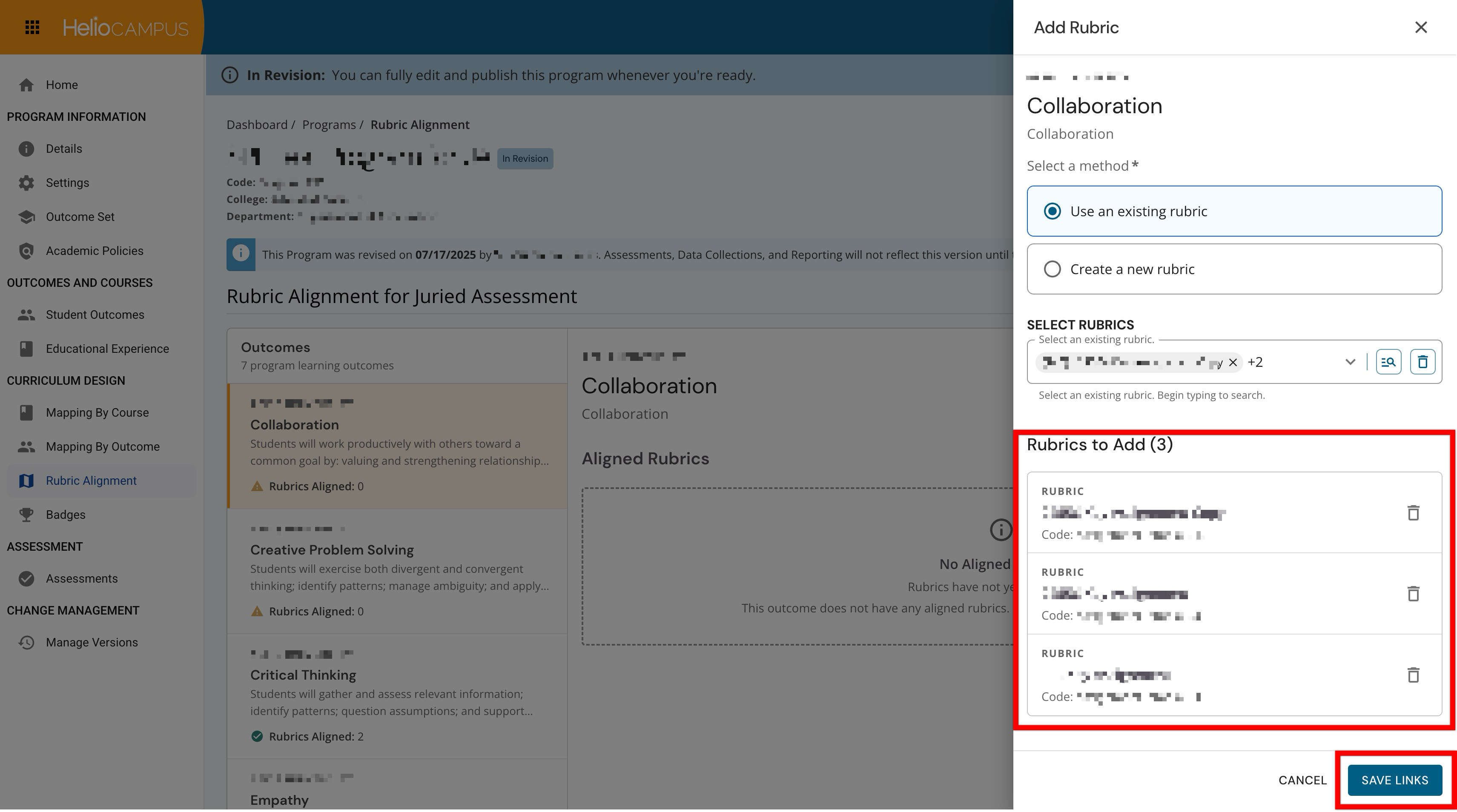
The selected rubrics will display and should be reviewed before clicking Save Links. Once saved, the selected rubric will be aligned to the program and can be used as part of the Juried Assessment workflow.
-
Create and Align to a New Rubric
-
To align a rubric to a program, navigate to the program home, select the Rubric Alignment page, and click Add Rubric.
-
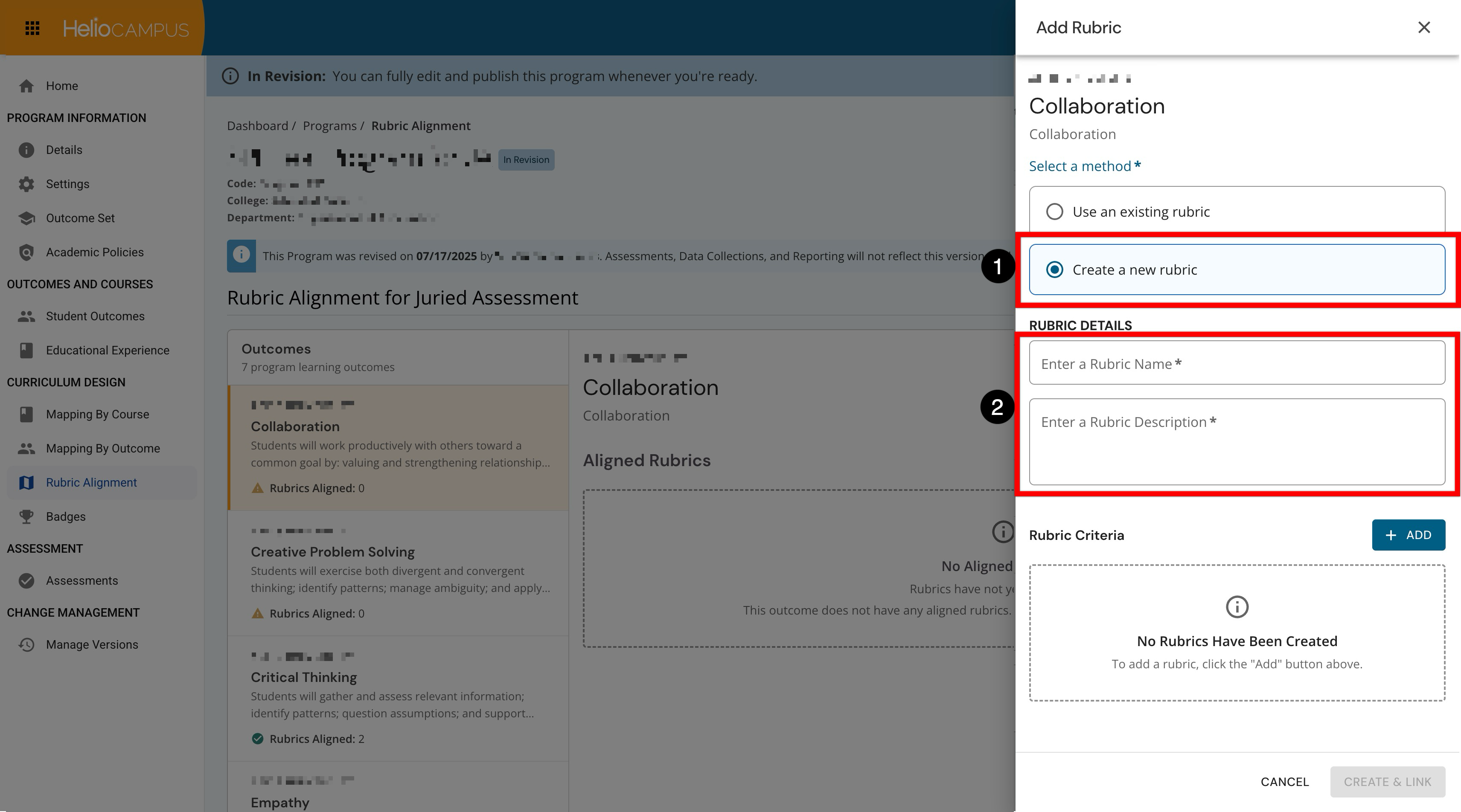
Select the option to create a new rubric (1) and enter the required rubric details (2).
-
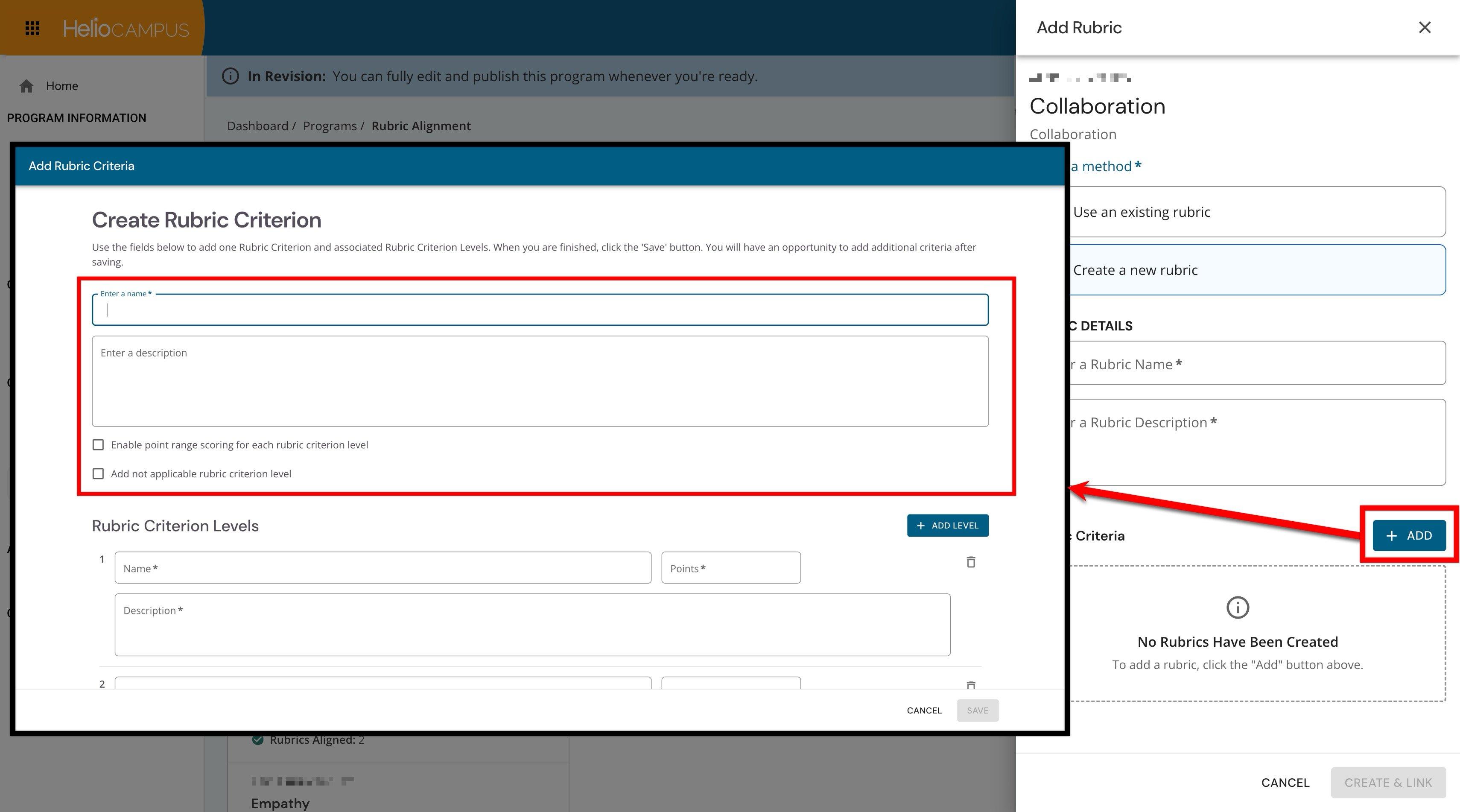
Click Add to configure the new rubric criterion title, description, and optional criterion level configurations. While a description is not required, descriptions can help users to understand how the rubric is connected to the outcome.
-
Enabled Point Range Scoring For Each Criterion Level: Allows each criterion level to use a range of possible point values instead of a single fixed point value. This is useful when assessors need flexibility to assign a score within a level, such as 3–4 points, instead of selecting one exact point value.

-
Add Not Applicable Rubric Criterion Level: Adds a Not Applicable level to the criterion. This gives assessors an option to mark the criterion as not applicable when that criterion should not be scored for a specific artifact or submission. Typically, a not applicable selection is not treated the same as a scored performance level.

-
-
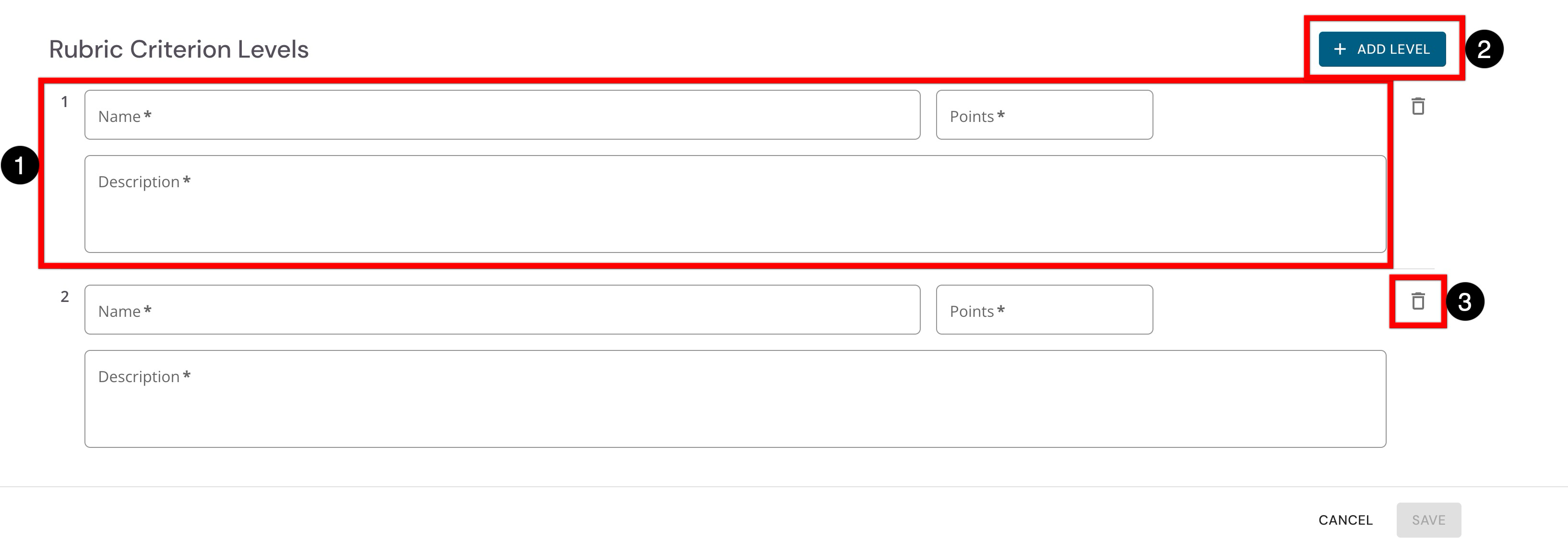
Enter the required rubric information (1). Additional levels can be added by clicking Add Level (2), or unnecessary levels can be removed (3). Clicking Save will add the criterion levels to the new rubric.
-
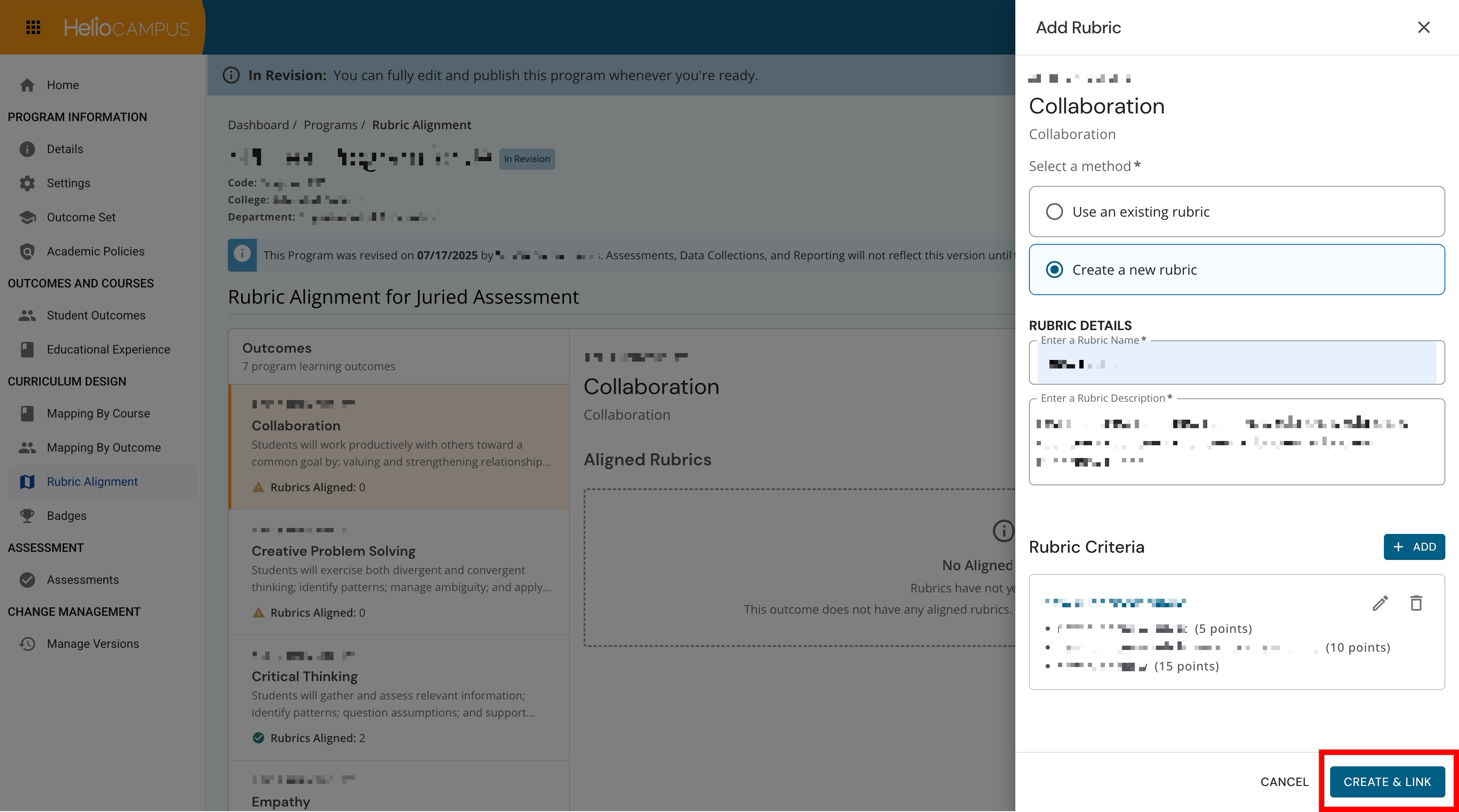
The newly created criteria will display and should be reviewed before clicking Create & Link. Once saved, the new rubric will be aligned to the program and can be used as part of the Juried Assessment workflow.
-
Remove an Aligned Rubric
-
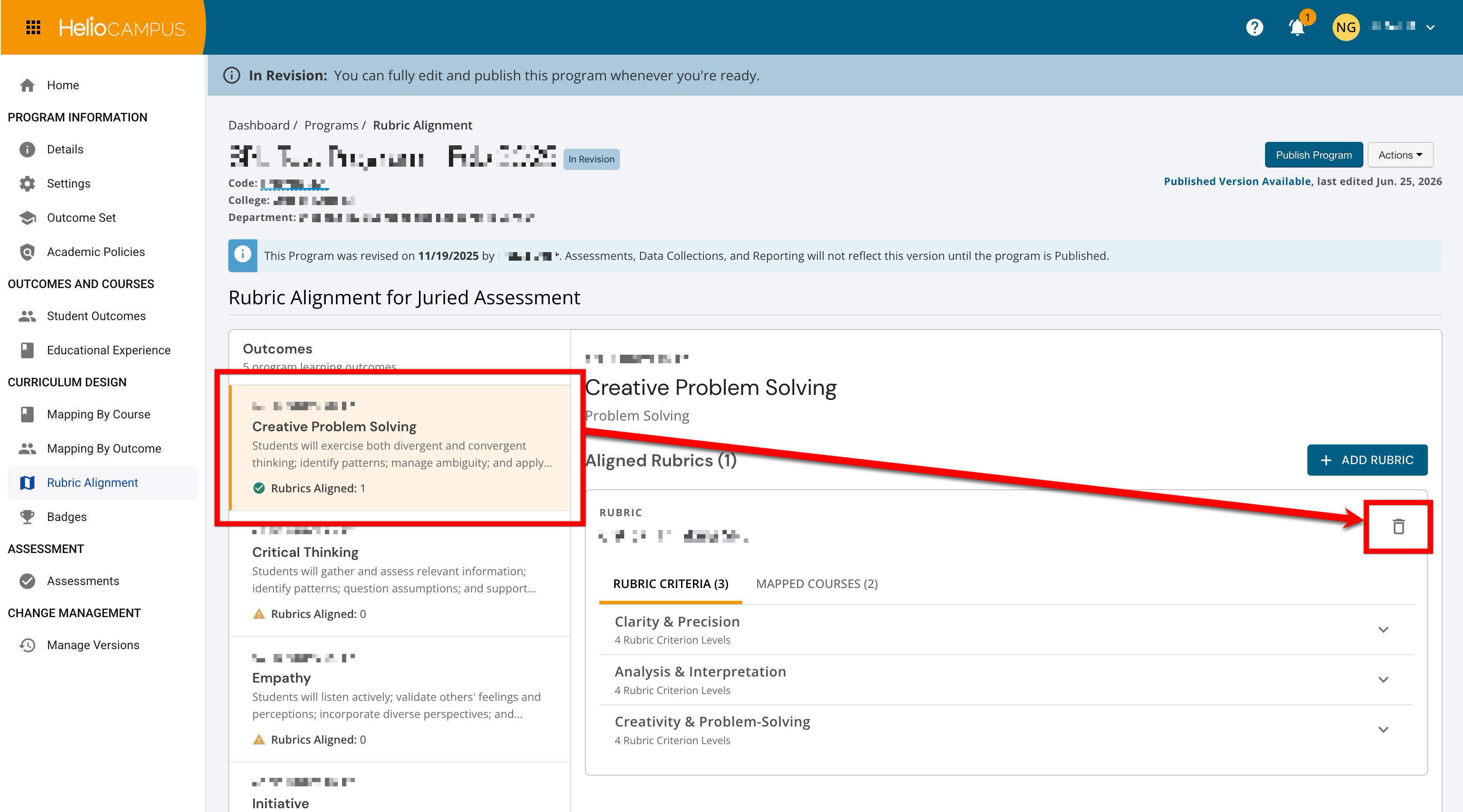
To remove an aligned rubric, navigate to the program home and select the Rubric Alignment page.
-
Select an outcome and click the Delete option.