
The Settings page is used to review and manage the instance-level configuration for a data collection. These settings control when the collection is available, how workflow tasks are communicated, and how participants are reminded to complete their assigned work. A collection is a specific collection cycle or workflow generated from a data collection schedule. The schedule provides the original structure and default values, while the Settings page lets authorized administrators review or adjust eligible settings for the current instance.
Downstream and Cross-Platform Impacts
-
Form Availability: Activation and start dates determine when forms are generated and distributed.
-
Participant Access: Invitation and task notifications direct users to assigned collection work.
-
Workflow Progression: Notification method and stage settings influence how users respond as forms move between workflow steps.
Considerations
-
Action Items: A form may be available in a user’s Action Items before the related email notification is delivered.
-
Editing Limitations: Settings inherited from a schedule may be limited or unavailable for editing after the collection becomes active or reaches a later status.
-
Instance-Level Changes: Changes made on the instance Settings page affect the current collection; they do not automatically change future instances created from the schedule.
-
Workflow Overrides: Workflow Configuration can override corresponding notification settings on the Settings page.
-
Notification Content: Verify dynamic text and links before enabling a notification so recipients receive accurate information.
-
Reminder Timing: Reminder frequency is calculated from the collection start date, and reminder messages are not sent on the start date.
-
Email delivery: Notifications may be delivered after a form becomes available in Action Items because emails are processed daily.
Best Practices
-
Review the Settings page before the activation and start dates. Confirm dates, ownership, assignments, and workflow notification behavior together.
-
Use schedule-level changes for recurring defaults and instance-level changes for one-time exceptions.
-
Test notification wording, links, and dynamic text before launching a new workflow.
-
Disable notifications in both the Settings page and Workflow Configuration when no email should be sent.
User Role Access and Permissions
|
User Role |
Capabilities |
|---|---|
|
Institution Admin |
Review and manage eligible settings for Data Collections within the Institution’s authorized scope. |
|
College Admin |
Manage eligible settings for Data Collections owned by the College or associated Departments. |
|
Department Admin |
Manage eligible settings for Data Collections owned by the Department. |
|
Other Authorized Administrative Roles |
Access or edit available settings according to organizational scope, configuration, and permissions. |
|
Participants and Reviewers |
Do not administer instance settings. They receive notifications and access assigned forms based on the configured dates and workflow. |
Data Collection Schedule Settings
Data collection dates are inherited from the related collection schedule. The available date fields and whether they can be edited depend on the collection status, the schedule configuration, and the administrator’s permissions. Review the dates before the collection becomes active to confirm that the schedule matches the intended cycle. Changes to activation, start, or end dates may affect form availability, invitations, reminders, deadlines, and when the Data Collection moves between statuses.
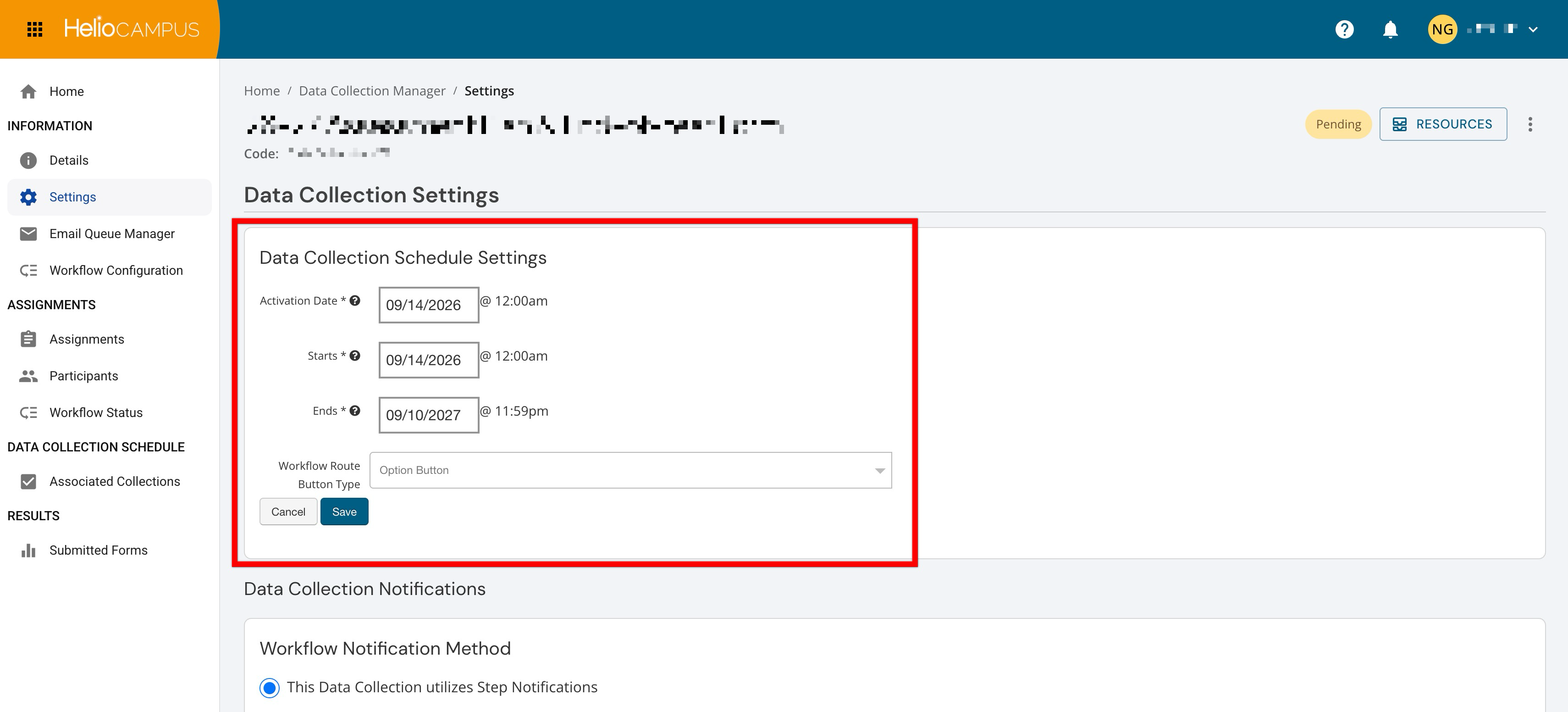
The dates are displayed in the Institution’s timezone. These dates are typically inherited from the collection schedule but may be editable for the current instance, depending on its status and the administrator’s permissions.
|
Activation Date |
Determines when the collection becomes active. After this date, some settings may no longer be editable. |
|
Starts |
Determines when the collection opens for participants. Forms are generated and distributed, and participants can begin their assigned work. |
|
Ends |
Determines when the collection closes. The collection remains available through the specified end time; after that, it can move to a completed or finalized state. |
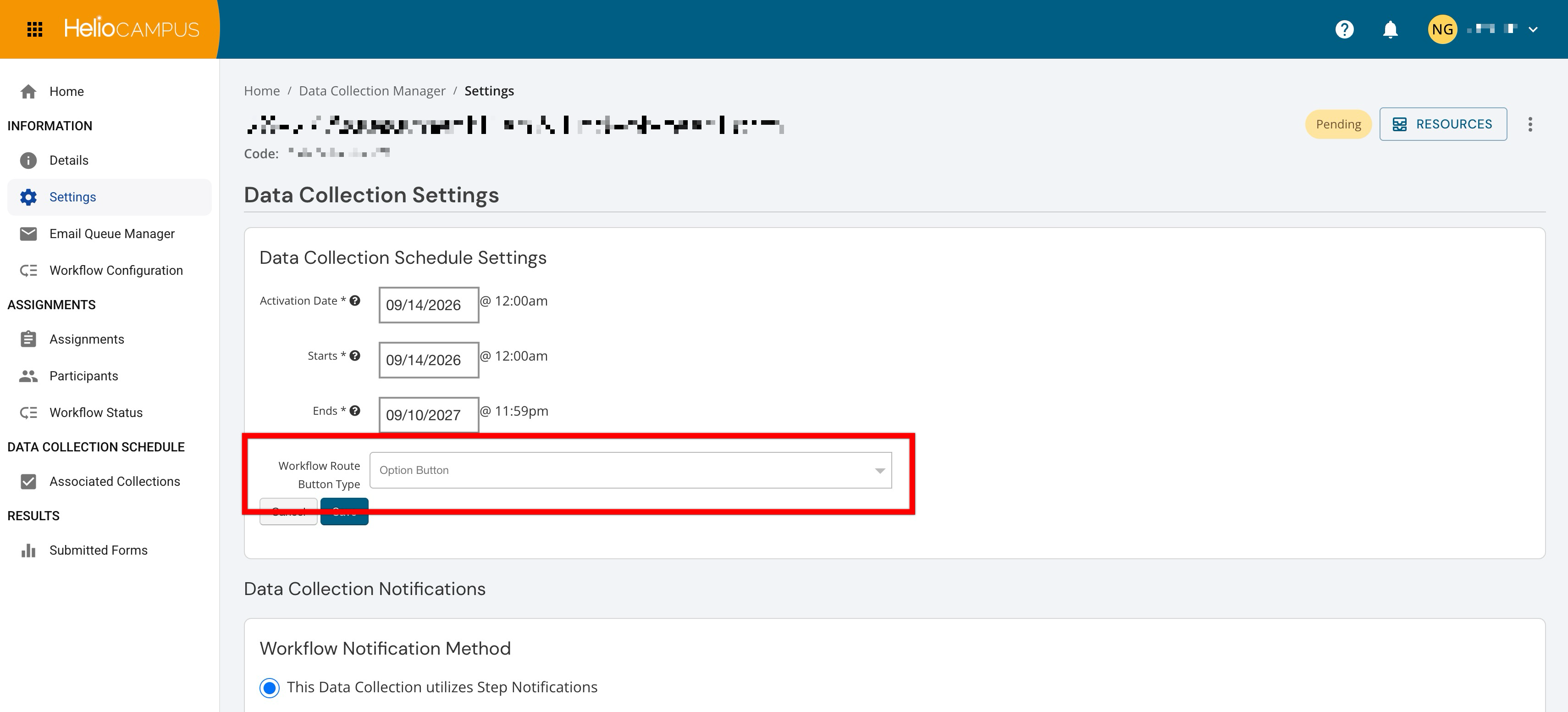
The Workflow Route Button Type setting controls how workflow routing choices are displayed to users. It does not change the workflow logic or destinations. If a workflow has only one possible next step, this setting may have little or no visible effect. The route labels (such as Approve, Reject, or Send Back for Revisions) are configured in the workflow and can be customized independently of how they are displayed. Both options provide the same routing choices; they only change how those choices appear to the user.
For example, a reviewer might choose Approve to move the form forward or Send Back to return it for revisions. In the screenshot, the setting is Option Button, which means the available workflow routes are presented as selectable option buttons. The user selects one route before submitting the form.
|
Option |
Result |
|---|---|
|
Option Button |
Displays the available routes horizontally as buttons. For example, a user might see Approve and Send Back as side-by-side buttons. 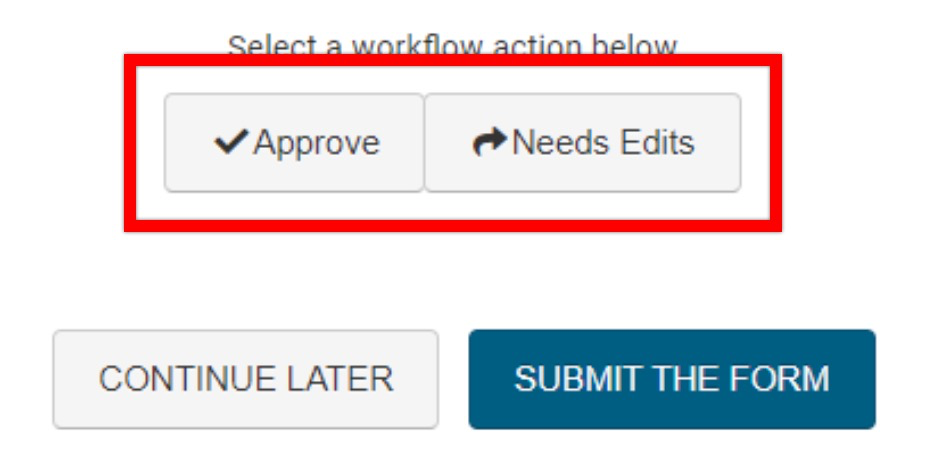
|
|
Radio Button |
Displays the available routes as selectable radio-button choices, typically in a vertical list. The user selects one choice and then submits the form. 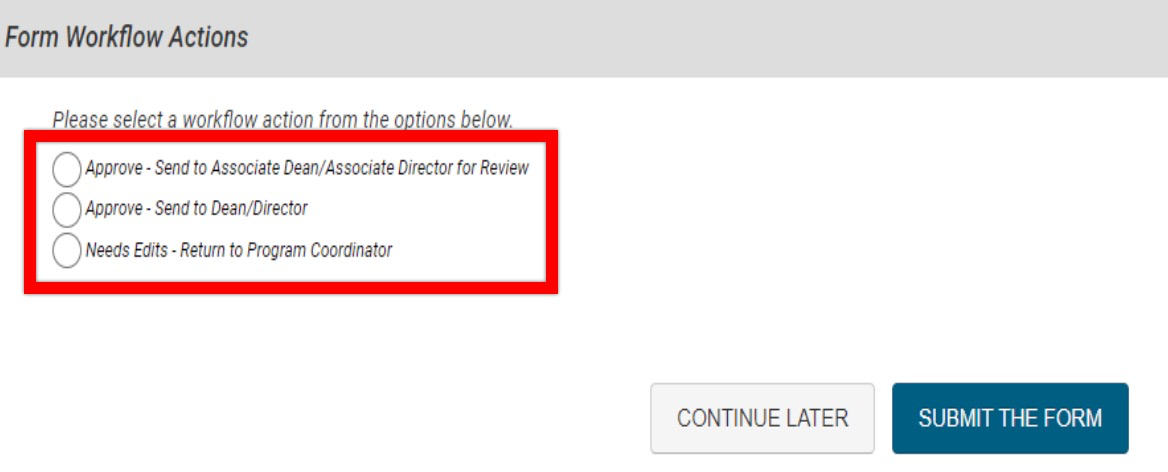
|
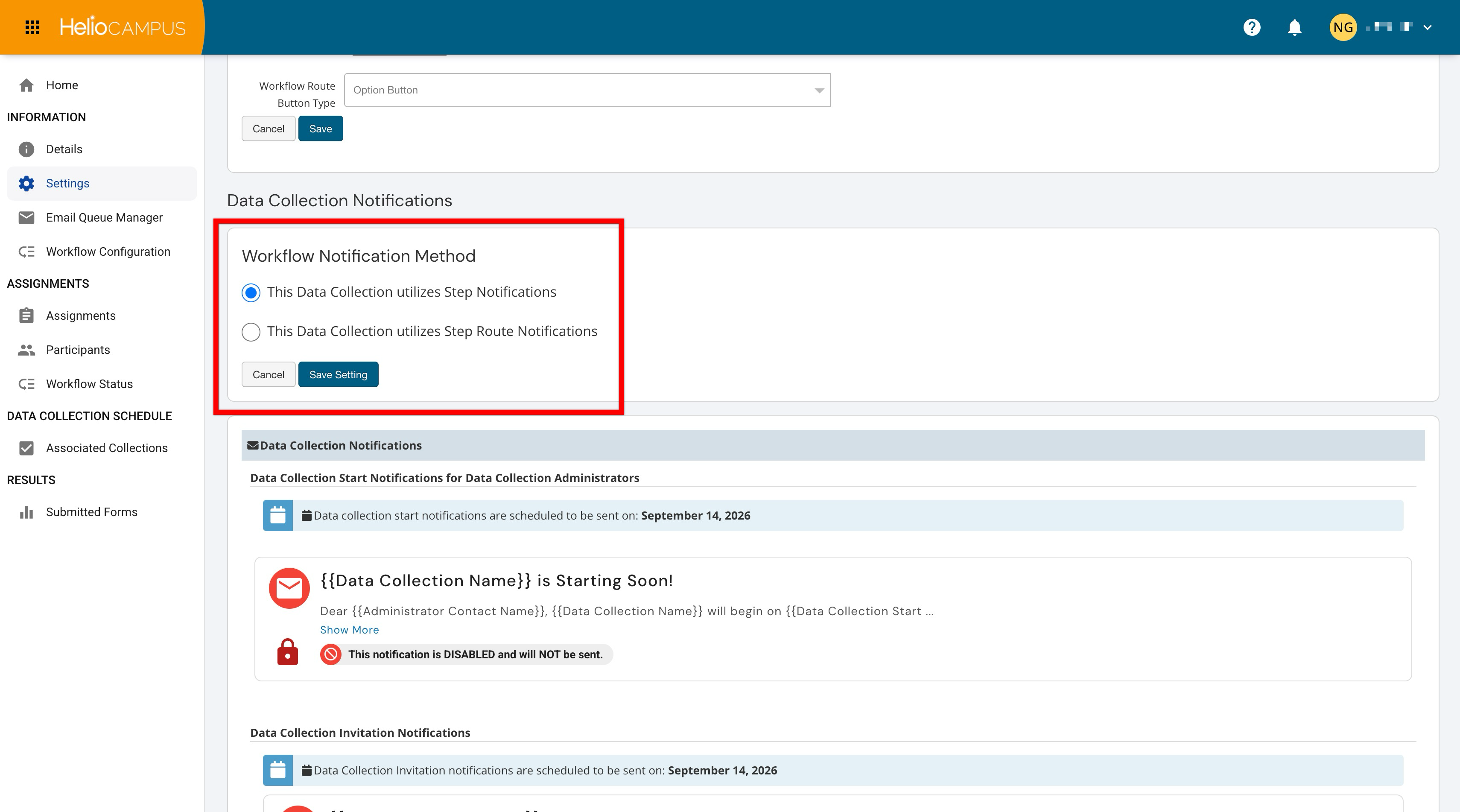
Workflow Task Notification Method
The Workflow Task Notification Method controls how the platform notifies users when a collection form reaches their step in the workflow.
-
Task Notifications: Task Notifications are appropriate when the Data Collection uses a straightforward workflow and the same general notification message is sufficient for the assigned work.
-
Task Action Notifications: Task Action Notification templates can be customized for individual workflow stages from Data Collection Manager > Data Collection Homepage > Workflow Configuration.
Product Tip
If an approve/reject step sends a form back to its original owner, the owner may receive another notification when the form returns to the first workflow step. Task Action Notifications can help provide step-specific context instead of repeating the same general message.
|
Selection |
Result |
|---|---|
|
Task Notifications |
Select This Data Collection Utilizes Task Notifications when standard task-based emails are appropriate. When selected, users receive an email when a form reaches their workflow step. With this option, form submission notification content is the same whether the form is approved or sent back. |
|
Task Action Notifications |
Select This Data Collection utilizes Task Action Notifications when messages need to reflect the specific workflow action or route that sent the form to a user. With this option, email content can differ based on whether a user sends the form back or forwards it. This option supports more detailed notifications and is recommended for workflows that include branches, feedback loops, approvals, rejections, or repeated routing. |
Data Collection Start Notifications for Data Collection Administrators
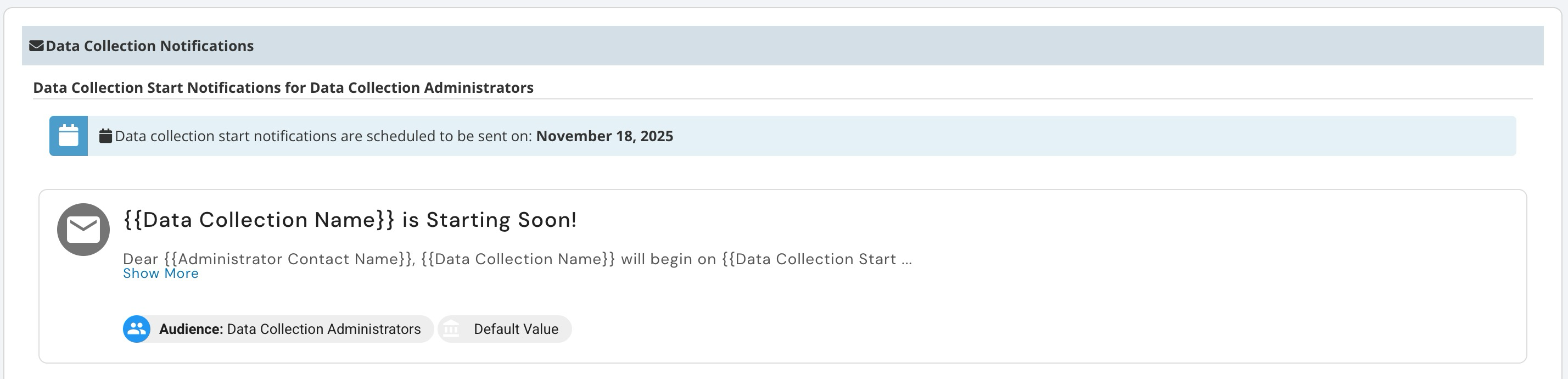
This notification is sent when the collection’s start date is reached to alerts the data collection owner or administrators about the collection’s start date. This notification is sent once when enabled, and is commonly disabled by default when the Institution does not need a separate start-date message. Dynamic text can include the contact’s name, Data Collection name, start date, and a link to review settings and course assignments.
The administrator email is inherited from the user account of the collection’s owner/creator; this is typically the HelioCampus Administrator who created the collection.
Data Collection Invitation Notifications
⚠️ This notification cannot be customized after the collection’s start date has been reached.
This notification alerts participants in the first workflow step that their collection form is available. The message can be customized until the Data Collection reaches its Start Date. This notification is sent once on the selected start date; a participant receives one invitation email even when they have multiple forms to complete. Dynamic text can include the participant’s name, Data Collection name, end date, a link to provide feedback, and the Institution’s support email.
For this notification to send:
-
The collection must be in Published status.
-
The Data Collection Invitation notification must be enabled.
-
The recipient is assigned the user role indicated by the Role Name field on the collection Details page.
This notification is triggered when:
-
The collection start date is reached.
-
A new eligible user/business object is added via the Assignments page.
Product Tip
This notification is only sent to users in the first step of a collection workflow. To notify users at later steps in a workflow, configure Workflow Stage Settings by navigating to Data Collection Manager > Data Collection Homepage > Workflow Configuration.

Data Collection Reminder Notifications
This reminder is for first-step participants who still have a form to complete. The platform sends reminder emails once per day to participants with outstanding work. The notification content and reminder frequency can be customized. The collection start date is day one of the configured reminder frequency. For example, if reminders are configured for every three days, the start date begins the countdown; a reminder is not sent on the start date itself. Dynamic text can include the participant’s name, Data Collection name, end date, a link to provide feedback, and the Institution’s support email.
This notification still remains editable after the collection’s start date has been reached.

Notification Configuration Options
Enabled emails on the Workflow Configuration page take precedence over emails on the Settings page. Emails are not duplicated when both locations contain configuration for the same workflow activity. The platform’s daily event process sends collection notification emails, which may arrive after the form appears in the user’s Action Items. If several forms are available for the same user and workflow step on the same day, the platform generally combines them so the user does not receive multiple duplicate emails. Use the following guidance when deciding where to configure data collection emails.
|
Requirement: The Institution does not want to send collection emails. |
|
Disable the applicable notifications on the Settings page and review Workflow Stage Settings to confirm that stage-level emails are also disabled. Used when:
|
|
Requirement: Emails are needed only for users in the first workflow step. |
|
Use the Settings page notification templates and select the appropriate Workflow Task Notification Method. Used when:
|
|
Requirement: Each workflow step needs its own email content. |
|
Configure the task notification through Data Collection Homepage > Settings. Configure the notification templates through Workflow Configuration > Workflow Stage Settings. Used when:
|
|
Requirement: Emails must reflect branching or feedback-loop routing. |
|
Use Task Action Notifications and configure stage-specific templates through Workflow Configuration. Used when:
|