
Developmental levels define an Institution’s standard way to describe how learning progresses across a program. When enabled, these levels can be used during curriculum mapping to indicate whether an outcome is being introduced, reinforced, or emphasized (e.g., the level names an Institution chooses). This adds helpful context beyond “mapped or not mapped” by showing where students are expected to begin building competency and where they are expected to demonstrate it at a higher level. Because these levels can be set at different points in the Organizational Hierarchy, they also support consistent language across Colleges and Departments. Institutions that want comparable maps and reports across units often standardize the number of levels and the naming convention, then lock the configuration at the appropriate level.
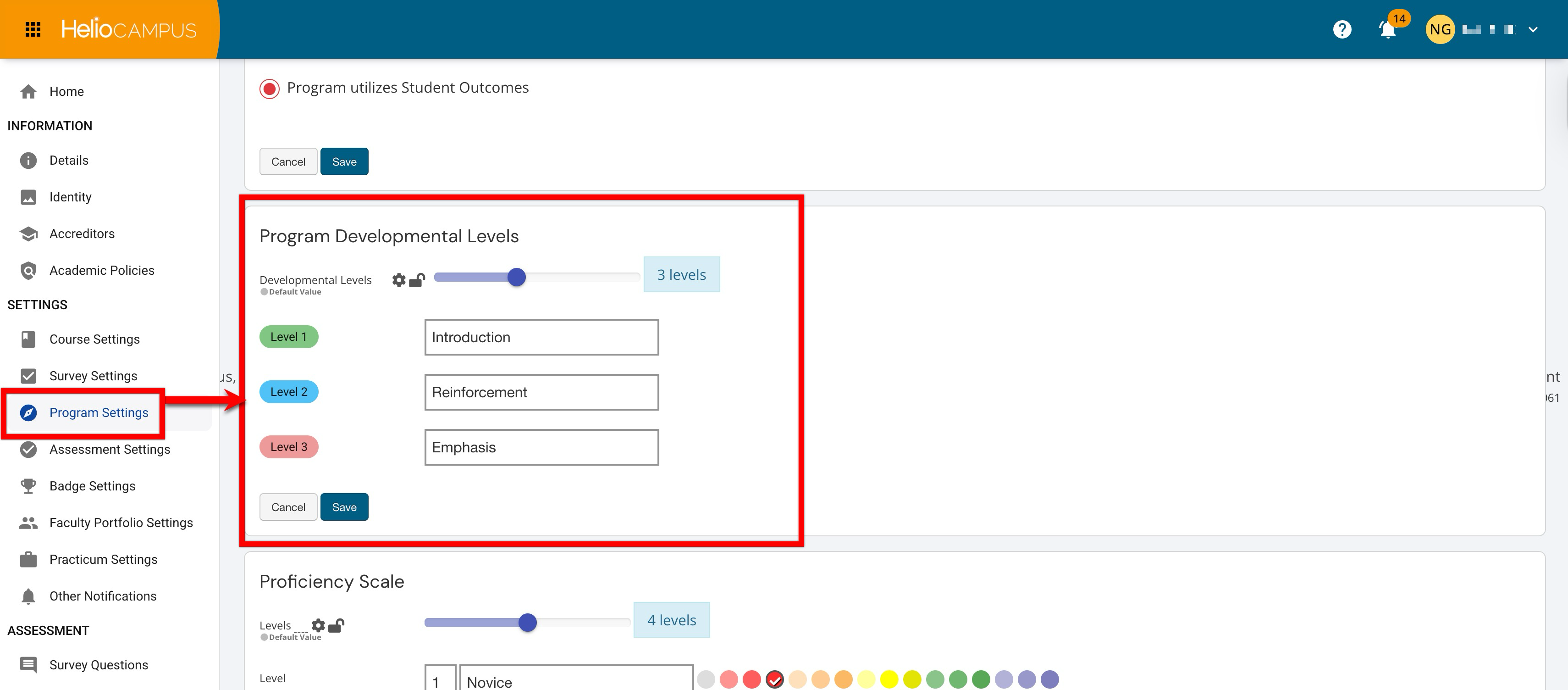
Settings can be locked at a higher level to prevent configuration at lower levels and apply defaults and governance at the appropriate hierarchy level. For example, if developmental levels are enabled and locked at the College level, all Departments under the College inherit the locked configuration and cannot change it. If the Institution later locks a different configuration for that field, the Institution lock overrides the College lock, and the College and all associated Departments inherit the new locked Institution configuration. Learn more.
Downstream Impacts
-
Curriculum Mapping Quality: Captures progression across the curriculum, not just coverage. Levels make it easier to spot gaps (only “Introduction,” no later reinforcement) and redundancies (too much “Emphasis” in a narrow area).
-
Change Management: Changing the number of levels or redefining their meanings after mapping is underway may require teams to revisit existing maps to keep data consistent.
Considerations
-
Define Meanings, Not Just Labels: Agree on what each level means (in plain language) so mapping is consistent across programs.
-
Keep the Level Count Stable and Align on Mapping Use: If maps will support reporting, accreditation narratives, or longitudinal review, choose and maintain a level model to adhere to over the long term. Standardization will matter more than local flexibility, and it will help you avoid rework later.
-
Standardize and Lock: If governance is centralized, lock the developmental-level configuration at the Institution so that downstream units inherit the same progression model and cannot redefine it.
Enable Developmental Levels for the Institution
This functionality is disabled by default. To learn more and enable this functionality, please contact Support.
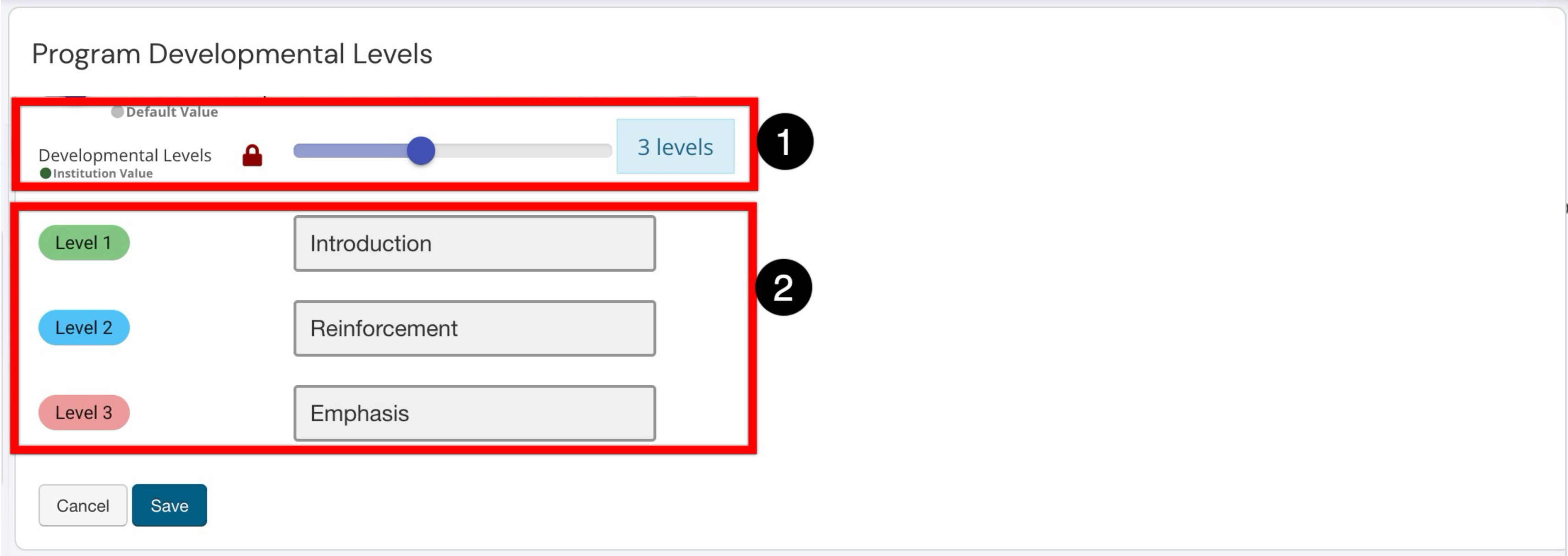
The Developmental Levels slider (1) determines how many levels are available, and Institution-wide names can then be defined for each level (2), such as Introduction, Reinforcement, and Emphasis. Once configured, these levels provide a consistent way for programs to communicate where students are first exposed to an outcome and where learning is expected to deepen.
|
Enabled |
Programs can use developmental levels during mapping and analysis. Admins can set the number of levels and the labels for each level, unless they are locked at a higher level in the hierarchy. |
|
Disabled |
Developmental levels are not used in mapping. Mapping remains focused on alignment without capturing the intended progression of learning across the program. |