
These settings control how programs collect and contextualize assessment evidence. They determine whether course-level outcome (CLO) assessment can still occur for courses that are mapped to a program, allowing Institutions to preserve CLO measurement while maintaining program-level alignment for mapping and reporting. They also determine whether programs can collect student assignment samples as part of assessment workflows, adding supporting artifacts that provide context for scores and proficiency results and strengthening review, validation, and accreditation preparation efforts. In a centralized governance model, these settings are often managed and locked at the Institution level to prevent programs or downstream units from using different structural levels. This reduces confusion in cross-program reporting and ensures Colleges and Departments inherit the same behavior.
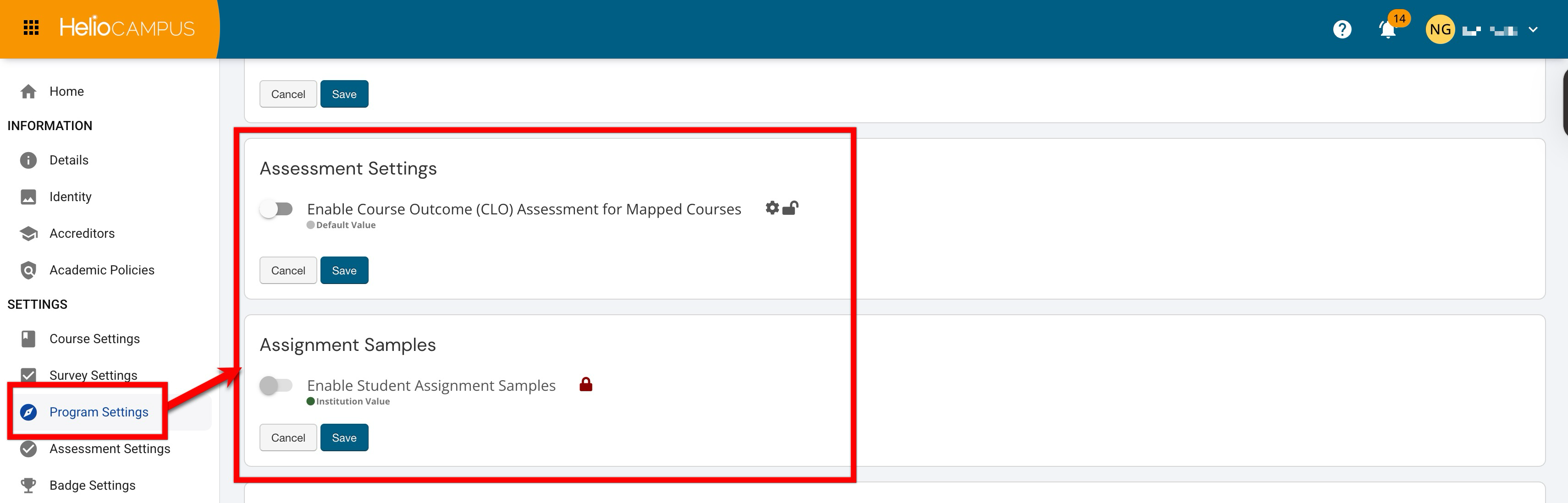
Settings can be locked at a higher level to prevent configuration at lower levels and apply defaults and governance at the appropriate hierarchy level. For example, if the CLO assessment for mapped courses is enabled and locked at the College level, all Departments within the College inherit that configuration and cannot change it. If the Institution later locks a different configuration, the Institution lock overrides the College lock, and the College and all associated Departments inherit the new locked Institution configuration. Learn more.
Downstream Impacts
-
Outcomes Assessment: These settings determine whether course-level outcome (CLO) assessment remains available for courses that are mapped to a program, which affects where outcome evidence is collected and how results are interpreted at the course versus program level.
-
Assessment Workflows and Configuration: These settings can influence whether Instructors and admins can continue CLO-based data collection in mapped-course scenarios and whether assignment samples can be included in the evidence collected for review.
-
Evidence Context: When assignment samples are enabled, stakeholders can pair proficiency results with representative student work artifacts, strengthening validation, internal review, and accreditation preparation.
-
Change Management: Changes to these settings can shift expectations mid-cycle, so communication and timing matter.
Considerations
-
Governance: Enabling either feature may require clearer process guidance (what gets assessed, what artifacts should be uploaded, who owns review).
-
Decide the Measurement Model for Mapped Courses: Confirm whether the Institution expects CLO assessment to remain available when a course is mapped to a program, or whether mapped courses should rely solely on program-aligned measurement.
-
Assignment Sample Utilization: Decide whether samples are required or optional.
-
Set Ownership and Process: Identify who is responsible for:
-
CLO assessment configuration and ongoing maintenance for mapped courses.
-
Uploading and curating assignment samples.
-
Reviewing samples and how they are used during analysis or accreditation preparation.
-
Best Practices
-
Assignment Sample Viability: Clarify what “good” samples look like (e.g., representative work, targeted competency evidence) so that uploads are consistent and useful.
-
Avoid Mixed Practices Across Units: Keep these settings consistent to ensure comparable results and reliable reporting. When differences occur, outcomes may reflect configuration differences rather than actual performance, complicating the interpretations of clear conclusions and actionable data.
-
Coordinate Timing and Communication: Update settings during defined governance windows to avoid disrupting active assessment cycles. Communicate expectations before changes go live, since enabling or disabling these options changes what users can collect and what reviewers should expect to see.
Assessment Settings
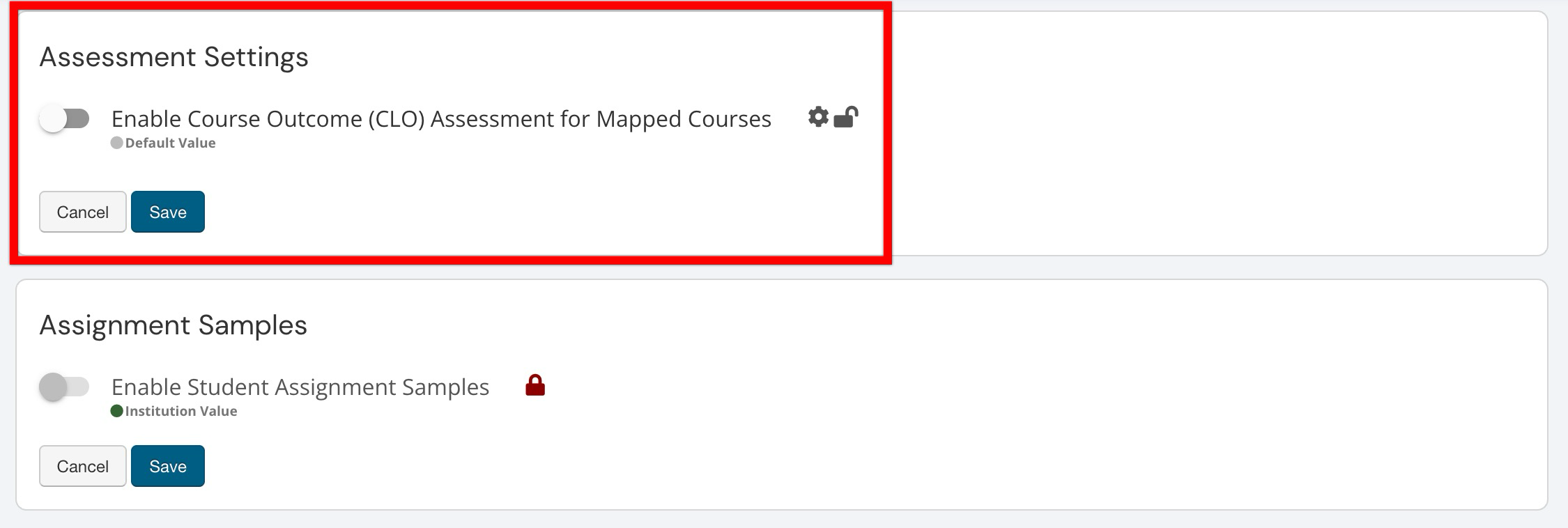
Assessment Settings determine whether Course Learning Outcome (CLO) assessments can still occur for courses mapped to a program. Enabling this option supports Institutions that want program alignment through mapping while continuing to measure CLOs at the course level for data collection and reporting. Once saved, this setting helps standardize how mapped courses contribute outcome evidence across the hierarchy.
|
Enabled |
Mapped courses can still support CLO assessment, enabling course-level outcome measurement alongside program-level mapping and assessment. |
|
Disabled |
Mapped courses will collect data only through Program Assessment, and CLOs will not be assessed separately via CLO Assessment (even if some CLOs are not mapped within a program). |
Assignment Samples
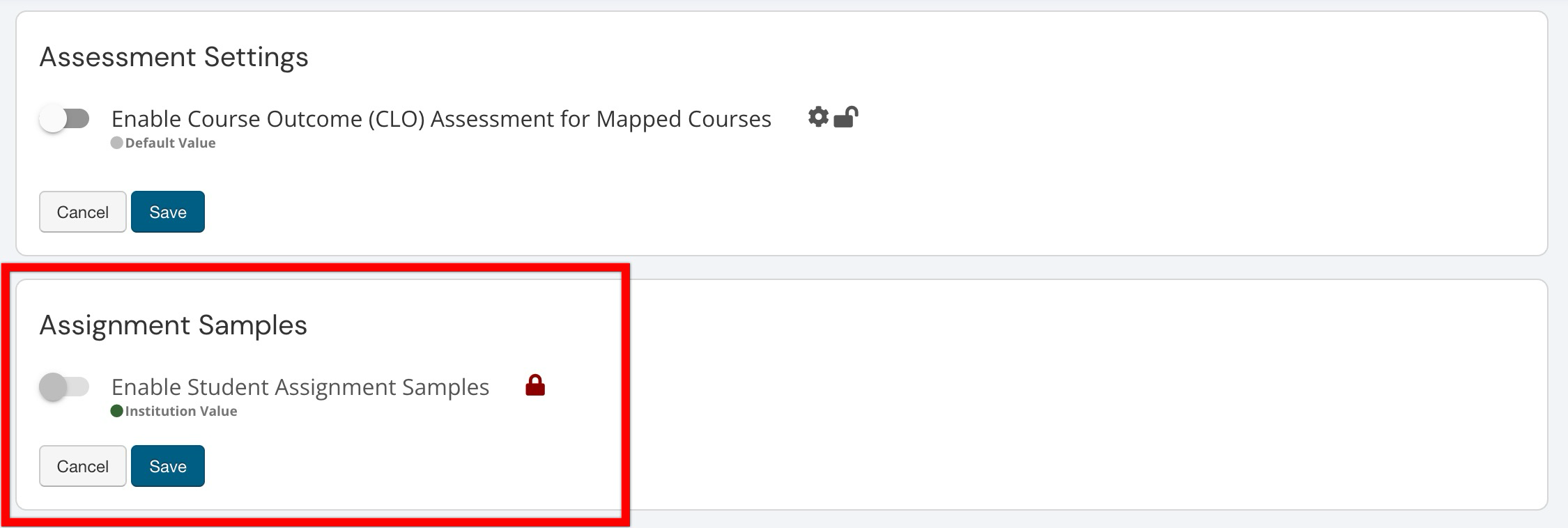
These settings determine whether programs can collect student assignment samples as supporting evidence during assessment workflows. Artifacts provide helpful context for interpreting results and can strengthen review and reporting by pairing performance data with representative student work. Standardizing this setting at the institution level supports more consistent evidence-based practices across programs and organizational units.
|
Enabled |
Users can collect and manage student assignment samples within the program assessment workflow, adding artifacts alongside results. |
|
Disabled |
Assignment samples are not collected through this workflow, and review is limited to performance results without attached student work examples. |