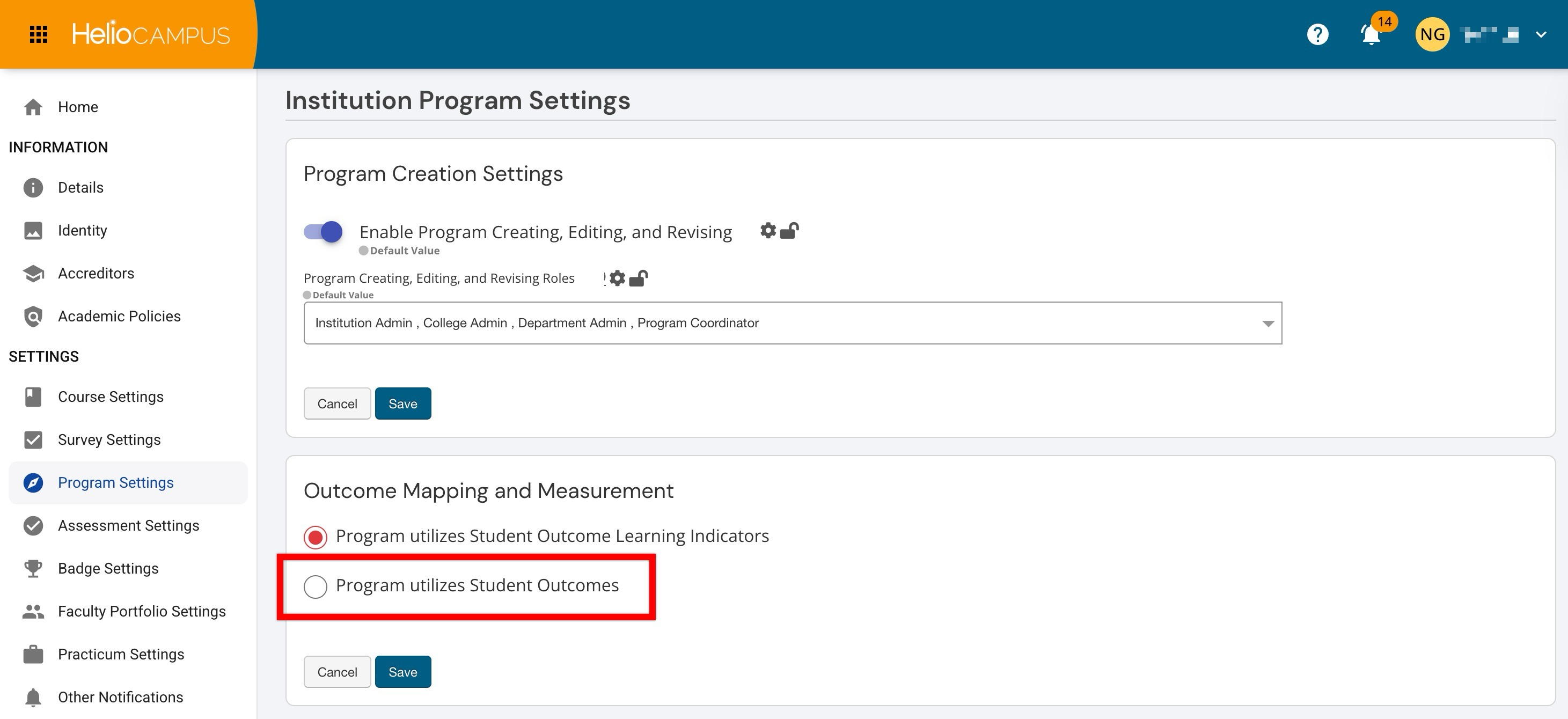
Outcome Mapping and Measurement defines the core structure the platform uses to organize and evaluate program learning expectations. This setting determines whether programs will be built around Student Outcomes or Student Outcome Learning Indicators, which affects how outcomes are created, related, and represented throughout program workflows. Because this choice becomes the foundation for how learning is described at the program level, it is best to align on an Institution-wide approach early and apply it consistently across Colleges and Departments.
Product Tip
The configuration of this setting should occur prior to curriculum mapping and before any assessments begin.
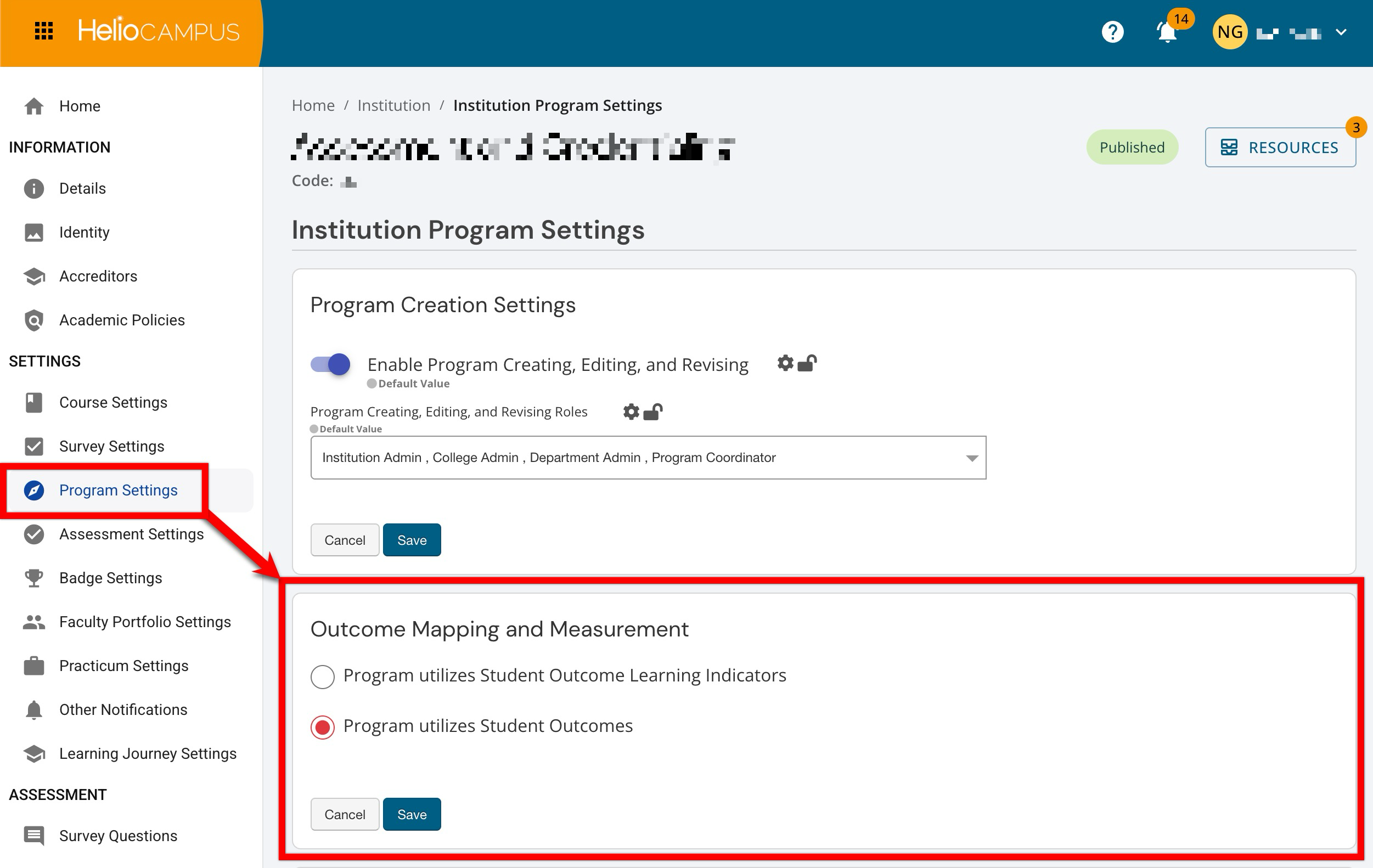
Settings can be locked at a higher level to prevent configuration at lower levels and apply defaults and governance at the appropriate hierarchy level. For example, if Program Utilizes Student Outcomes is selected and locked at the College level, all Departments under the College inherit the locked configuration and cannot change it. If the Institution later locks a different configuration for that field, the Institution lock overrides the College lock, and the College and all associated Departments inherit the new locked Institution configuration. Learn more.
Downstream Impacts
-
Outcome Creation and Maintenance: Determines whether program learning expectations are authored and managed as outcomes only, or as outcomes plus indicator-level structure.
-
Curriculum Mapping: Influences how detailed the mapping can be and what users see as the “units” of mapping when aligning the curriculum with program expectations.
-
Assessment Configuration and Interpretation: Affects how assessment results are associated with program learning expectations and how stakeholders interpret performance across programs.
-
Reporting Consistency: Standardizing this choice supports cleaner comparisons and trend analysis across programs, units, and time periods. Mixed configurations across the hierarchy can make reporting harder to interpret and reduce confidence in institution-wide analytics.
Considerations
-
Change Management: Institutions must choose one method: student outcomes or student outcome learning indicators. Because this setting establishes the underlying measurement model, changing it later typically requires follow-up work to realign the mapping and ensure that reporting remains meaningful.
Changing the Outcome Mapping and Measurement configuration at any time will reset all curriculum mapping for a program; once reset, it can not be recovered, although historical assessment data (if present) will be retained.
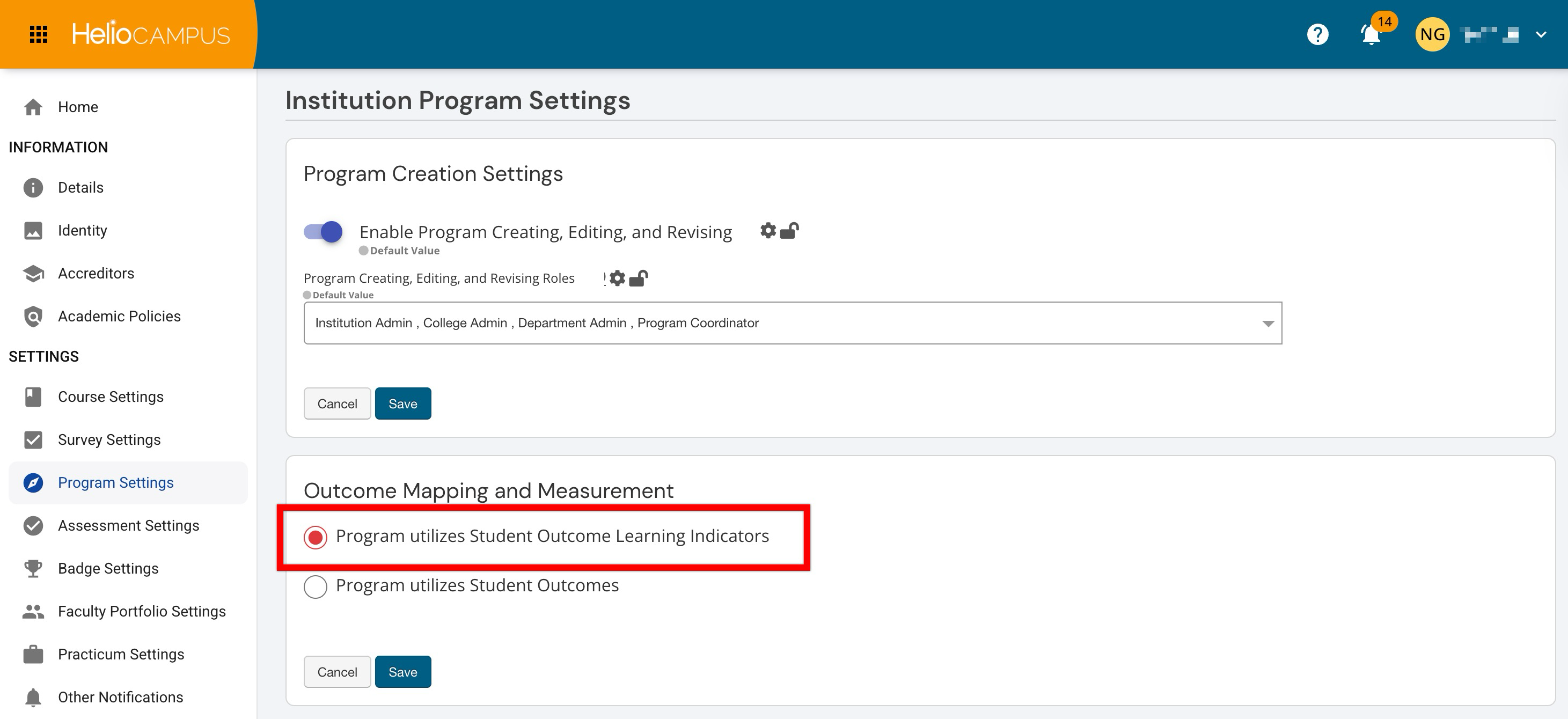
Program Utilizes Student Outcome Learning Indicators
If Program utilizes Student Outcome Learning Indicators is selected, programs are structured to support a more granular, indicator-based model for mapping and measurement. Programs will use performance indicators for student achievement, e.g., PLO 1, PLO 2, PLO 2.1, PLO 2.2, and PLO 3. Performance indicators provide the means to evaluate and measure the attainment of program outcomes, helping to ensure that educational goals are effectively met. This model typically increases governance and maintenance needs because indicators must be defined consistently across programs to enable reliable cross-program reporting. Clear naming conventions and ownership become more important to avoid indicator sprawl or overlapping definitions. Overall, using learning indicators supports deeper analysis and more actionable improvement planning, especially for programs that want a detailed competency model or need finer-grained evidence for accreditation and program review.
When selected:
-
Programs are structured with an added layer of detail beneath program-level outcomes. Instead of mapping and measuring only against broad outcomes, the program can be organized into learning indicators that represent more specific, measurable components of student learning.
-
For curriculum mapping, indicators become the primary “targets” to which courses are aligned. This supports more precise mapping conversations, such as:
-
Which courses address which part of a broader program outcome?
-
Are key competencies reinforced across multiple points in the curriculum, or concentrated in one area?
-
-
For measurement, assessment results can be linked at the indicator level, improving clarity when reviewing performance. This makes it easier to pinpoint what specifically students are struggling with or excelling at, rather than only seeing a single outcome-level rollup.
Program Utilizes Student Outcomes
If Program utilizes Student Outcomes is selected, programs are structured around program-level outcomes as the primary units for mapping and measurement. Programs will utilize Program Learning Outcomes (PLOs) that students will achieve, e.g., PLO 1, PLO 2, PLO 3, etc. This structure is typically best when an Institution wants a simpler, easier-to-maintain outcomes model that still supports meaningful program-level reporting and continuous improvement.
When selected:
-
Programs are organized around a single, program-level set of outcomes (PLOs) that represent the primary “targets” for learning.
-
In curriculum mapping, those program-level outcomes become the primary targets to which courses and learning experiences are aligned. This supports a straightforward mapping model in which the question is: “Where in the curriculum is each program outcome introduced, reinforced, and emphasized?”
-
In measurement, assessment results are interpreted at the outcome level, which makes it easier to roll up performance and report progress against each program outcome without needing to manage a separate indicator layer.