Assignment Proficiency Scale Thresholds define how raw assignment scores are translated into the Institution’s Proficiency Scale levels. This setting sets the “cut scores” that separate one proficiency level from the next (for example, the score at which a student moves from Apprentice to Proficient). By standardizing thresholds at the Institution level, stakeholders can interpret assignment-based results consistently across programs, courses, and terms, even when grading practices vary. This setting is especially important when assignment results are used for program-level assessment and reporting, because the thresholds determine how frequently students are categorized into each proficiency level.
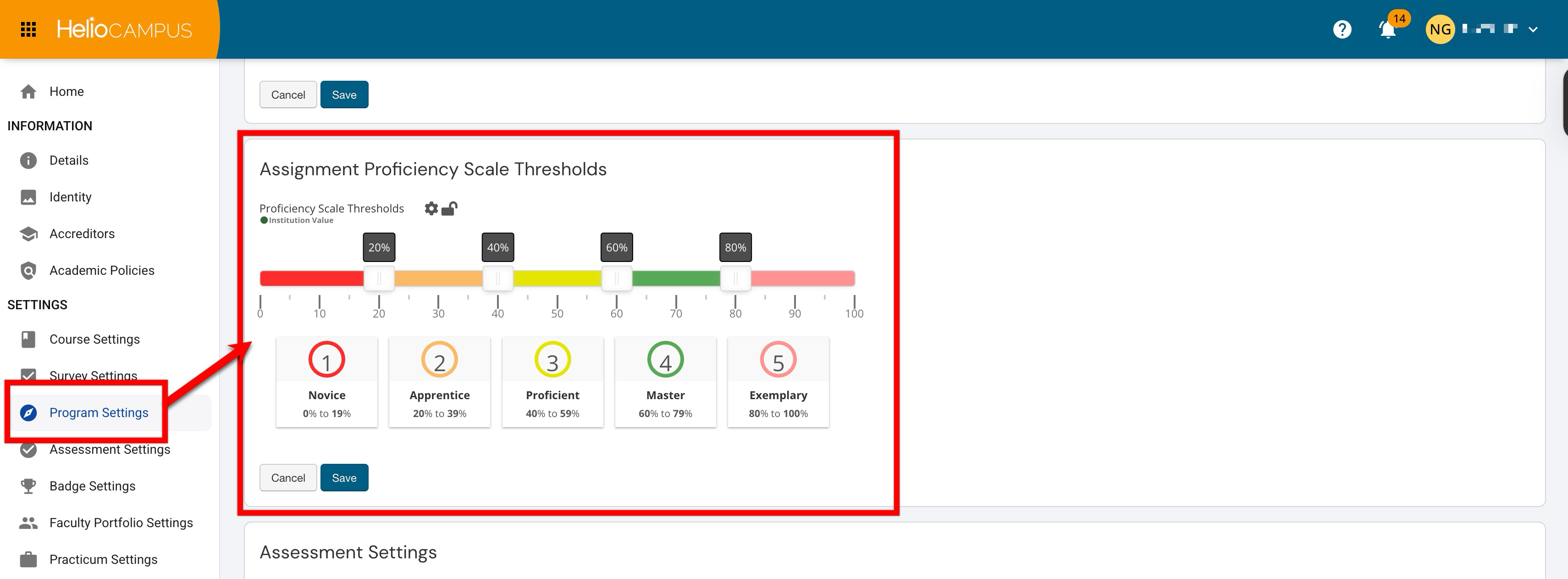
Settings can be locked at a higher level to prevent configuration at lower levels and apply defaults and governance at the appropriate hierarchy level. For example, if the thresholds are locked at the College level, all Departments within the College inherit that configuration and cannot change it. If the Institution later locks a different configuration, the Institution lock overrides the College lock, and the College and all associated Departments inherit the new locked Institution configuration. Learn more.
Downstream Impacts
-
Score-to-Level Consistency: Thresholds determine how assignment scores map into proficiency categories, which impacts how results are interpreted across the platform.
-
Reporting and Trend Analysis: Consistent thresholds support cleaner comparisons across programs and terms. Changes to thresholds can shift how results appear over time, even if underlying scores do not change.
-
Alignment to Goals: Performance goals based on proficiency levels depend on these thresholds. If thresholds change, the Institution’s “success” benchmark may effectively change in practice.
-
Change Management: In a centralized governance model, these settings are often managed and locked at the Institution level to prevent programs or downstream units from using different structural levels. This reduces confusion in cross-program reporting and prevents the unintentional redefinition of what it means to be “Proficient” or “Master” based on local grading norms.
Best Practices
-
Align Thresholds to Institutional Grading Expectations: Confirm the cut scores reflect how the Institution wants to interpret performance (especially around “meets expectations” vs. “exceeds expectations”).
-
Keep Thresholds Stable: Frequent changes make longitudinal comparisons harder and can reduce confidence in trend reporting.
-
Coordinate with the Proficiency Scale and Performance Goals: Review thresholds alongside level names and performance goals so the full proficiency model is coherent.
Assignment Proficiency Scale Thresholds
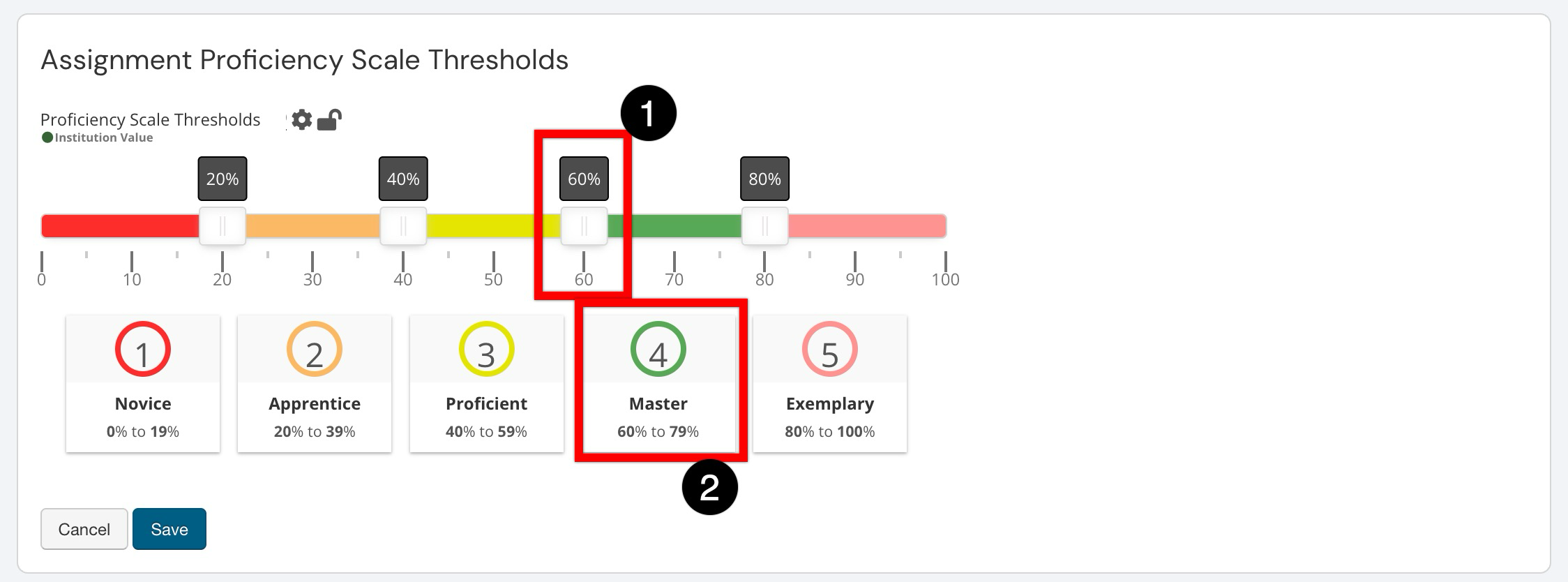
Use the slider breakpoints (1) to set the minimum score required for each level, then review the level cards (2) to confirm the score ranges align with the Institution’s expectations for Novice through Exemplary. Once saved, these thresholds provide a consistent score-to-proficiency mapping for assignment-based measurement and reporting. With the thresholds shown below, an assignment score of 45% would be categorized as Proficient, while a score of 60% (1) would be categorized as Master (2).